
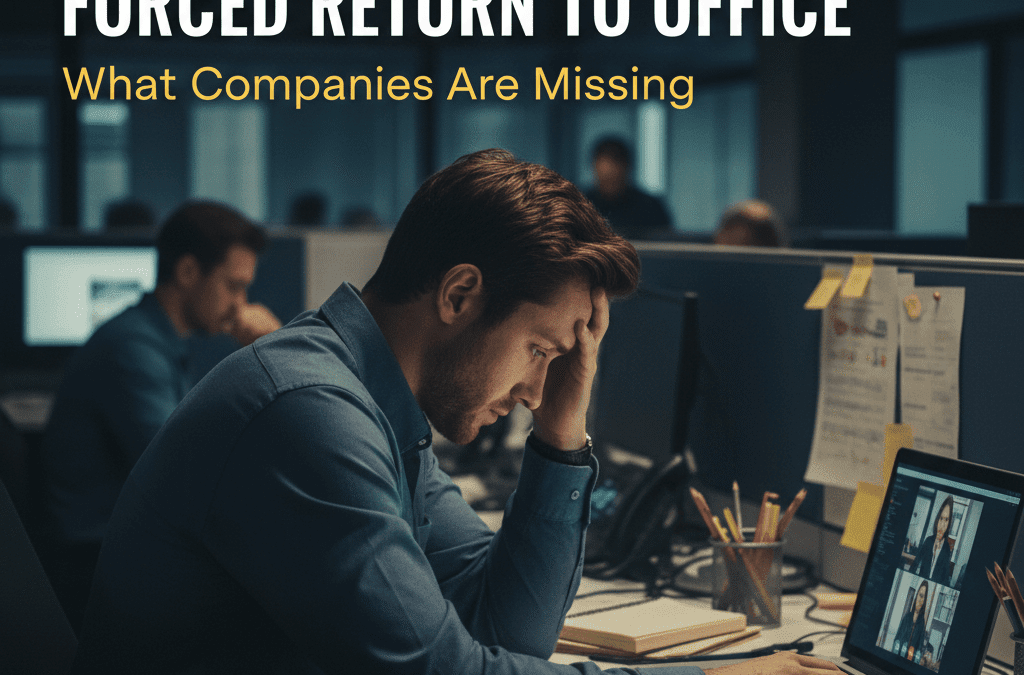
Last month, I watched a colleague break down during a video call. Sarah had been a model of efficiency in our pre-pandemic office, but now—splitting her week between home and headquarters—she struggled to maintain her composure. “I feel like I’m failing everywhere,” she confessed. “At home, I’m distracted by work. At work, I’m rushing to leave for home commitments. I’m constantly packing and unpacking my life.”
Sarah isn’t alone. While hybrid work promised the best of both worlds—flexibility with connection—emerging evidence suggests it may instead be delivering the worst: the commuting stress of office work combined with the isolation of remote work, creating a uniquely taxing middle ground that satisfies neither employers nor employees completely.
As organizations cement their post-pandemic work policies, we’re witnessing an uncomfortable truth: hybrid work models, despite their popularity, may be creating unprecedented strain on employee well-being that few companies are adequately addressing.
The Psychological Tax of Constant Transitions
Hybrid work demands a type of cognitive and emotional agility that humans aren’t naturally equipped to sustain long-term. The constant switching between work environments creates what psychologists now call “transition fatigue.”
The Hidden Cost of Context Switching
A 2023 study from the University of California found that employees in hybrid arrangements spend an average of 72 minutes per transition day mentally adjusting between work environments—time that registers as neither productive nor restful. This represents nearly 15% of a workday lost to transitional stress.
Actionable insight: Create consistent “environment anchors” in both locations—similar desk setups, computer configurations, and even coffee mugs—to reduce cognitive load during transitions.
Jason, a marketing director at a tech firm, developed what he calls “transition rituals” to manage this strain: “I use my commute strategically—the first ten minutes for planning my day, the middle portion for a podcast that stimulates creativity, and the final stretch for mindfulness. It transforms dead time into a purposeful boundary between worlds.”
The Psychological Burden of Dual Identities
When working from home, many professionals report feeling pressure to appear “extra available” to combat perceptions of reduced productivity. Conversely, office days often involve heightened performance pressure—making them socially and emotionally draining.
Practice to implement: Establish team norms that explicitly value output over presence, regardless of work location. Document these principles and revisit them quarterly.
Managerial approach: Leaders should model healthy boundary-setting by communicating their own hybrid routines and respecting others’ designated focus time, regardless of location.
The Inequality Factor: Not All Hybrid Experiences Are Created Equal
The hybrid work experience varies dramatically based on factors often overlooked in corporate policies.
The Home Environment Disparity
Research from Stanford University reveals that employees with dedicated home offices report 32% higher satisfaction with hybrid arrangements than those working from shared or improvised spaces. This satisfaction gap has widened as temporary pandemic setups have become semi-permanent fixtures.
A Boston Consulting Group survey found that 64% of employees have never received a stipend adequate to create an ergonomic home workspace, despite spending 50-60% of their work time there.
Corporate solution: Implement tiered home office stipends based on space constraints, not just job level. Employees in challenging home environments may need greater support.
Individual strategy: If space-constrained, invest in modular furniture that can transform spaces between work and personal use, reducing the feeling of work permanently invading home life.
The Commuter’s Dilemma
For employees with longer commutes, hybrid work creates a particularly painful paradox: the commute becomes more psychologically burdensome when done less frequently, yet remains too regular to eliminate housing decisions based on office proximity.
A transportation study from the University of Chicago found that commuters who shifted from daily to 2-3 day office attendance reported a 24% increase in commute-related stress, despite traveling fewer total miles. The researchers attributed this to the loss of commuting routines and adaptive mechanisms.
Organizational consideration: Allow team-level flexibility in determining which days require office presence, enabling commute carpooling and more efficient transportation planning.
Communication Overload: The Digital Burnout Factor
Perhaps the most insidious aspect of hybrid work is how it has exponentially increased communication channels while decreasing communication clarity.
The Meeting Multiplication Effect
Microsoft’s Workplace Trends research documented a 252% increase in weekly meeting time for the average worker since 2020, with hybrid workers experiencing the highest burden. Notably, hybrid teams tend to schedule more meetings to compensate for partial co-location, creating what one researcher called “the worst of both worlds.”
Elena, an HR director at a manufacturing company, implemented what she calls “location-intentional scheduling”: “We designate in-office days specifically for collaborative work and meetings, while remote days are protected for deep focus. It sounds simple, but it required a complete cultural reset about when and why we meet.”
Team protocol: Establish “meeting-free zones” that align with location—for example, no virtual meetings on in-office days to maximize face-to-face interaction value.
Individual boundary: Block calendar time specifically for transition days, acknowledging the productivity impact of environment switching.
Digital Presenteeism and Response Expectations
The pressure to appear constantly available has intensified in hybrid environments. A 2022 Gallup workplace study found that hybrid employees check work communications during off-hours 37% more frequently than fully remote or fully in-office counterparts.
Leadership responsibility: Executives must explicitly define response-time expectations that differ by communication channel and urgency, not by work location.
Technology solution: Implement communication tools that allow scheduling of messages to respect recipients’ working hours, regardless of when the sender is working.
The Belonging Paradox: Connected Yet Disconnected
The most profound impact of hybrid work may be on our fundamental sense of workplace belonging—a critical factor in both performance and retention.
The Hybrid Social Hierarchy
Research from the Center for Workplace Mental Health found that 76% of hybrid workers report feeling disadvantaged in informal influence networks compared to colleagues with more office presence. This “proximity bias” creates subtle hierarchies that undermine the promised flexibility of hybrid arrangements.
Particularly concerning is how this affects career development. A longitudinal study of promotion rates at four global companies found that employees who spent 60%+ time in office were 1.4 times more likely to be promoted than their hybrid counterparts with similar performance ratings.
Structural intervention: Create “influence equity” by ensuring key meetings and decisions include multiple participation modes, with dedicated facilitators ensuring equal voice.
Career development tactic: Maintain a “visibility journal” documenting contributions and ensuring they’re communicated regardless of work location.
The Relationship Maintenance Burden
Perhaps most taxing is the emotional labor required to maintain workplace relationships in hybrid settings. What once happened organically now requires intentional effort.
Marcus, a team lead at a financial services firm, describes this strain: “Before, I built rapport through small daily interactions. Now, I’m scheduling one-on-ones, planning team-building activities, and constantly checking in—all while trying to do my actual job. It’s exhausting in a way that’s hard to quantify.”
Relational practice: Schedule “no-agenda” virtual coffee breaks with colleagues to preserve spontaneous connection without adding formal meeting burden.
Moving Beyond the Hybrid Compromise
The current implementation of hybrid work often represents an uneasy compromise rather than a thoughtful redesign of work itself. To address the unseen strain, organizations need to move beyond simply splitting time between locations.
First, we must acknowledge that hybrid work requires new skills and support systems. Companies investing in transition coaching report 28% higher employee satisfaction and 23% lower burnout rates among hybrid workers.
Second, policies must evolve from rigid “days in office” mandates to purpose-based frameworks that match location to work function. The most successful hybrid organizations have shifted from asking “how many days?” to “which activities benefit from which environment?”
Finally, we need to recognize that hybrid work may not be the final destination but rather a transitional phase as we reimagine work entirely. Organizations that view their current hybrid models as experiments rather than permanent solutions demonstrate greater adaptability and employee trust.
As Sarah told me months after her breakdown: “What helped wasn’t working from home more or going to the office more. It was my company finally acknowledging that hybrid work is fundamentally different—not just old work in two locations. Once they started redesigning expectations instead of just relocating them, everything changed.”
The unseen strain of hybrid work won’t be resolved by simply adjusting the number of office days or improving video call technology. It requires reimagining work structures built for a single-location era. Only by addressing the psychological tax of transitions, the inequality of experience, the communication overload, and the belonging paradox can we transform hybrid work from an uncomfortable compromise to a sustainable model that truly supports employee well-being.
Where This Insight Came From
This analysis was inspired by real discussions from working professionals who shared their experiences and strategies.
- Share Your Experience: Have similar insights? Tell us your story
At ModernWorkHacks, we turn real conversations into actionable insights.




0 Comments