Hook: Discover actionable insights grounded in real conversations and practical wins.
By 9:00 a.m., Sam had already promised the day would be different. The sticky note on the laptop read “Finish deck. Reschedule dentist. Clean inbox. Start the course.” A tidy mug of coffee steamed, the calendar was color-coded, and for once there were no urgent pings. At 9:05, a quick email check “just to clear the small stuff.” At 9:20, a tab rabbit hole. By 10:30, the coffee was cold, the sticky note looked hostile, and the day felt “off.” The big things didn’t happen. Again.
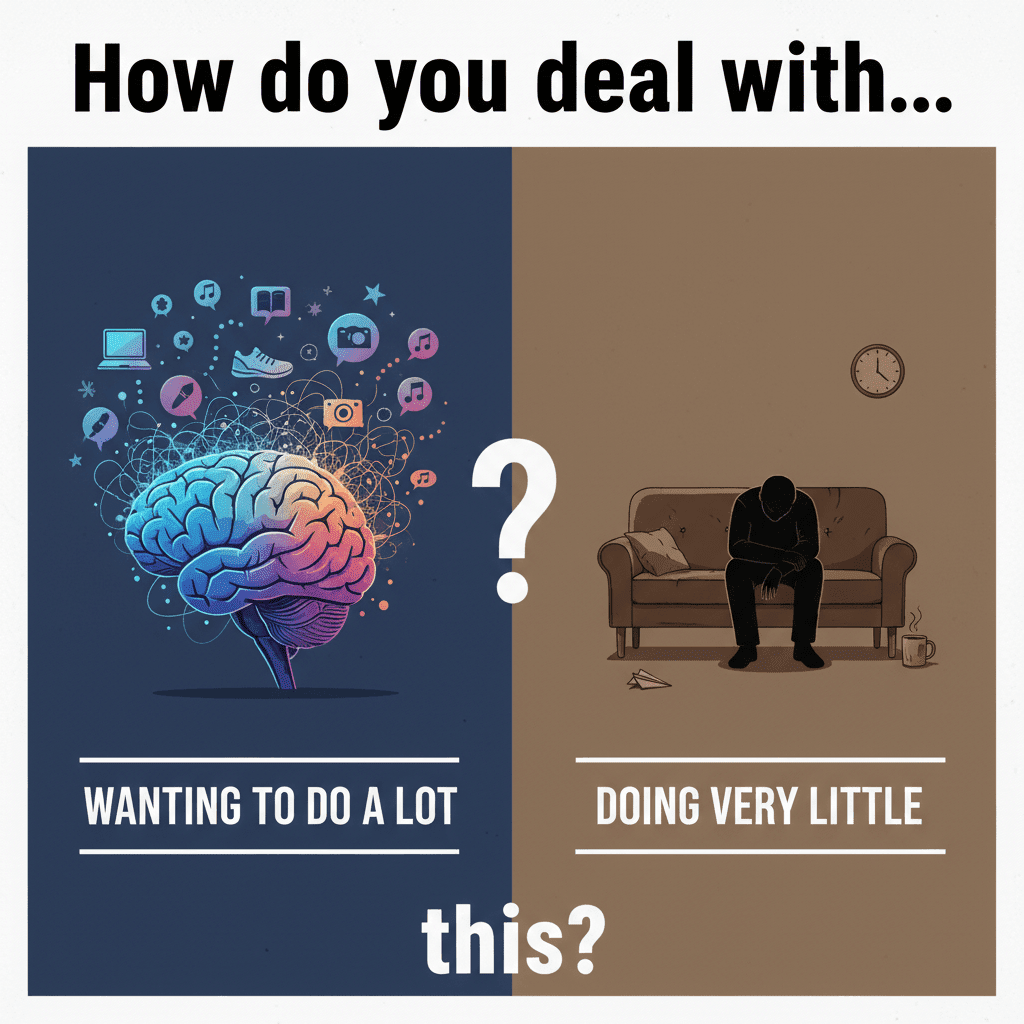
If that story sounds familiar, you’re in good company. In hundreds of conversations—from founders to grad students, from new parents to seasoned managers—the same pattern shows up: we want to do a lot, genuinely, yet we do very little of what matters. It’s not laziness. It’s the hidden mechanics of attention, energy, and friction. The good news is that there are practical ways to bridge the gap without turning your life into a boot camp.
This article distills key takeaways from real discussions and field-tested tactics. You’ll learn why the “do a lot” instinct collides with reality, where the gap lives, and how to design systems that gently—and reliably—turn intention into action.
Why wanting to do a lot is normal (and why it quietly backfires)
The human wish-list brain
When people describe their ideal weeks in coaching sessions or community threads, they rarely picture an empty calendar. We crave growth, contribution, and variety; our brains light up at possibility. This is healthy. The problem isn’t ambition—it’s the mismatch between a future-facing wishlist and today’s finite time, energy, and attention.
In real-world discussions, three forces often surface:
- Dopamine from planning, not doing. The brain rewards you for imagining outcomes (“finishing the deck,” “launching the app”). Planning feels productive; it is—but it can also substitute for the harder, slower feedback of doing. Result: a comforting illusion of progress.
- Invisible “activation energy.” The first five minutes of a meaningful task can be awkward and cognitively expensive. We underestimate that cost and over-schedule aspirational blocks that crumble at the starting line.
- Identity pressure. People say, “I’m the kind of person who does a lot.” The identity is inspiring—but it can turn into perfectionism. If you can’t do it perfectly, you delay, which keeps you from doing anything.
The paradox of productivity media
Common in forum debates: the more tips you collect, the worse you feel. You stack methods, not momentum. Every new trick promises to solve the old problem; the stack adds decision fatigue and a subtle message that you, alone, are the bottleneck. In reality, what you need is less novelty and more trust in a small, boring toolkit that shrinks friction and amplifies follow-through.
Actionable takeaways
- Rename the goal: from “do a lot” to “do the right little.” Ambition stays big; execution shrinks to the next concrete, low-friction step.
- Expect activation energy. Plan a five-minute “warm start” for any important task: open the doc, name the file, paste a rough outline, write one ugly paragraph.
- Pick one trusted system to practice for 30 days; stop collecting methods while you build consistency.
The execution gap: where good intentions go to stall
Friction audits beat willpower
Again and again, people discover they’re not short on will—they’re drowning in friction. Friction is anything that makes starting or continuing harder than it needs to be: unclear next steps, tools scattered across devices, tasks that are actually multi-step projects, or a workspace that blurs work and entertainment. In group discussions, the most common source of friction is ambiguity. “Do taxes” is a project disguised as a task; so is “finish deck.”
The second culprit is context switching. Every swap—between apps, roles, or mental frames—costs cognitive energy. Even small toggles add up. The third is emotional friction: aversion, fear of judgment, perfectionism. That friction is real; wrestling it head-on is optional. Designing around it works better.
Hidden constraints you can’t ignore
Real life isn’t a lab. People mention sleep debt, caregiving, health fluctuations, and a meeting culture that slices the day into confetti. Many also note energy variability: they can do creative work early, logistics mid-day, and only shallow tasks late. Pretending these constraints don’t exist fuels magical calendars and inevitable disappointment.
From aspiration to flow: the clarity formula
Threads that end in sustained wins share a pattern: clarity before commitment. Clarity has three layers:
- Why now? Connect the task to a near-term benefit or consequence you actually feel. “Drafting the deck now means I leave work by 6 and keep date night.”
- What exactly? Convert the blob into atomized steps: “Open deck template; list 5 client pains; paste 3 case metrics; draft slides 1-3.”
- Where and when? Place the work in a specific context: “Quiet room, laptop only, 9:30–10:15.”
Actionable takeaways
- Run a one-time friction audit: pick one stubborn task and list every point of resistance (unclear steps, missing info, open tabs, noisy room). Remove or reduce each friction by 20%.
- Re-label project-blobs: add a verb and a concrete scope. “Deck” becomes “Draft slides 1-3 with placeholder bullets.”
- Batch similar modes: group admin calls together, creative drafting together, errands together, to minimize context switches.
Systems, not willpower: design that does half the work
Calendars that reflect reality
People who consistently ship don’t rely on giant to-do lists alone. They timebox a few meaningful blocks, reserve buffer, and choose ceilings and floors. A ceiling is the ideal (60 minutes drafting); a floor is the minimum (10 minutes writing a bad first paragraph). Floors protect momentum on rough days; ceilings protect energy on good days.
In discussions across teams, a “default week” emerges as a powerful tool: set recurring blocks for core modes (Focus, Admin, Meetings, Recovery) and treat deviations as exceptions. This reduces daily decision-making and makes trade-offs visible. When a meeting lands in a Focus block, you feel the cost, not just the calendar fill.
Implementation intentions and start-lines
A recurring theme in success stories: if-then plans. “If it’s 9:30 and I’ve poured coffee, then I open the draft and write 3 sentences with the door closed.” The plan removes negotiation. Another trick people love: preloading the start line. Open the doc and leave a note to your future self at the end of a session: “Next: brainstorm 3 headlines; don’t edit.” It’s astonishing how much friction this erases.
Environment engineering
People underestimate how much environment beats discipline. In open discussions, the following tweaks come up repeatedly:
- Attention borders. Use one browser profile for deep work with only essential tabs; use another for everything else.
- Single-task surfaces. Full-screen the document, keep only one tool visible, move your phone out of reach.
- Physical cues. A particular lamp, playlist, or seat signals “writing mode.” It sounds silly; it works.
Identity and micro-trust
People often say, “I don’t trust myself to follow through.” Rebuilding trust doesn’t come from heroic sprints; it comes from meeting your own small promises daily. Identity-based habits help here: instead of “I must finish 10 tasks,” try “I’m the kind of person who opens the doc at 9:30 and moves the ball one yard.” Do that 10 days in a row, and confidence—plus output—compound.
Actionable takeaways
- Create a default week with 3–5 recurring Focus blocks. Protect them like meetings with your future self.
- Set ceilings and floors for key tasks. On tough days, hit the floor and stop; on great days, enjoy the ceiling and stop before exhaustion.
- Write a 1-sentence if-then for your top task tomorrow. Put it on a sticky note in your workspace.
- Engineer one attention border: separate browser profiles or a separate user account for deep work.
Tactics that actually work when you’re tired, busy, or overwhelmed
The two-minute gateway and the five-minute hill
When you feel stuck, scale down. A favorite from countless threads: the two-minute gateway. Do any action that takes under two minutes and moves your task forward: open the doc, write the title, list three bullets. If that’s all you do, it still counts. Another: the five-minute hill. Commit to working for five minutes; at the end, you can stop guilt-free. Paradoxically, most people keep going.
Task slicing by friction, not by time
Traditional advice slices tasks by time (“work 25 minutes”). In practice, people find it easier to slice by friction. Identify the sticky part—often starting, unclear inputs, or switching tools. Solve that first. For example, if you always stall on “find the data,” isolate and complete that before drafting. You’ll glide later.
Minimum viable progress (MVPg)
A repeated win across industries: define what “progress” means so small it’s undeniable. If a project feels heavy, set a minimum viable progress unit: one figure labeled, one paragraph messy but on the page, one outreach email sent. String 10 MVPg moments, and the project’s psychological weight melts.
Energy-aware scheduling
People who make peace with their energy curves produce more with less strain. Common patterns from real-life calendars:
- High-creative mornings. Reserve these for idea generation, writing, design, complex problem-solving.
- Midday logistics. Email, errands, approvals, low-stakes calls.
- Late-day review. Light planning, tidy-ups, and readings.
Instead of forcing your brain to do its worst job at its worst time, let it play its position.
Anti-perfection warm starts
Perfectionism shows up as over-prep, endless outlining, or “I need one more resource.” A recurring counter-move people love: deliberately make a “bad first” version. Name the file “Ugly Draft” or add a time-boxed rule: “I will produce a hilariously rough outline in 12 minutes.” Humor and speed disable the inner critic just long enough to cross the start line.
Bounded sprints with gentle stops
Many swear by short sprints with kind endings. Try 25–40 minutes of focused work, followed by a 5-minute stretch, water, and one deep breath outside the task. The win isn’t the sprint length—it’s the predictable, renewing rhythm that prevents the “all-or-nothing” spiral.
Decision rules that kill dithering
Discussion threads often highlight micro-rules that remove indecision:
- Rule of three priorities. Pick three outcomes for the day; if a task doesn’t serve one, it waits.
- One-touch for quick items. If it takes under two minutes and is truly necessary, do it now; otherwise schedule it.
- Single-in, single-out. For every new commitment you accept, defer or decline something of equal weight.
Actionable takeaways
- Choose a two-minute gateway for your top task today and do it immediately.
- Define the minimum viable progress unit for your biggest project this week.
- Map your energy curve for five days; then protect one prime-hour block for deep work next week.
- Adopt one decision rule (rule of three, one-touch, or single-in/single-out) for the next 14 days.
From solo effort to sustained momentum: social scaffolding, reflection, and course-correction
Accountability that doesn’t feel heavy
People who stick with action often enlist light, friendly accountability. Not a drill sergeant—just a witness. Common strategies from community check-ins:
- Daily “start signal.” Message a friend at the moment you begin your focus block with a single line: “Starting 9:30–10:00: slides 1-3.”
- End-of-day receipts. Send one bullet of what moved, one bullet of what blocked, one bullet of what you’ll try tomorrow.
- Co-working sessions. Silent Zoom rooms or library meetups where people work in parallel. The shared presence reduces drift.
Done lists and momentum maps
To-do lists are promises; done lists are proof. Many find a nightly done list rewires motivation. You see that something did move. Expand this into a momentum map: capture tiny wins, however humble. Over a week, momentum becomes visible and self-reinforcing.
The weekly reset ritual
When real-life challenges knock people off track, the ones who bounce back have a gentle reset ritual. It’s not a marathon review; it’s 30–45 minutes with four moves:
- Clear. Inbox to a few flagged items, desktop to tidy, list brain-dump of open loops.
- Choose. Three outcomes for the week that truly matter.
- Block. Put your Focus blocks on the calendar, with floors and ceilings noted.
- Prepare. Preload start lines for the first block of each outcome.
Failure as data, not verdict
In vulnerable discussions, people confess: “I blew it this week.” The breakthrough happens when failure becomes data. Ask: What made starting hard? Which friction showed up? What assumption was wrong (time, energy, scope)? What is the 20% design tweak that would’ve prevented the stall? Treat each stumble as an experiment with a next iteration, not a character judgment.
Actionable takeaways
- Pick one lightweight accountability method and test it for seven days.
- Keep a daily done list for one week; at week’s end, circle the tiny actions that created outsized momentum.
- Schedule a 30-minute weekly reset this Sunday; follow the Clear–Choose–Block–Prepare sequence.
- When you miss a block, write a 3-line debrief: what blocked, what I’ll tweak, what I’ll try next time.
Key takeaways from real discussions
Patterns that repeatedly show up
- Start lines beat deadlines. The people who get traction obsess over making starts frictionless, not just declaring finishes important.
- Floors protect the habit; ceilings protect the human. By setting both, you keep going on hard days and avoid burnout on good days.
- Ambiguity is the silent killer. Converting blobs into next, visible steps is the highest-ROI move.
- Environment is a multiplier. Tool and context choices quietly decide your day more than motivation does.
- Micro-trust compounds. Keeping tiny promises to yourself rebuilds confidence and makes bigger commitments credible.
- Reflection is leverage. Quick, honest debriefs turn stumbles into strategy upgrades.
What people stopped doing
- Collecting endless methods without practicing any one deeply.
- Planning fantasy weeks that ignore meetings, kids, or energy rhythms.
- Writing shame-driven lists so long they guarantee failure.
- Using willpower as the main tool instead of design and defaults.
What people started doing
- Choosing three weekly outcomes and preloading the first step of each.
- Blocking mode-based time (Focus, Admin, Meetings, Recovery) with floors and ceilings.
- Working in shorter, kinder cycles with predictable breaks.
- Sharing start signals with a friend or group to anchor action.
- Celebrating minimum viable progress and tracking done lists.
A practical blueprint you can start today
Step 1: One-page clarity
Open a blank page and answer, briefly:
- Why do these next two weeks matter to me? (Name a concrete benefit you will feel.)
- What are the three outcomes that would make these two weeks a win?
- For each outcome, what is the minimum viable progress I can complete in 30 minutes?
Step 2: Default week with floors and ceilings
On your calendar:
- Create three Focus blocks this week, each 45–90 minutes, during your best energy windows.
- For each block, write a floor (the least you’ll do) and a ceiling (the most you’ll do).
- Add a 15-minute weekly reset on Friday afternoon or Sunday evening.
Step 3: Preload start lines
Before you end today:
- Open the doc for tomorrow’s top task and leave a note to your future self: “Next: list 5 bullets. Don’t edit.”
- Close everything else and put your phone out of reach from your work seat.
- Write an if-then: “If it’s 9:30 and I have coffee, then I open the doc and write 3 ugly sentences.”
Step 4: Light accountability
Text a friend or use a coworking channel:
- Send a start signal before each Focus block.
- Send a one-line receipt after: “Wrote slides 1–3; floor met.”
Step 5: Debrief and adjust
After three days, do a five-minute review:
- What helped me start? Keep it.
- What added friction? Remove, reduce, or route around it.
- What assumption was wrong (time, energy, scope)? Rewrite the rule for the next block.
Common obstacles and how to handle them
- “I keep getting pulled into urgent stuff.” Add a daily 30-minute “firebreak” for inevitable urgencies so they don’t cannibalize your Focus blocks.
- “I procrastinate when I feel behind.” Use the five-minute hill. Commit to moving one inch. Momentum cures shame.
- “Meetings ate my morning.” Move one Focus block to your second-best energy window and set a ceiling of 40 minutes. Some work is better than none—protect the floor.
- “I drift into tabs.” Create an attention border: a separate browser profile with only the tools you need. Install a friction step to open entertainment tabs.
- “I doubt the quality of my work.” Separate drafting from editing. Draft badly in a short sprint; schedule a later, fresh edit block.
Signals you’re on track
- You start sooner, even if you don’t always finish more.
- Your done list grows daily with small, specific wins.
- Your calendar shows fewer but more protected Focus blocks.
- You feel less dread before starting and less guilt after stopping.
- Missed days lead to quick tweaks, not spirals.
The point isn’t to “do a lot” by brute force. It’s to make the right little actions so easy and regular that doing them becomes your default, not a heroic exception. Over weeks, those “littles” add up to the “lot” you wanted all along.
Call to action: Pick your one-degree shift now
Ambition is your ally; design is your lever. Choose one of the following and do it in the next ten minutes:
- Write a one-sentence if-then for tomorrow’s top task and place it where you’ll see it.
- Create one Focus block on your calendar this week with a floor and a ceiling.
- Preload a start line: open the doc, type the title, and leave a note to your future self.
- Send a start-signal message to a friend inviting them to co-work for 25 minutes.
Then, tonight, capture one line on a done list. Repeat tomorrow. That’s how wanting to do a lot quietly becomes doing a lot—one right little at a time.
Where This Insight Came From
This analysis was inspired by real discussions from working professionals who shared their experiences and strategies.
- Source Discussion: Join the original conversation on Reddit
- Share Your Experience: Have similar insights? Tell us your story
At ModernWorkHacks, we turn real conversations into actionable insights.





0 Comments