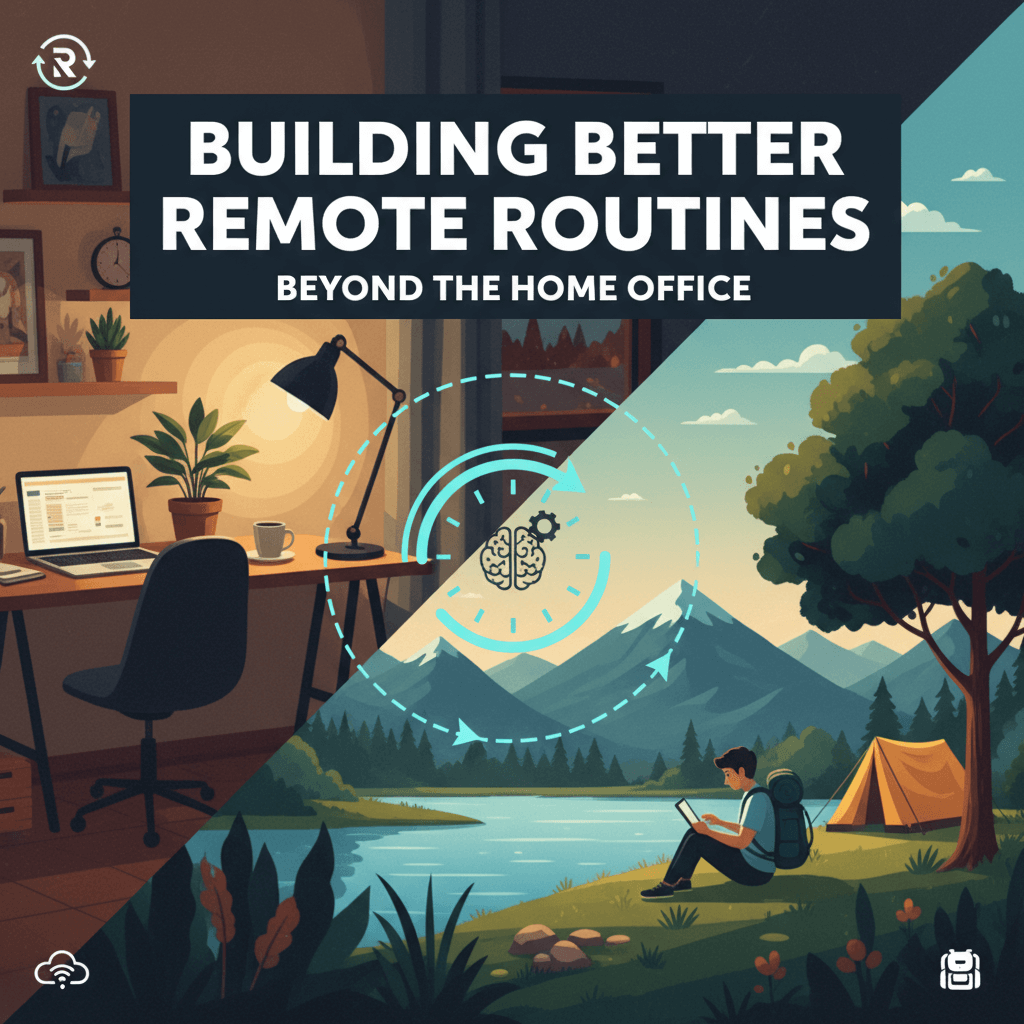
It was 9:15 AM on a Tuesday when I realized I’d been staring at my laptop screen in pajamas for nearly two hours, coffee long cold, with no clear separation between when my day “started” and when work began. Despite being three years into remote work, that morning was my wake-up call: having a home office wasn’t enough—I needed a complete remote routine overhaul.
This scenario might sound painfully familiar to many remote workers who’ve watched their work-life boundaries blur into an indistinguishable haze. The freedom of working from anywhere has evolved from novelty to norm, yet many of us are still wrestling with how to structure our days in ways that preserve both our productivity and our mental wellbeing.
The secret to thriving—not just surviving—in remote work extends far beyond having a dedicated workspace. It lies in intentionally designing routines that create psychological boundaries, foster focus, and protect our most precious resource: our mental health.
The Psychology of Remote Work Boundaries
When Emily Chen, a software developer in Seattle, found herself answering Slack messages at 11 PM, she knew something had to change. “Without the physical separation of an office, my brain couldn’t distinguish between ‘work mode’ and ‘home mode,'” she explains. “I was always mentally on-call, and it was draining me completely.”
Emily’s experience reflects what psychologists call “boundary blurring”—a phenomenon that’s become increasingly common among remote workers.
Why Traditional Boundaries Matter More When Working Remotely
According to a 2022 study published in the Journal of Occupational Health Psychology, remote workers who maintain clear boundaries between work and personal life report 34% lower burnout rates and 27% higher job satisfaction than those with blurred boundaries.
Dr. Maya Thornton, organizational psychologist and remote work researcher, explains: “Our brains crave contextual cues that signal transitions. When you worked in an office, your commute, the office environment, and even seeing colleagues served as powerful psychological triggers that your brain used to shift gears between work and personal modes.”
Without these cues, remote workers must deliberately create substitutes that help their brains transition between different mental states.
The Rise of “Fake Commutes” and Transition Rituals
One increasingly popular solution is the “fake commute”—a deliberate morning and evening ritual that mimics the transitional function of a traditional commute. These aren’t just trendy work-from-home hacks; they’re psychologically sound practices with measurable benefits.
Marketing director James Watkins implemented a 20-minute morning walk around his neighborhood before sitting down at his desk. “That walk is sacred time. I process what’s ahead, listen to industry podcasts, and mentally prepare for work. By the time I return home, I’m in work mode,” he shares. “Similarly, an evening walk helps me decompress and signals that work is done for the day.”
Three actionable transition rituals to try:
- Morning movement ritual: A short yoga sequence, neighborhood walk, or bike ride that physically moves you into your workday
- Sensory transitions: Changing clothes, lighting a specific candle only during work hours, or using a particular essential oil diffuser blend to signal “work time”
- Digital boundaries: Using different browsers for work and personal use, or setting up separate user profiles on your devices
Morning Rituals That Set the Foundation
The way you begin your day dramatically influences everything that follows. For remote workers, intentional morning routines aren’t luxury—they’re necessity.
When social media manager Tara Williams found herself constantly reactive—jumping straight from bed to email—her productivity and creativity suffered. “I was responding to everyone else’s priorities before establishing my own,” she recalls. “Now, I protect the first hour of my day like it’s made of gold.”
The Science of Morning Momentum
Research from the Journal of Applied Psychology suggests that the activities we engage in during the first hour after waking significantly impact our cognitive performance and emotional regulation throughout the day.
“The first hour of your day is prime neurological real estate,” explains neuroscientist Dr. Julian Reeves. “Your brain’s prefrontal cortex—responsible for decision-making and focus—is most responsive during this time, before becoming fatigued by the countless decisions we make throughout the day.”
This explains why many successful remote workers fiercely protect their mornings from distractions and external demands.
Crafting Your Ideal Remote Morning
Financial analyst Marcus Johnson transformed his workday by implementing what he calls a “power hour” before logging on. “I dedicate 20 minutes to physical movement, 20 minutes to reading something inspiring, and 20 minutes to planning my day. This routine has been transformative for my focus and productivity.”
Effective morning rituals to experiment with:
- Hydration before caffeine: Drinking 16oz of water before coffee improves cognitive function and alertness
- Priority planning: Identifying your 1-3 most important tasks before opening email or messaging apps
- Mindfulness practice: Even 5 minutes of meditation or deep breathing can reduce stress hormones and improve focus
Strategic Breaks: The Underrated Productivity Tool
When graphic designer Sophia Kim found herself making careless mistakes and feeling perpetually foggy, she assumed she needed to work harder. Instead, she discovered that working differently—specifically, incorporating strategic breaks—was the answer.
“I was suspicious of breaks,” she admits. “I thought they were for people who couldn’t focus. Now I understand they’re actually for people who want to maintain focus throughout the entire day, not just the first few hours.”
The Science of Mental Restoration
According to research from the University of Illinois, the brain’s attentional resources deplete with extended focus on a single task. Brief diversions from tasks dramatically improve one’s ability to focus for prolonged periods.
The data is compelling: a DeskTime productivity study found that the most productive remote workers typically work for 52 minutes, then break for 17 minutes. This rhythm aligns with our natural cognitive cycles.
Designing Breaks That Actually Recharge You
Content strategist Leo Park implemented a break system that transformed his productivity. “I used to power through for hours, then wonder why my work quality declined. Now I take three types of breaks: micro-breaks (2-3 minutes every hour), medium breaks (15-20 minutes mid-morning and mid-afternoon), and a proper lunch away from my desk.”
Effective break strategies to implement:
- Nature exposure breaks: Even brief contact with natural environments has been shown to restore attention and reduce stress
- Movement intervals: Short bursts of physical activity between work sessions improve blood flow to the brain and enhance cognitive function
- Social connection pauses: Brief, meaningful interactions (even virtual ones) can combat isolation and provide perspective
Evening Winddown: Creating Closure in a Boundaryless Environment
The end of your workday deserves as much intention as the beginning. Without the physical act of leaving an office, remote workers must create deliberate closure rituals.
Technical writer Aiden Rivera struggled with work thoughts invading his evening family time until he implemented a structured shutdown routine. “Without a clear end to my workday, my brain kept spinning on projects well into the evening. Now I have a 15-minute shutdown sequence that helps me mentally close my work tabs, not just the browser ones.”
The Psychological Power of Closure
The Zeigarnik Effect—a psychological phenomenon where uncompleted tasks create mental tension—explains why work thoughts intrude on our personal time. Our brains are naturally wired to remember unfinished business.
“Creating closure is about giving your brain permission to release work thoughts until tomorrow,” explains psychologist Dr. Rebecca Lin. “Without this permission, your subconscious continues problem-solving in the background, preventing true recovery.”
Designing Your Workday Conclusion
Project manager Devon Washington created a three-part shutdown ritual that transformed his work-life balance. “First, I review what I’ve accomplished and update project trackers. Second, I create a prioritized list for tomorrow. Finally, I write a single sentence that captures my intention for the evening ahead. This process takes less than 10 minutes but completely changes how present I am with my family.”
Effective workday conclusion practices:
- Accomplishment acknowledgment: Documenting what you completed provides psychological closure and combats the feeling that you never “finish” anything
- Tomorrow preparation: Setting clear starting points for the next day prevents morning decision fatigue
- Physical shutdown gesture: A symbolic action like closing your laptop, changing clothes, or turning off your office light that signals “work is done”
Personalizing Your Remote Routine
Perhaps the most important insight about remote work routines is that there is no one-size-fits-all solution. The most effective routines align with your natural energy patterns, work responsibilities, and personal circumstances.
When UX researcher Mia Johnson tried to force herself into an early-morning routine based on popular productivity advice, she felt perpetually behind and inadequate. “I was fighting my natural rhythms because I thought successful remote workers all started at 5 AM. When I finally designed a routine around my actual peak performance times—late morning and early evening—everything changed.”
Finding Your Unique Rhythm
Research on chronobiology—the study of natural physiological rhythms—suggests that individuals have inherent differences in their optimal performance times. About 15% of people are true “morning larks,” 20% are “night owls,” and the majority fall somewhere in between.
“The most effective remote routine is one you’ll actually follow,” emphasizes productivity coach Eliza Moreno. “Start by tracking when you naturally feel most focused, creative, and energetic, then build your most important work around those windows.”
Steps to personalize your remote routine:
- Energy tracking: Monitor your natural energy, focus, and mood patterns for two weeks to identify your personal productivity peaks
- Constraint identification: Acknowledge the non-negotiable elements of your schedule (childcare, team meetings, etc.) and build around them
- Experimentation commitment: Test new routine elements for at least two weeks before deciding if they work for you
Conclusion: The Intentional Remote Life
Remote work offers unprecedented freedom—but with that freedom comes the responsibility to create structure where none inherently exists. The most successful remote professionals aren’t those with perfect home offices or the latest productivity apps; they’re those who have thoughtfully designed daily practices that honor both their work commitments and their humanity.
As we continue navigating this evolving landscape, remember that your remote routine isn’t just about maximizing productivity—it’s about creating a sustainable, fulfilling relationship with work that preserves your wellbeing and joy.
The ultimate challenge I offer you is this: choose one element of your remote routine to redesign this week. Whether it’s implementing a morning ritual, creating a fake commute, or establishing a shutdown sequence, start small and observe the impact. Your future self—more focused, balanced, and present—will thank you for taking this step toward a more intentional remote life.
The home office revolution has given us unprecedented freedom in where we work. Now it’s time to be equally intentional about how we work—creating rhythms and boundaries that allow us to thrive, not just survive, in this new world of work.
Where This Insight Came From
This analysis was inspired by real discussions from working professionals who shared their experiences and strategies.
- Share Your Experience: Have similar insights? Tell us your story
At ModernWorkHacks, we turn real conversations into actionable insights.




0 Comments