A few months ago, a friend who runs operations at a mid-sized fintech called me in a panic. His team had just rolled out an AI-powered workflow tool, and within days, employees were asking uncomfortable questions: Where is our data going? Who can see these internal processes? Is this model training on our customer information? The software vendor’s answers were vague, buried in legal jargon, and ultimately unsatisfying. They shelved the tool—not because it didn’t work, but because trust evaporated.
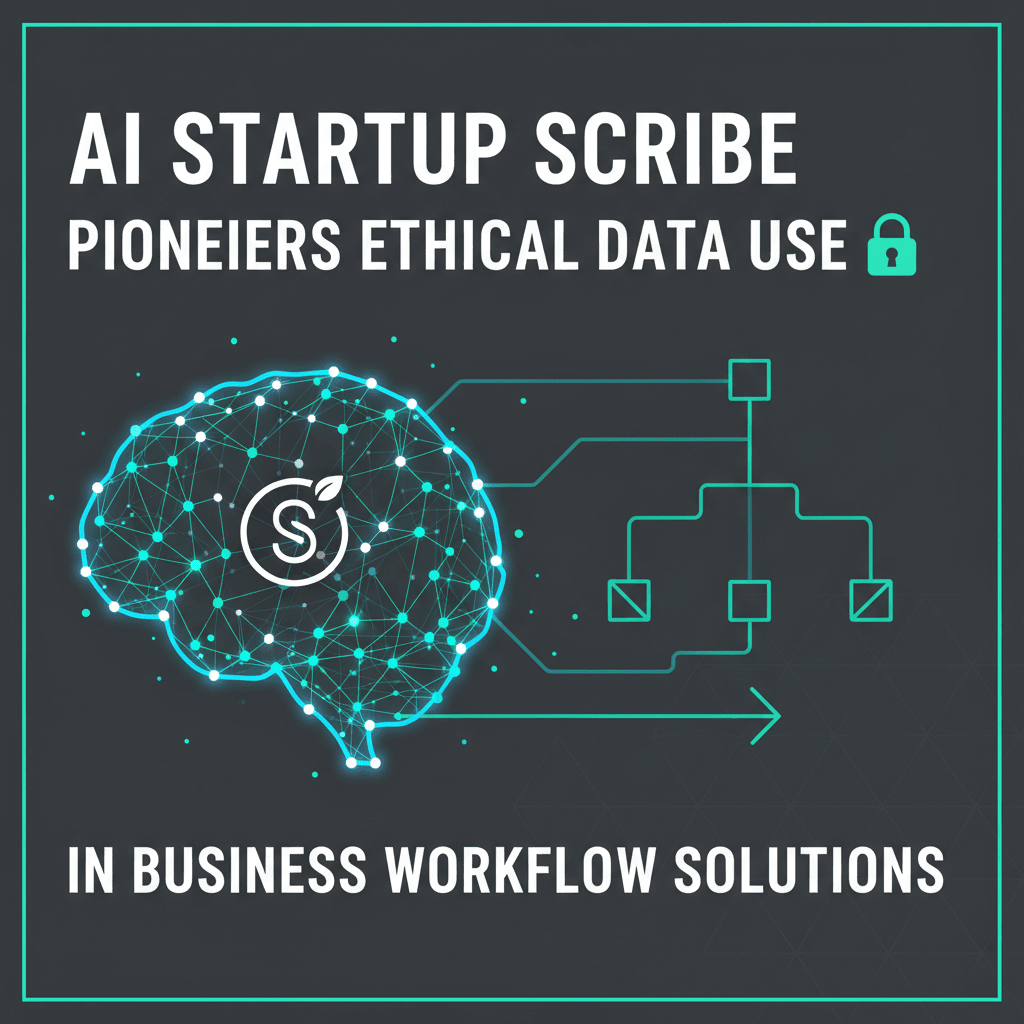
That moment captures a broader tension playing out across business today. AI adoption promises efficiency, insight, and scale, yet it also raises profound concerns about data ethics and privacy. Into this environment steps Scribe, a newly minted AI unicorn valued at $1.3 billion, turning heads not only for its growth but for its principled stance on ethical data use. My thesis is simple: Scribe’s approach signals a critical shift in how AI companies can win—not just with performance, but with trust.
The Rise of Scribe: More Than a $1.3 Billion Valuation
From workflow documentation to AI-powered intelligence
Scribe began with a deceptively simple idea: automatically document business processes as people work. Instead of writing manuals or recording training videos, teams could generate step-by-step guides in real time. What differentiated Scribe early on was usability, but what accelerated its growth was timing. As remote and hybrid work exploded, companies needed clarity and consistency in workflows.
Over time, Scribe layered AI into its platform—analyzing workflows, suggesting optimizations, and enabling faster onboarding. This evolution pushed the company into the AI spotlight and, ultimately, unicorn status.
Actionable takeaways for business leaders:
- Evaluate AI tools beyond features: Ask how they evolve over time and whether their roadmap aligns with your values.
- Map AI adoption to real pain points: Scribe succeeded because it solved documentation friction before adding intelligence.
Why the market rewarded Scribe
According to CB Insights, enterprise workflow automation is projected to exceed $30 billion by 2027. Investors aren’t just betting on automation—they’re betting on platforms that can scale responsibly. Scribe’s valuation reflects confidence not only in its revenue but in its restraint.
In Reddit communities like r/startups and r/artificial, discussions around Scribe consistently highlight this distinction. Users praise the company for “not being creepy” with data, a surprisingly powerful differentiator in a crowded market.
Actionable takeaways:
- Monitor community sentiment: Platforms like Reddit often surface trust issues before analysts do.
- Understand investor signals: Valuations increasingly reflect governance and ethics, not just growth curves.
Ethical Data Use as a Competitive Advantage
What Scribe does differently with data
Scribe has taken a firm stance: customer data is not training data by default. Unlike many AI vendors that quietly absorb user inputs to refine models, Scribe offers explicit opt-in policies and clear boundaries around data usage. Internal workflows remain siloed, encrypted, and customer-controlled.
This may sound obvious, but research from Pew Research Center shows that 81% of Americans feel they have little or no control over data collected about them. In enterprise settings, that anxiety multiplies when sensitive processes and intellectual property are involved.
Actionable takeaways:
- Demand explicit data-use policies: “We may use your data” is no longer acceptable.
- Prefer opt-in over opt-out models: This flips the power dynamic back to the customer.
Ethics as strategy, not marketing
What’s compelling is that Scribe doesn’t frame ethics as a branding exercise. In interviews and product documentation, the language is pragmatic: ethical data use reduces risk, builds trust, and accelerates adoption. This resonates with procurement teams and legal departments who are often the final gatekeepers of AI tools.
A 2024 Gartner report found that organizations with strong AI governance frameworks are 40% more likely to scale AI initiatives successfully. Ethics, it turns out, is operational leverage.
Actionable takeaways:
- Align ethics with operational goals: Treat privacy as infrastructure, not PR.
- Involve legal and compliance early: Tools like Scribe reduce friction downstream.
Reddit, Community Trust, and the New AI Reputation Economy
Why Reddit matters in enterprise AI
It might seem odd to cite Reddit in a discussion about enterprise software, yet ignoring it would be a mistake. Subreddits focused on startups, SaaS, and AI act as informal peer review systems. Founders, engineers, and operators share unfiltered experiences—good and bad.
Scribe’s name frequently appears in threads about ethical AI, often contrasted with competitors accused of opaque data practices. This organic advocacy is difficult to manufacture and deeply influential.
Actionable takeaways:
- Listen where your users talk: Community platforms reveal trust gaps early.
- Engage without controlling the narrative: Authenticity beats polished messaging.
Community engagement as risk mitigation
High engagement also acts as a feedback loop. When users understand and trust a company’s data practices, they’re more likely to report issues, suggest improvements, and stick around. This reduces churn and reputational risk.
In contrast, companies that dismiss community concerns often face backlash that spills into mainstream media. We’ve seen this pattern repeatedly in AI controversies over the last two years.
Actionable takeaways:
- Track qualitative trust signals: Sentiment can matter as much as NPS.
- Respond to criticism transparently: Silence is often interpreted as guilt.
Case Studies: Ethical AI in Action
A healthcare operations team avoids a compliance nightmare
One Scribe customer—a regional healthcare provider—used the platform to document patient intake and billing workflows. Given HIPAA constraints, they were initially hesitant to deploy AI at all. Scribe’s clear data boundaries and on-premise options allowed them to proceed without exposing sensitive patient information.
The result was a 25% reduction in onboarding time for new administrative staff, without triggering compliance red flags.
Actionable takeaways:
- Match AI tools to regulatory reality: Not all platforms are safe for sensitive industries.
- Use ethics as an enabler: Strong privacy controls unlock use cases that would otherwise be impossible.
A fintech startup earns employee buy-in
Another example comes from a fintech startup documenting fraud review processes. Employees were wary of surveillance-style AI. Scribe addressed this by clearly communicating what was captured, how it was used, and what was excluded. Adoption followed.
Internal surveys showed a 30% increase in employee confidence around AI tools—a reminder that trust isn’t just external.
Actionable takeaways:
- Communicate internally about AI ethics: Employees are stakeholders, too.
- Design for psychological safety: Transparency reduces resistance.
What Scribe Signals for the Future of AI in Business
The end of “move fast and break trust”
For years, tech culture celebrated speed above all else. AI has forced a reckoning. Broken trust now carries existential risk—from regulatory fines to customer exodus. Scribe represents a counter-narrative: move deliberately and build credibility.
Regulators are catching up as well. The EU AI Act and similar frameworks emphasize data minimization and user consent, effectively validating Scribe’s approach.
Actionable takeaways:
- Future-proof your AI stack: Choose vendors aligned with emerging regulation.
- Audit existing tools: Identify hidden data exposure before regulators do.
A blueprint for responsible scale
Scribe’s success challenges the assumption that ethical constraints slow growth. Instead, they may accelerate it by removing friction and fear from adoption. As AI becomes embedded in everyday workflows, this balance will define the next generation of winners.
Actionable takeaways:
- Redefine innovation metrics: Include trust, not just speed.
- Reward vendors who say no: Boundaries are a sign of maturity.
Synthesis: Trust Is the Real Workflow Optimization
When I think back to my friend’s abandoned AI rollout, I can’t help but wonder how different the outcome might have been with a tool like Scribe. The technology itself is rarely the blocker; trust is. Scribe’s $1.3 billion valuation is impressive, but its deeper achievement is proving that ethical data use can be a growth strategy, not a constraint.
As readers—whether founders, operators, or investors—the challenge is clear. We must demand more from the AI tools we adopt and build. Ask hard questions about data. Listen to community voices. Reward companies that treat privacy as a promise, not a loophole.
The call to action: The next time you evaluate an AI solution, don’t start with what it can do. Start with what it refuses to do with your data. That decision may define not just your workflow efficiency, but your credibility in an AI-driven world.
Where This Insight Came From
This analysis was inspired by real discussions from working professionals who shared their experiences and strategies.
- Share Your Experience: Have similar insights? Tell us your story
At ModernWorkHacks, we turn real conversations into actionable insights.



0 Comments