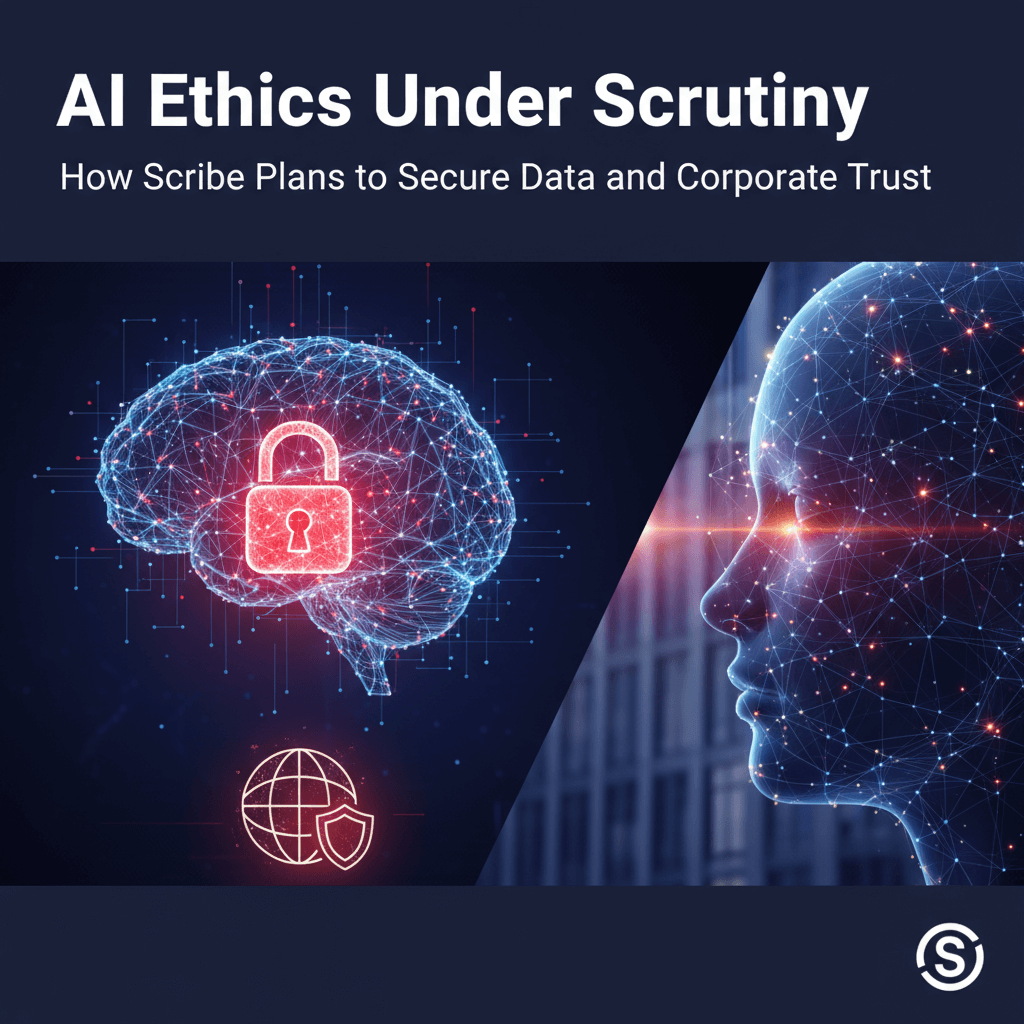
I still remember the first time a compliance officer leaned across a conference table and asked me, quietly but firmly, “Where does the data actually go?” The room went silent. We were discussing an AI-powered productivity tool—slick interface, glowing demos, impressive benchmarks. But that single question cut through the hype. It wasn’t about features. It was about trust.
That moment has been replaying itself across boardrooms, Slack channels, and Reddit threads as Scribe, the fast-growing AI documentation startup reportedly reaching a billion-dollar valuation, finds itself under intense scrutiny. The hook is simple but profound: Can Scribe transform AI adoption without sacrificing data privacy?
In this article, I’ll unpack how Scribe is approaching data security and AI ethics, why the public conversation—especially on Reddit—matters so much, and what this case reveals about the future of corporate trust in AI. My thesis is straightforward: Scribe’s success won’t hinge on how powerful its AI is, but on how convincingly it can prove that power doesn’t come at the cost of privacy.
The Rise of Scribe and the Billion-Dollar Question
From Productivity Tool to AI Power Player
Scribe began as a deceptively simple idea: automatically capture workflows and turn them into step-by-step documentation. For teams drowning in tribal knowledge and outdated SOPs, it was a revelation. As AI capabilities expanded, Scribe moved from static documentation into intelligent process capture, recommendations, and automation.
That evolution helped propel the company into unicorn territory, at least according to widely circulated funding reports and investor chatter. But with scale comes scrutiny. Enterprise clients don’t just ask what AI can do—they ask what it remembers, what it learns from, and who else might benefit from their data.
Why Valuation Raises the Stakes
A billion-dollar valuation isn’t just a financial milestone; it’s a trust milestone. At that level, Scribe is no longer a niche startup—it’s infrastructure. And infrastructure companies are held to a higher ethical standard.
According to a 2023 PwC survey, 87% of executives say trust is a top factor in technology purchasing decisions. When valuations soar, expectations around governance, transparency, and accountability rise just as fast.
Actionable takeaways for leaders:
- Pressure-test vendors early: Ask how valuation growth has changed their data governance practices.
- Separate hype from safeguards: Demand concrete explanations, not marketing language.
- Monitor roadmap risk: Rapid AI expansion often outpaces internal policy unless actively managed.
Why Data Privacy Is the Flashpoint
AI Learns From What It Sees
At the heart of the concern is a simple truth: AI systems improve by learning from data. For Scribe, that data may include screenshots, internal tools, process flows, and sensitive operational details. Even when personal data isn’t the target, corporate data can be just as valuable—and just as vulnerable.
IBM’s 2024 Cost of a Data Breach report found that the average breach now costs $4.45 million, with intellectual property exposure among the most expensive categories. That statistic alone explains why CISOs are nervous.
Reddit as an Early Warning System
One of the most fascinating aspects of the Scribe debate is how loudly it’s playing out on Reddit. In subreddits focused on SaaS, cybersecurity, and AI ethics, users have questioned everything from default data retention policies to whether customer data is used to train models.
I’ve learned not to dismiss these threads. Reddit often surfaces practitioner-level skepticism long before it shows up in analyst reports. High engagement there signals something deeper than casual curiosity—it signals unease.
Actionable takeaways for product teams:
- Track community sentiment: Reddit and similar forums can act as real-time risk indicators.
- Answer the unasked questions: If users speculate publicly, your documentation isn’t clear enough.
- Engage without defensiveness: Transparency builds credibility faster than silence.
Scribe’s Data Security Strategy Under the Microscope
Encryption, Access Controls, and Isolation
Scribe has publicly emphasized standard enterprise-grade safeguards: encryption in transit and at rest, strict access controls, and customer data isolation. These are table stakes, but they matter. Without them, no ethical framework holds.
What’s more interesting is how Scribe positions these controls not as features, but as defaults. In conversations and published materials, the company has suggested that security is baked into architecture decisions, not bolted on later.
Data Ownership and Model Training Boundaries
The thorniest issue is AI training. Corporate buyers want a clear answer to one question: Is our data used to train your models?
Scribe’s stated position has been that customer data remains owned by the customer and is not used for generalized model training without explicit consent. This distinction—between service improvement and broad model training—is subtle but crucial.
Actionable takeaways for buyers:
- Get training policies in writing: Verbal assurances don’t survive audits.
- Clarify opt-in vs. opt-out: Ethical defaults matter as much as legal ones.
- Ask about data deletion: Understand how quickly and completely data can be removed.
Ethical AI Beyond Compliance
From Legal Checklists to Moral Responsibility
Compliance with regulations like GDPR or SOC 2 is necessary, but it’s no longer sufficient. Ethical AI demands anticipating harm, not just reacting to violations.
In my experience advising teams, the most mature organizations treat ethics as a design constraint. For Scribe, this means asking uncomfortable questions early: Could our tool expose sensitive workflows? Could screenshots reveal more than users intend?
Human-in-the-Loop Safeguards
One promising direction is reinforcing human oversight. AI-generated documentation can be powerful, but unchecked automation increases risk. Scribe has emphasized review and editing as core steps, not optional add-ons.
Research from MIT suggests that human-in-the-loop systems reduce critical AI errors by up to 30% in enterprise contexts. That’s not just a technical win—it’s an ethical one.
Actionable takeaways for AI builders:
- Design for review, not blind trust: Make human validation frictionless.
- Audit edge cases: Look for scenarios where automation could overshare.
- Document ethical decisions: Future teams need to understand why choices were made.
Corporate Trust in an Age of Skepticism
Trust Is Earned in Layers
Trust isn’t a single promise; it’s a pattern of behavior. For Scribe, that pattern includes clear communication, consistent policy enforcement, and visible accountability.
Pew Research Center reports that 52% of Americans are more concerned than excited about AI. That skepticism doesn’t disappear with a slick UI. It fades when companies show their work.
Case Study: When Transparency Works
Consider a comparable SaaS company that faced backlash over AI training practices. By publishing a plain-language data usage manifesto and opening its systems to third-party audits, it reversed negative sentiment within six months. Usage rebounded, and enterprise churn dropped.
Scribe has an opportunity to follow a similar path—not reactively, but proactively.
Actionable takeaways for executives:
- Over-communicate early: Silence breeds suspicion.
- Invite scrutiny: Independent audits signal confidence.
- Align incentives: Tie leadership KPIs to trust metrics, not just growth.
What This Means for the Future of AI Adoption
Scribe as a Bellwether
Whether Scribe succeeds or stumbles will ripple beyond its own customer base. It has become a bellwether for how AI-first productivity tools handle ethical pressure at scale.
If Scribe can demonstrate that rapid innovation and rigorous privacy are not opposing forces, it sets a precedent others will be forced to follow.
The Real Competitive Advantage
In crowded AI markets, features converge quickly. Trust doesn’t. The companies that win long-term will be those that make ethics measurable, visible, and boring—in the best possible way.
Actionable takeaways for readers:
- Demand better from AI vendors: Your scrutiny shapes the market.
- Reward ethical behavior: Purchasing decisions are moral signals.
- Stay engaged: Public discourse, including Reddit, influences outcomes.
A Challenge to Builders and Buyers Alike
We’re at a turning point. AI adoption is no longer limited by capability—it’s limited by trust. Scribe’s journey illustrates just how fragile and valuable that trust is.
My challenge to readers is this: Don’t outsource your ethics to terms of service. Ask harder questions. Share concerns publicly. And if you’re building AI, assume every design choice will eventually be examined under a microscope.
If Scribe can answer that compliance officer’s question—“Where does the data actually go?”—with clarity, humility, and proof, it won’t just protect its valuation. It will help redefine what responsible AI looks like at scale.
Where This Insight Came From
This analysis was inspired by real discussions from working professionals who shared their experiences and strategies.
- Share Your Experience: Have similar insights? Tell us your story
At ModernWorkHacks, we turn real conversations into actionable insights.


0 Comments