Discover actionable insights drawn from real-world conversations, team retros, and the unfiltered threads where people actually say what they think about where and how they work best.
The day the office broke for me
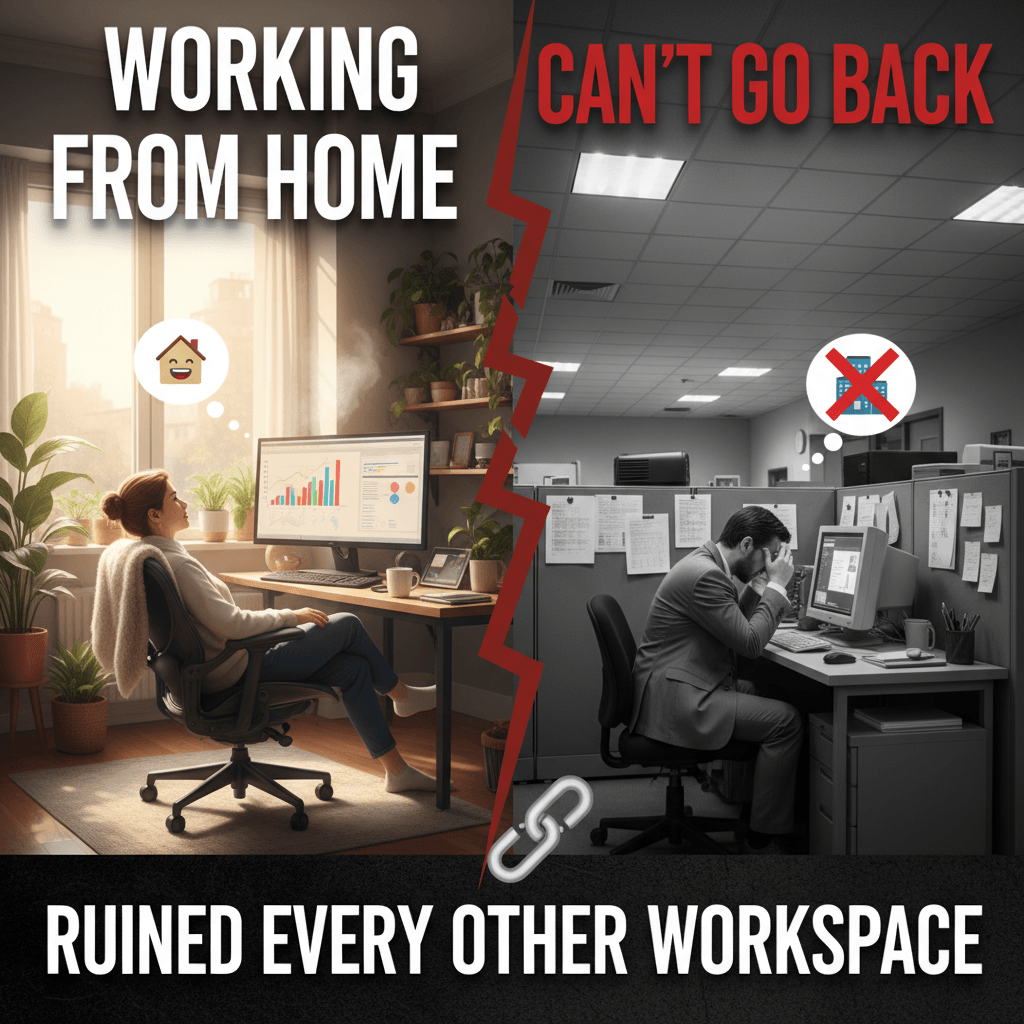
It wasn’t a dramatic epiphany. No slammed laptops or grand resignations. Just a Tuesday when I packed my bag and tried to give the office a fair chance. I left early to beat traffic, the coffee shop had a line, the bus was late, and by the time I scanned into the building, every small compromise I hadn’t noticed before had gathered into one obvious truth: working from home had re-tuned my sense of what “work” feels like, and the office didn’t fit anymore.
At home, my morning is a quiet rhythm: a mug that fits my hand, a chair dialed to my body, a desk bathed in the kind of light that makes me feel alert without buzzing. I know the arc of my concentration and shape meetings around it. My notes are where I left them. My tabs open to the exact context I need. The walk from desk to kitchen is 12 seconds of decompression, not a perfunctory trek between rooms searching for a surface to perch on.
In the office that day, I hunted for a spot with decent light and a monitor that wasn’t calibrated to an unknown blue. I adjusted a chair that refused to remember me. Headphones tried to cancel the HVAC whoosh, snippets of neighboring standups, and the slap of someone’s sneakers. In between, I waited: for a meeting room, for a coworker to get out of one, for the laptop to authenticate on a guest network that didn’t remember me either. My screen time stretched between interruptions like taffy, thinner each time it was pulled.
By lunch, I realized it wasn’t just inconvenience. It was the tax on attention. Every micro-friction—badge taps, desk hunts, re-explaining context to the person who popped by—compounded into a loss I could feel but not log. The work I did produce felt fractionally more performative, tuned to be witnessed instead of measured by its impact.
Late afternoon, a colleague I admire swung past my shoulder and said, “It’s so good to see you here. We need more faces.” I smiled, meant it, and still felt the tug. Because “faces” was code for a culture built around co-presence, while my work best unfolded around coherence. The hours I’d spent earning the right environment felt like hidden overtime. At home, I didn’t have to earn my groove—it just met me there.
On my commute back, I realized something quietly devastating to the institution of the office: once your baseline for focused, humane productivity rises, everything else feels like a downgrade. I wasn’t trying to be precious. But years of remote practice had made the essentials—autonomy, predictable quiet, tools that fit me like gloves—non-negotiable. Going elsewhere felt like consenting to do worse work, more slowly, with more friction, for the sake of proximity. And I couldn’t unknow that.
That Tuesday didn’t make me anti-office. It made me pro-conditions. And it set me on a path to ask a better question than “office or home?”—namely, “What makes work truly work?” The answers, it turns out, are less about square footage and more about sovereignty.
Why every other workspace fails me now
It isn’t about comfort in the lazy sense. It’s about control in the craft sense. When home showed me what frictionless work could feel like, I started seeing how other spaces interfere with the mechanics of doing meaningful, measurable output. Here’s what shifted.
Time sovereignty beats schedule density
At home, I control the cadence. Meetings cluster where my brain is social. Deep work takes the primetime hours. In shared spaces, the day bends around other people’s calendars, coffee breaks, and room availability. The result is a schedule built like patchwork—colorful, lively, and loaded with seams.
- At home: I anchor two daily deep-work blocks, flex around them, and treat meetings as the exception to the rule.
- Elsewhere: I spend prime energy negotiating for quiet and reassembling attention after interruptions.
Ergonomics is not a luxury—it’s cognitive infrastructure
People roll their eyes at chair talk until they feel what a dialed-in workstation does to thinking. Custom setup translates to predictable posture, fewer micro-aches, and less energy diverted to physical management. Hot desks and borrowed chairs ask the body to compromise first, then focus second.
- At home: Monitor height, keystroke feel, lighting and temperature are dialed to me, not to a building average.
- Elsewhere: I become a tourist in my own tools, constantly adapting, reconfiguring, and losing flow.
Sensory control is a productivity multiplier
The hum of an office is neutral for some and hostile for others. Open-plan acoustics reward extroverts and penalize concentration heavy roles. Home lets me script my soundscape: noise floor, music style, even silence on demand. That’s not decadence; it’s scaffolding for sustained cognition.
- At home: I shape sound, light, scent, and interruptions like a studio engineer.
- Elsewhere: I am at the mercy of whatever’s happening one table over.
Micro-recovery moments matter more than we admit
In between sprints, I can walk barefoot to the kitchen, fold a quick stack of towels while a build runs, or stretch during a one-on-one. These tiny resets lower stress and restore focus. In shared spaces, recovery is public, performative, or skipped. The body holds the tension while the brain tries to power through.
Async by design, not by apology
At home, I write first and talk later. Documents carry context. Threads resolve without a meeting. Office rhythms often default to “Can we just grab a room?” Every “grab a room” preempts thoughtful writing and narrows who can contribute meaningfully.
None of this is about moral superiority for remote work. It’s engineering: reduce noise, increase agency, add recovery—and throughput rises. Once you know the shape of your best work, any space that fights it feels like a downgrade.
What real discussions reveal
The internet is full of caricatures about remote work: pajama-clad slackers vs. badge-tapping grinders. The truth is in between—and much more practical. In 1:1s, Slack threads, AMA transcripts, and community forums, a more nuanced picture emerges. Different roles, life stages, and neurotypes find different benefits and risks. Here are key takeaways echoed across those conversations.
Managers and executives
- Output clarity beats presence optics. Leaders who shifted from “Are you here?” to “What did we ship?” saw higher accountability and less micromanagement.
- Written culture scales judgment. When decisions live in docs, new hires ramp faster and politics has less oxygen.
- Hybrid without design is chaos. Ad hoc in-office days fracture teams. When in-person time has a purpose (kickoffs, retros, training), value rises.
- Metrics matter. Teams that instrumented work (cycle times, customer impact, quality) argued less about location and more about results.
Individual contributors
- Deep work is the differentiator. Engineers, writers, analysts, and designers report that uninterrupted blocks at home outperform any office equivalent.
- Commute time reallocated to life. People reinvest saved hours into sleep, fitness, family, or learning, fueling better performance.
- Context-switch tax is visible now. Once you feel the cost of interruptions, you stop treating them as harmless.
- Social needs vary widely. Some crave office buzz weekly; others find it draining and prefer planned, intentional meetups.
Caregivers and parents
- Flexibility is the difference between thriving and burning out. School pickups, appointments, and sick days become manageable without hiding life from work.
- Boundaries are learnable. Rituals like door signs, noise cues, and shared calendars reduce household friction.
- Quality time rises. Even 30 reclaimed minutes daily changes family dynamics.
New grads and career visibility
- Access beats osmosis. Open doc archives, office hours, and structured shadowing outperform hoping to overhear brilliance.
- Proactive networking is a skill. Remote newbies who book weekly 15-minute intros ramp culture faster than passive office presence.
- Clear ladders matter more remotely. When promotion criteria are explicit, visibility anxiety drops.
Neurodivergent and disabled workers
- Sensory control is not optional. Home setups reduce overwhelm and allow sustained, high-quality output.
- Asynchronous time supports spikes and troughs. People can work with their brains, not against them.
- Accessibility improves with intention. Captions, transcripts, and written artifacts widen inclusion more than office seating charts.
IT and security
- Security is a practice, not a place. Device posture, MFA, and least-privilege policies reduce risk more than a locked building.
- Standardized, automated setups win. Zero-touch provisioning, SSO, and remote monitoring trade hallway fixes for resilient systems.
- Support becomes proactive. Analytics surface issues before tickets spike; training moves to bite-sized, on-demand modules.
HR, L&D, and culture builders
- Belonging lives in rituals. Weekly demos, shoutouts, and interest groups create cohesion without co-location.
- Performance clarity is culture. When excellence is defined, bias based on presence shrinks.
- In-person is a tool, not a default. Offsites, community days, and workshops—designed with intent—beat five days of ambient proximity.
Across these threads, one theme repeats: when you design for clarity and autonomy, the “where” recedes. But for many of us, home didn’t just equal the office. It surpassed it. Not because couches are magic, but because our best work depends on conditions easier to control at home.
The actionable home-work playbook
If working from home has ruined other spaces for you too, don’t just celebrate—stabilize it. Great remote work is a system. Build one you can trust on good days and bad, across quarters and career shifts.
Design your space like a tool, not a shrine
- Calibrate ergonomics. Set monitor top at or slightly below eye level; elbows at 90 degrees; wrists neutral; feet flat. If budget is tight, stack books under monitors, use a rolled towel as lumbar support, and elevate your laptop with a stand.
- Engineer your light. Aim for indirect, diffuse lighting in front of you; avoid backlighting that causes eye strain. Use warm light in the evening to cue shutdown.
- Control sound. Build a two-mode soundscape: one playlist for focus, one for admin. Add a white noise or fan track for neighbor noise. Noise-canceling headphones are an investment, not a luxury.
- Simplify surfaces. Keep only current work tools on the desk. Put “inspiring clutter” on a separate shelf to avoid visual noise.
- Make reset visible. A small tray for end-of-day items (pen, notepad, badge) signals shutdown. Close the loop physically.
Own your time with ruthless, humane structure
- Block deep work first. Two 90-minute blocks daily, protected like meetings. Treat them as your non-negotiable craft time.
- Stack meetings. Cluster all synchronous time into 2-3 windows per week, aligned with your social energy peaks.
- Adopt a shutdown ritual. Last 10 minutes: write tomorrow’s top three, clear your desk, and physically step away. Don’t let work ooze into the evening by default.
- Use “office hours.” Publish two weekly slots where anyone can ping you for quick help. It reduces random interruptions the rest of the time.
- Track energy, not just time. Note when you feel sharp vs. foggy; shift difficult tasks to sharp windows.
Make writing your default interface
- Document decisions. One-page memos beat three status meetings. Start with context, options considered, decision, and next steps.
- Thread with purpose. Label threads by outcome needed (“FYI,” “Feedback by Friday,” “Blocker”). Set expectations to avoid endless pings.
- Replace recurring meetings. Convert status meetings to async updates with a single weekly sync reserved for blockers and priorities.
- Standardize templates. PRD, RCA, retro—give each a canonical template so quality doesn’t depend on who writes it.
Automate the boring, ritualize the important
- Automate starts and stops. Use focus modes to silence notifications during deep work; schedule “do not disturb” globally.
- Build a daily check-in bot. Auto-prompt the team each morning: “Top focus, blockers, help requested.” Summaries beat meetings.
- Use keyboard shortcuts and text expanders. Save snippets for frequent responses, links, and tickets.
- Instrument your work. Track cycle time, throughput, and quality metrics. Numbers quiet debates about location.
Strengthen collaboration with explicit rituals
- Weekly demos. Friday show-and-tell: ship small, show often. Seeing progress maintains momentum and shared context.
- Rotating facilitation. Different teammates run standups and retros. It spreads ownership and surface area for voices.
- Milestone kickoffs in person (or with cameras on). Design these for alignment: constraints, risks, roles, and the “definition of done.”
- Async retros after big pushes. A 48-hour window for input leads to richer, less biased reflection.
Guard wellbeing without apology
- Schedule micro-recoveries. 5-minute resets every 60–90 minutes: stretch, water, sunlight. Treat them as cognitive maintenance.
- Move daily. A brisk 20-minute walk replaces a commute and improves sleep and mood.
- Define “off.” Choose a device-free hour nightly. Align focus modes with your household’s rhythms.
- Social on purpose. Set recurring friend/colleague coffees, interest clubs, or co-working sessions that fuel, not drain, you.
Make yourself legible for growth
- Publish a working README. How to communicate with you, your focus hours, preferred channels, and how you make decisions.
- Ship logs. Keep a lightweight, shareable log of what you shipped, learned, and unblocked weekly. It’s your visibility engine.
- Ask for feedback in writing. Quarterly, request strengths, growth edges, and examples. Collate patterns into a growth plan.
- Mentor and be mentored. Offer one office hour monthly; ask one person you admire for a quarterly check-in.
Keep security and compliance boringly solid
- Harden devices. Full-disk encryption, auto-lock, OS updates, reputable antivirus, and hardware keys or authenticator apps.
- Segment networks. Use a separate Wi-Fi for work devices; consider a dedicated VLAN if you can.
- Zero trust by habit. Principle of least privilege, strong passwords via a manager, and never mixing personal and work accounts.
- Backups. Cloud sync plus periodic offline backups for critical work artifacts.
Close the loop with your team and leadership
- Propose a remote charter. Define core hours (if any), response time norms, meeting hygiene, documentation expectations, and in-person cadence.
- Bundle your ask with outcomes. When negotiating location, present performance data, customer wins, and a plan for collaboration.
- Design intentional in-person time. Quarterly offsites with clear agendas: strategy, training, bonding. Measure ROI with pulse surveys and velocity after.
Your next move: make every hour and place work for you
If other workspaces feel like downgrades now, you’re not broken—you’re calibrated. You’ve experienced what it’s like when environment amplifies attention instead of taxing it. That doesn’t mean you’ll never set foot in an office or work elsewhere; it means you’ll refuse to trade craft for convenience or optics.
If you must use other workspaces again, stack the deck
- Build a go-bag. Compact keyboard, mouse, laptop stand, travel power strip, and a short HDMI/USB-C kit. Familiar tools neutralize hot-desk friction.
- Curate a noise kit. ANC headphones, foam earplugs, and a white noise playlist. Pre-tune settings so you’re not thrashing on-site.
- Pre-book the day. Reserve rooms in two-hour deep-work blocks before others fill them; cluster meetings around those.
- Carry your context. Download key docs offline. Keep a “start here” note with your priorities to avoid reorientation tax.
- Negotiate an anchor day. If hybrid is mandatory, designate one “no-meeting deep day” at home. Show how it improves team throughput.
- Set boundary scripts. Phrases like “I’m heads-down on a deadline; can we sync at 2:30?” preserve relationships and focus.
Turn insights into team-wide upgrades
- Run a friction audit. For a week, everyone logs top three daily friction points. In a retro, choose two to eliminate with process or tools.
- Pilot async sprints. For two weeks, replace status meetings with written updates and a single blocker sync. Compare outcomes to baseline.
- Codify decision hygiene. Every significant decision gets a one-pager. Track reversal rates and speed to alignment.
- Instrument before you argue. Establish a few simple metrics—cycle time, quality escapes, customer NPS—so debates about location have data.
Call to action
You don’t have to convince everyone that home is best. You only need to prove that great work thrives under certain conditions—and then build those conditions with intent. This week:
- Audit your week. Note when you felt most effective and what conditions enabled it. Write it down.
- Run two experiments. Protect two deep-work blocks and convert one recurring meeting to an async update.
- Publish your working README. Share your focus hours, channels, and expectations with your team.
- Invite a conversation. Send this article to your manager or team and propose a 30-minute session to design your team’s remote charter.
- Measure and iterate. After two weeks, compare output, stress, and satisfaction. Keep what works; discard what doesn’t.
The question isn’t whether offices are dead or homes are sacred. It’s whether we’ll honor the craft of knowledge work by giving it the environment it deserves. Working from home has raised the standard. Now raise your system to meet it. Start today—build your playbook, run your experiments, and lead your team toward a way of working you’ll never want to walk back from.
Where This Insight Came From
This analysis was inspired by real discussions from working professionals who shared their experiences and strategies.
- Source Discussion: Join the original conversation on Reddit
- Share Your Experience: Have similar insights? Tell us your story
At ModernWorkHacks, we turn real conversations into actionable insights.
![[Workflow Included] A simple 5-node Instagram posting workflow for beginners](https://modernworkhacks.com/wp-content/uploads/2026/04/workflow-included-a-simple-5-node-instagram-posting-workflow-for-beginners-1024x675.png)



0 Comments