
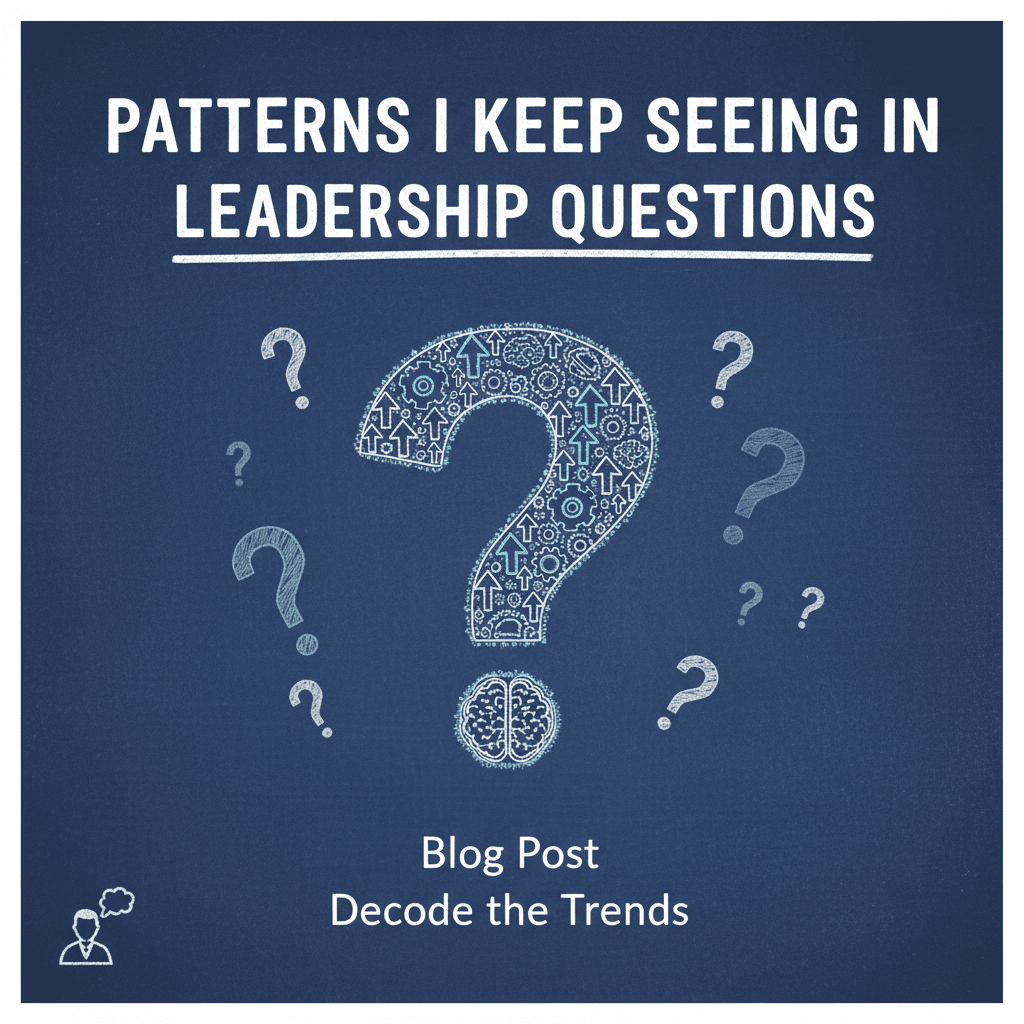
Discover actionable insights. If you’ve ever wondered why so many leadership dilemmas sound eerily familiar, you’re not imagining it. The questions keep circling the same hidden roots. This article distills what I’ve learned from countless real discussions—what’s actually going on beneath the symptoms leaders report, and what to do next time you recognize a similar pattern.
A Corridor Outside the Boardroom: The Moment That Changed How I Read Leadership Questions
It was a Tuesday, ten minutes before a board update. A VP stopped me in the corridor with a deceptively simple question: “Can you help me word this slide so the board doesn’t think we failed?” Her team had missed a milestone. The data was honest but unflattering. She wanted better phrasing. I asked for five minutes to understand the story behind the slide.
We walked into an empty conference room. What started as a wording exercise turned into a diagnosis of how her team set priorities, how decisions were made, and who felt responsible for trade-offs. The missed milestone wasn’t a writing problem. It was a decision-rights problem that had been postponed for months by well-meaning coordination meetings that created the illusion of progress without clarity.
Later that day, I opened my inbox and saw different versions of the same question: “How do I keep my team accountable without being a micromanager?” “How do I stop endless debates and make a decision that sticks?” “How do I handle passive resistance to a change everyone claims to support?” It clicked: we aren’t dealing with a hundred separate leadership issues. We’re seeing a handful of recurring patterns wearing different costumes.
Since then, when I read a leadership question, I try to strip away surface details and look for the pattern underneath. The patterns tell you what to do next. And when you act on the pattern—not just the symptom—you make progress that compounds.
- Key takeaway from real discussions: The problem presented is often a proxy for a deeper operating pattern—clarity, trust, decision rights, or rhythm. Diagnose the pattern first; the answer becomes dramatically clearer.
People and Trust Patterns: When “Soft” Issues Quietly Dictate Hard Outcomes
Most leadership questions that look like performance, alignment, or culture problems trace back to the same three people-and-trust patterns. Leaders often try to fix these with tools or policies—new dashboards, reorganizations, a different meeting template. But the leverage lives in how people build clarity, candor, and commitment.
Pattern 1: Vague Expectations, Silent Agreements
The most common pattern I encounter is leaders and teams operating on silent agreements—assumptions never made explicit. People believe they share a definition of success, timelines, quality, and trade-offs. In reality, they do not. Then “accountability” conversations turn into archaeology digs through slack threads, emails, and memories, looking for the missing agreement.
The giveaway question: “How do I hold people accountable?” The better question: “Did we make the commitment explicit enough that accountability feels fair and objective?”
When expectations are clear, accountability is a consequence; when they’re not, accountability feels like punishment.
- Signals you’re seeing this pattern: Frequent rework, reasonable people blaming miscommunication, dependence on individual heroics, status meetings filled with interpretation rather than verification.
- What to do this week:
- Replace “Are we aligned?” with “What exactly are we committing to, by when, at what quality, with what constraints?”
- Use a one-page “Clarity Brief” for any significant initiative: objective, owner, decision rights, definition of done, constraints, risks we accept.
- Close loops with a written recap after any decision: “We decided X, by Y date, with Z criteria. Owner: A.”
- Key takeaway from real discussions: Leaders who ritualize written agreements see fewer “accountability” problems because the expectation gap disappears.
Pattern 2: Feedback Avoidance Masquerading as Niceness
Leaders want a supportive culture and confuse that with feedback avoidance. They wait for the “perfect time,” soften the message until it’s unrecognizable, or outsource it to performance reviews. Teams read the silence as “everything’s fine,” then feel blindsided later. Meanwhile, leaders ask: “How do I get people to take feedback well?”
The real question: “How do I build a system where feedback is frequent, specific, safe, and expected?” Normalizing feedback makes it a gift, not a verdict.
- Signals you’re seeing this pattern: Surprises in performance reviews, “We’re like a family” language used to dodge hard truths, ideas that circle without a decision, chronic drift from stated standards.
- What to do this week:
- Adopt SBI (Situation-Behavior-Impact) for all feedback. “In yesterday’s client call (S), you cut off Maria mid-sentence (B), which undermined our pitch (I). Next time, pause and invite her in.”
- Install a “feedback minute” at the end of recurring meetings: one appreciative note, one improvement note. Short, routine, normalized.
- Model receiving feedback with gratitude. Ask, “What’s one thing I could do that would make your work easier?” Then act on it publicly.
- Key takeaway from real discussions: When leaders give and receive small, frequent feedback, big corrective conversations become rare and less emotional.
Pattern 3: The False Trade-Off Between Care and Candor
Many leaders believe they must choose between being caring or being candid. That false trade-off creates resentment, politeness theater, and whispered dissent. Teams perform better when leaders practice caring candor—clear standards, direct language, respectful delivery, and follow-through help both people and performance.
- Signals you’re seeing this pattern: Over-indexing on tone while under-indexing on clarity, performance management delayed “to not rock the boat,” conflict avoided until it explodes.
- What to do this week:
- Write “care and candor” into your team norms: “We say the hard thing, kindly and early.”
- Practice the three-sentence standard: “Here’s the expectation. Here’s where we are. Here’s what happens next.”
- Separate person from problem out loud: “I value you and your contributions. This behavior misses our standard. Let’s fix it together.”
- Key takeaway from real discussions: Teams trust leaders who are predictably clear and fair more than leaders who are merely agreeable.
Decision-Making and Prioritization Patterns: Why So Many Problems Are Really Choice Problems
Another cluster of recurring questions comes down to decisions—who makes them, how, and when. Leaders think in terms of consensus, collaboration, and inclusion. All valuable. But without crisp decision architecture, you get endless debates and zero motion.
Pattern 4: Decision Paralysis Disguised as Collaboration
Leaders fear steamrolling, so they invite wide input. Good instinct. But when input is confused with veto power, nobody knows who decides. Talk expands to fill the vacuum. The team burns time crafting the “perfect” decision, ignoring that learning happens after a decision, not before it.
- Signals you’re seeing this pattern: Meetings end with “Let’s circle back,” decisions revisited multiple times, long threads that never converge, people assume consensus is required.
- What to do this week:
- Use the DARE checklist: Define the Decision, name the Approver, clarify Required input, set the Earliest decision time.
- Time-box debates. “We’ll collect input for 48 hours, decide Friday, and re-evaluate in two weeks if new data emerges.”
- Adopt reversible vs. irreversible framing. Make reversible decisions fast with guardrails; reserve extra rigor for the few that are costly to unwind.
- Key takeaway from real discussions: Most decisions are reversible; speed plus review beats slow perfection in complex environments.
Pattern 5: Meetings as a Substitute for Outcomes
Leaders often ask, “How do I fix unproductive meetings?” Hidden beneath is a simpler issue: meetings are used to manage anxiety instead of moving outcomes. When the operating rhythm is unclear, meetings become the de facto project manager—everyone shows up to feel “on it,” while work fragments between status updates.
- Signals you’re seeing this pattern: People leave meetings unclear on owners and next steps, recurring status meetings that persist out of habit, pre-meetings about the meeting.
- What to do this week:
- Shift from agenda to outcome: “By the end, we will have decided X, assigned Y, and confirmed Z.” Cancel meetings without outcome statements.
- End with the 3 Os: Owner, Outcome, and “Okay by when?” Then send the decision recap within an hour.
- Replace status meetings with written updates read asynchronously; use meeting time for decisions and blockers only.
- Key takeaway from real discussions: Meetings improve when they’re one step in a clear workflow, not the entire workflow.
Pattern 6: Firefighting Crowding Out Strategy
Leaders report feeling trapped in the urgent at the expense of the important. They search for a time-management hack. But the root isn’t a calendar trick. It’s a portfolio problem: too many simultaneous priorities, no explicit trade-offs, and a culture that rewards responsiveness over results.
- Signals you’re seeing this pattern: Constant context switching, strategic projects perpetually “in progress,” leaders who can’t find two uninterrupted hours a week for deep work.
- What to do this week:
- Run a “stop-doing” review: list current initiatives; for each, decide kill, pause, or proceed. Publicly kill at least one to make room for the strategic.
- Block two recurring deep-work windows weekly. Make them team norms, not personal quirks.
- Adopt a visible priority stack ranked 1-N. No ties. If something new enters the top three, move something out.
- Key takeaway from real discussions: Strategy is not a meeting; it’s a subtraction exercise. Great leaders curate focus as much as they create plans.
Systems, Change, and Remote/Hybrid Patterns: Building a Rhythm that Outlives Good Intentions
Even leaders with strong people skills and sharp decision instincts struggle if the system around them doesn’t support clarity and momentum. Many “change resistance” questions are really “system absence” questions. A well-designed operating rhythm reduces drag, distributes authority, and keeps change humane.
Pattern 7: Missing Operating Rhythm
Teams often operate on heroic effort rather than institutional rhythm. If your outcomes rely on a few people “holding it all together,” you’re paying an invisible tax in stress and execution risk. The rhythm—how plans become work, work becomes learning, and learning becomes iteration—should be boringly predictable.
- Signals you’re seeing this pattern: Goals created annually and forgotten, metrics sporadically updated, recurring ad hoc syncs that substitute for a plan-do-review cycle.
- What to do this week:
- Install a simple cadence: quarterly bets, monthly reviews, weekly priorities, daily standups. Keep artifacts lightweight and consistent.
- Make decision logs a living document. Each significant choice gets date, decider, context, and review date. Treat it like version control for decisions.
- Use retrospectives monthly for teams and quarterly for cross-functional groups. Ask: “What will we stop, start, continue?” and assign owners.
- Key takeaway from real discussions: Rhythm replaces heroics. Consistency compounds more than intensity.
Pattern 8: Change Fatigue and Communication Debt
Leaders often face pushback on changes that make sense on paper. The instinct is to repeat the “why” louder or to keep the plan secret until fully baked. Both approaches miss the core: change fails less from disagreement and more from communication debt—late, opaque, one-way messaging that ignores loss and agency.
- Signals you’re seeing this pattern: Rumor mills beating official announcements, check-the-box town halls, employees saying “We heard” instead of “We understand and are acting.”
- What to do this week:
- Map stakeholder impacts. For each group, write two sentences: “What they gain” and “What they lose.” Speak to both explicitly.
- Replace monologues with two-way forums. Publish FAQs and update them weekly with unanswered questions and your current best answers.
- Give teams local agency: “Here are three non-negotiables. Here are two areas you can adapt to your context. Report back what you changed.”
- Key takeaway from real discussions: People don’t resist change; they resist feeling powerless and uninformed. Give context early, and choices where you can.
Pattern 9: Remote/Hybrid Friction Hidden in the Gaps
Remote and hybrid teams encounter the same perennial issues as co-located teams, with one twist: the gaps get bigger. Informal alignment shrinks. Misunderstandings linger longer. Leaders try to replicate office life on video and wonder why fatigue skyrockets.
- Signals you’re seeing this pattern: Meetings creep across time zones, asynchronous work treated as second-class, side-channel messaging driving decisions, onboarding that’s a link dump.
- What to do this week:
- Adopt a “document then discuss” norm. Proposals and updates are written first; meetings are for decisions and nuance, not downloads.
- Schedule “office hours” blocks per time zone to reduce one-off scheduling pain and improve access without 24/7 availability.
- Design onboarding as a journey with checkpoints, buddies, and outcomes. Pair new hires with a cross-functional shadow for their first key project.
- Key takeaway from real discussions: In hybrid contexts, written communication is the backbone; meetings are the joints, not the skeleton.
Pattern 10: Accountability Without Blame
Leaders ask for higher accountability and accidentally install fear. The antidote is a system where results and learning are visible, and misses trigger improvement, not humiliation. That requires separating cause analysis from consequence decisions and applying both consistently.
- Signals you’re seeing this pattern: People hide bad news, “green” dashboards that mask amber realities, energy wasted on defense rather than fixes.
- What to do this week:
- Introduce two kinds of reviews: blameless postmortems for diagnosis; performance conversations for patterns of behavior. Don’t mix them.
- Publicly reward early flagging of risk and transparent reporting, not just heroics after a fire starts.
- Define “what we measure” and “what we value” clearly. If you celebrate speed but punish any mistake, you’re teaching caution, not learning.
- Key takeaway from real discussions: Accountability thrives where truth is safe. Fear breeds concealment; clarity breeds correction.
Personal Leadership Mindset Patterns: How You Show Up Shapes What Shows Up
Many leadership questions stem from the leader’s own patterns. When you upgrade your inner operating system, your team’s outer operating system follows. Here are three mindset shifts that repeatedly unlock better outcomes in real cases.
Pattern 11: Confusing Control with Influence
Leaders often try to increase control when results wobble. They add approvals, reviews, and check-ins. Short-term stability, long-term brittleness. High-performing teams run on influence: clear outcomes, shared standards, and empowered problem-solving.
- Signals you’re seeing this pattern: Bottlenecks at the leader, decision queues forming, talented people disengaging, “Why didn’t you just tell us?” questions.
- What to do this week:
- Shift from “Tell me your plan” to “Tell me your intended outcome, constraints, and first step.” Approve direction, not every move.
- Grant decision rights explicitly and in writing. Start small; expand based on demonstrated judgment.
- Ask weekly: “What should I stop controlling that would speed you up without increasing risk?” Act on one suggestion.
- Key takeaway from real discussions: Leaders who trade control for clarity and coaching amplify scale without amplifying chaos.
Pattern 12: Mistaking Busyness for Usefulness
When leaders feel pressure, they add activity. Excess meetings, hands-on edits, jumping into details others can handle. It feels helpful and visible. It often crowds out the unique value only you can provide: setting direction, making hard trade-offs, developing people, and stewarding culture.
- Signals you’re seeing this pattern: Calendar full of one-off syncs, constant Slack presence, “I’m the only one who can do this” thinking, fatigue without satisfaction.
- What to do this week:
- Audit your last two weeks. Mark each block: Direction, Decision, Development, or Distraction. Shift 20% of Distraction into Development.
- Ask your directs what they need from you that they aren’t getting. Remove one blocker they name within a week.
- Decide one ritual that keeps you strategic (weekly narrative memo, customer call, or metrics walk) and protect it rigorously.
- Key takeaway from real discussions: Your calendar is your strategy, expressed in hours. If it doesn’t match your intent, neither will your results.
Pattern 13: Underestimating the Power of Small Credibility Deposits
Trust is often discussed in grand terms, but in practice it’s built through micro-trust events: you do what you said, when you said, in the way you said—or you close the loop when you can’t. Leaders seeking big, dramatic moves to win trust miss the compounding effect of small, consistent deposits.
- Signals you’re seeing this pattern: “We’ve told them a dozen times,” but follow-through slips; commitments made casually in meetings and forgotten; promises renegotiated silently, not explicitly.
- What to do this week:
- Track every commitment you make out loud. End each day with a five-minute “promise review” and send two closes: one delivered, one renegotiated.
- Use precise language. Replace “I’ll look into it” with “I’ll send you a draft by Thursday 3pm.” Then do it.
- Close loops even when you have no progress: “No update yet; here’s what’s blocking it; next check-in is Monday.”
- Key takeaway from real discussions: Reliability beats charisma. Teams follow the leader who is predictably dependable.
Pattern 14: Treating Culture as an Abstract Instead of a System
Leaders talk about culture as values on a wall or words in an all-hands. Culture is actually the aggregate of behaviors you reward, tolerate, and correct. When you systematize those three levers, culture stops being fuzzy and starts driving performance.
- Signals you’re seeing this pattern: Values statements no one can tie to choices, brilliant jerks tolerated for results, “This isn’t who we are” reactions without follow-through.
- What to do this week:
- Translate each value into two observable behaviors you’ll reward and two you’ll correct. Share examples every month.
- Make hiring, promotion, and recognition processes explicitly test for the behaviors you claim to value.
- When you correct behavior, link it to values and outcomes: “We value rigor; skipping verification risks customers and trust.”
- Key takeaway from real discussions: Culture is choices at scale. If your systems don’t reinforce it, your slogans won’t either.
Pattern 15: Overlooking Energy as a Leadership Resource
Leaders ask for time hacks. But time without energy and attention is empty. Your team reads your energy as a signal of safety and possibility. Protecting and directing energy is a leadership act, not a luxury.
- Signals you’re seeing this pattern: Chronic exhaustion, creative droughts, sarcastic humor masking burnout, “We can’t” default thinking.
- What to do this week:
- Install energy check-ins. Start key meetings by asking, “What’s one thing you’re excited about and one constraint you’re facing?”
- Respect recovery. Normalize no-meeting blocks, encourage real vacations, and stop signaling status through overwork.
- Celebrate progress weekly. Call out one meaningful win per person tied to impact, not hours.
- Key takeaway from real discussions: Energy is contagious and finite. Lead like a steward, not a spender.
Actionable Playbook: Applying These Patterns in Your Next Leadership Question
If you’re reading a thread or facing a situation and wondering where to start, use this quick pattern-based playbook. It merges the most reliable moves surfaced across real discussions.
- Start with clarity before emotion: Ask, “What commitment did we make? To whom? By when? With what definition of done?” If you don’t have a written answer, make one. Most conflicts evaporate or become solvable once the commitment is explicit.
- Decide how a decision gets made before you make it: Name the decider, input providers, and deadline. Publish it. Input invites voices; decision rights prevent drift.
- Replace secrecy with staged transparency: Communicate early with context, then deepen details as you learn. Admit what you don’t know and when you’ll know more.
- Shift from one-off heroics to operating rhythm: Introduce lightweight cadences for planning, execution, review, and learning. Prefer consistent, simple rituals over heavy, infrequent ones.
- Make feedback frequent and small: One appreciative and one improvement note per week per person beats quarterly “big talks.” Use SBI to depersonalize.
- Curate priorities like a portfolio manager: Kill or pause lower-value work when you add a new bet. Insist on a visible ranked list and defend it.
- Design for remote first: Write to reduce meetings. Use meetings to decide and connect. Onboard as a guided experience, not a PDF avalanche.
- Model accountability without blame: Separate diagnosis from consequences. Publicly reward transparency and early risk flagging.
- Audit your leadership energy and usefulness: Reallocate time from low-leverage activity to direction, decisions, development, and culture. Protect deep work.
- Close loops like a machine: If you say it, track it. Deliver or renegotiate explicitly. Credibility compounds in these moments.
Key takeaways from real discussions: Leaders who default to clarity, explicit decision rights, routine feedback, and an intentional operating rhythm solve 80% of recurring leadership questions before they become crises.
Call to Action: Turn Patterns into Progress This Week
Reading patterns sharpens your instincts. Acting on them changes your outcomes. Here’s how to make this practical right now.
- Pick one live leadership challenge on your plate. Name the underlying pattern from this article in one sentence.
- Write the smallest possible experiment to address that pattern—one conversation, one decision log, one rhythm tweak, one feedback minute.
- Schedule it in the next 72 hours. Put it on the calendar with an owner and an outcome.
- Afterward, share the result with your team: what you tried, what you learned, and what you’ll do next. Invite their input and build the muscle together.
Leadership is not about having every answer. It’s about recognizing the shape of the problem quickly and moving with purpose. The patterns are here. The leverage is yours. Start small, start now, and let consistency do the heavy lifting.
Where This Insight Came From
This analysis was inspired by real discussions from working professionals who shared their experiences and strategies.
- Source Discussion: Join the original conversation on Reddit
- Share Your Experience: Have similar insights? Tell us your story
At ModernWorkHacks, we turn real conversations into actionable insights.
![[Workflow Included] A simple 5-node Instagram posting workflow for beginners](https://modernworkhacks.com/wp-content/uploads/2026/04/workflow-included-a-simple-5-node-instagram-posting-workflow-for-beginners-1024x675.png)




0 Comments