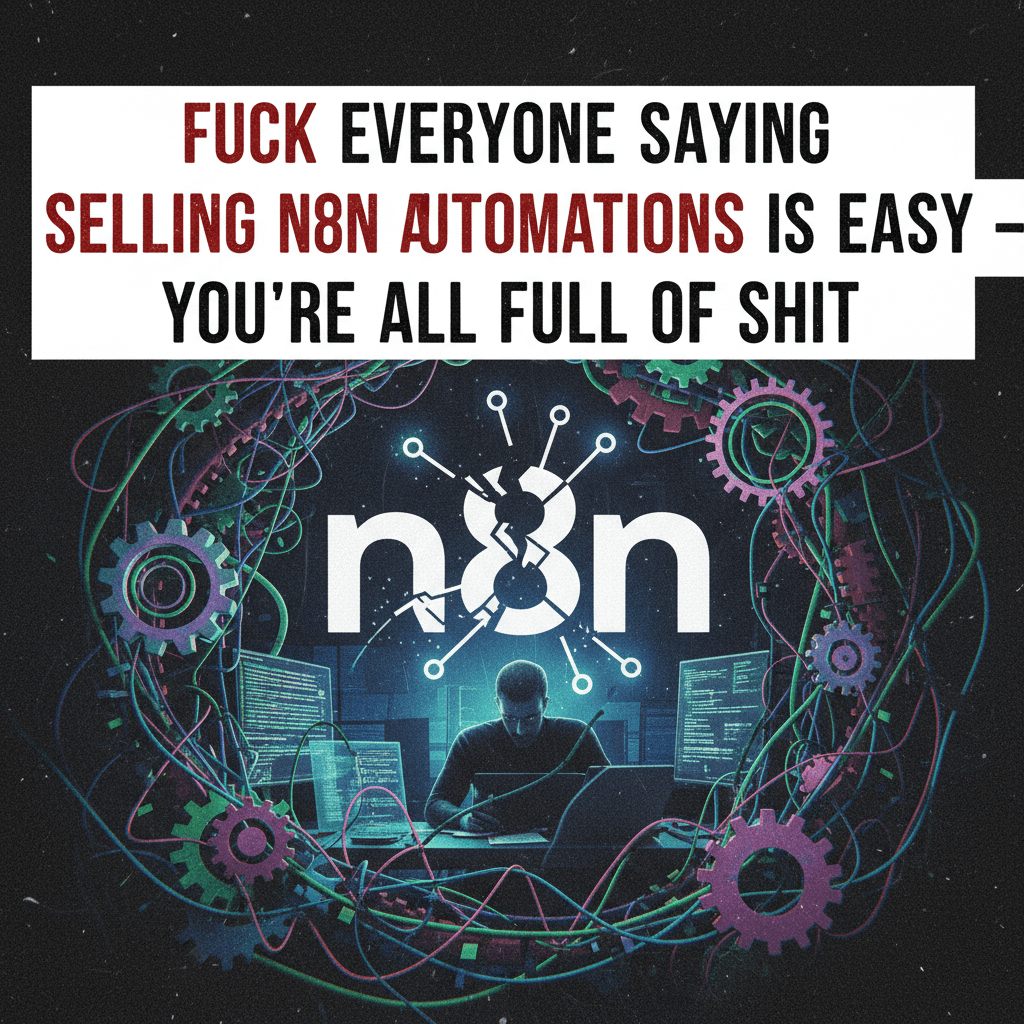
Discover actionable insights. If you’ve been lured into thinking n8n gigs sell themselves—quick scoping, quick cash, passive retainers—you’ve been sold a fantasy. The reality is messy, nuanced, and brutally practical. But if you’re willing to trade hot takes for hard process, there’s a repeatable way to win.
Here’s the story that woke me up.
Late Friday, a founder DMs me with “minor fixes” on an n8n setup someone else built. It was a thicket of HTTP Request nodes, scheduled triggers sniping third-party APIs every minute, a few clever Switch nodes, and zero error handling. They were syncing orders between a Shopify store, a 3PL, and their CRM. A promo blew up demand. One API throttled. A backoff wasn’t configured. Retries hammered the API harder. The workflow duplicated orders. A human fixed data by hand—twice. Monday morning, invoices were wrong and their CFO wanted heads.
That shop didn’t stop using n8n. They stopped trusting automation sellers who were sure “it’s all plug-and-play.” The data layer, reliability guarantees, and accountability had never been part of the conversation. The previous freelancer sold a diagram, not an outcome.
Fast forward: I took the job under a tight, accountable scope. Clear SLAs, explicit constraints, monitoring alerts, idempotency, and a runbook. No “wizardry,” no fragility. Just sober engineering with sales expectations set correctly. They paid more than the first build, gladly, because what they bought wasn’t a workflow—they bought less chaos.
If you want to sell n8n work consistently, stop selling magic. Start selling risk reduction, business outcomes, and speed-to-value you can stand behind. This article gives you the blueprint.
The reality behind the myth
Why “it’s easy” keeps going viral
Three reasons:
- Survivorship bias: People who stumbled into a perfect-fit client love to post the screenshots. You don’t see the half-finished builds they walked away from.
- Content economy: “I closed $10k in 3 hours” gets more likes than “I ran discovery, wrote a scope, de-risked dependencies, and delivered in 3 weeks.”
- Misplaced mental model: n8n is a toolkit, not a product. Toolkits are easy to demo and hard to operationalize.
The messy middle no one markets
- Ambiguity costs: Most buyers can’t articulate what they want beyond “connect X to Y.” Discovery is where you earn your money.
- Dependencies: Third-party APIs rate-limit, mutate payloads, or go down. Your workflow inherits every external quirk.
- Scale cliffs: A simple flow works at 100 events/day. At 10,000 events/day, it needs queues, idempotency, observability, and cost controls.
- Maintenance debt: If you don’t define ownership and patch cycles, you’re the on-call engineer forever—for free.
Consistent themes from real conversations
- Founders will pay a premium for predictability and clean handoff over raw speed.
- Ops leaders want control—clear runbooks, toggles, and routing rules they can understand.
- Engineering managers say “no” when you pitch “no-code magic,” and “yes” when you pitch reliable integrations with guardrails.
- Clients leave vendors who don’t explain constraints upfront. Honesty wins.
What buyers actually pay for
The job they need done
- Reduce manual work without breaking things: Make the monthly fire drill disappear. They’re buying their team’s time and sanity.
- Make data more reliable: One source of truth, fewer duplicates, fewer gaps, traceability when things go wrong.
- Move faster than IT queues: It’s not that they hate engineers; they hate waiting 6 months for a small integration.
- Control risk: Clear boundaries, fallbacks, and the comfort of knowing someone thought through failure modes.
Personas and how to pitch them
- Founder/GM: Speak revenue, cost, and speed. “We’ll reduce order processing time by 70% and cut errors to near-zero in 3 weeks.”
- Ops lead: Speak reliability and control. “You’ll get alerts on failures, a status dashboard, and a one-page runbook so your team can triage.”
- Engineering manager: Speak architecture and maintenance. “Queue mode, idempotency keys, rate-limited retries, structured logs, and staging workflows.”
Niches where n8n shines
- E-commerce ops: Order sync to 3PL, returns/refunds workflows, inventory reconciliation, fraud checks, proactive delay notifications.
- SaaS customer operations: Billing events to CRM, churn risk triggers, onboarding orchestration, usage alerts.
- Agencies: Lead routing, reporting pipelines, intake QA, onboarding checklists, client data normalization.
- B2B RevOps: Enrichment, deduplication, SDR routing, SLA alerts, renewal triggers.
Pick one. Specialize your copy, your demos, your case studies, and your discovery questions to that world. Generalists get ghosted; specialists get shortlists.
Scoping, pricing, and risk you can defend
Discovery that avoids surprises
Use this discovery checklist in your first call. If they can’t answer, that’s a sign you need a paid diagnostic.
- Process map: What triggers the workflow? What is the business outcome? What’s the happy path?
- Volume and variance: Daily/weekly event counts now and at peak. Seasonality. Batch sizes. Largest known payloads.
- Systems and constraints: APIs, rate limits, auth methods, max payload sizes, required headers, timeouts.
- Data integrity: Unique keys, idempotency requirements, update vs. create logic, dedup rules.
- Failure handling: What should happen on fail? Retry policy, manual review queue, escalation path.
- Non-functional requirements: SLA expectations, compliance needs (PII, GDPR), auditability, logging granularity.
- Ownership and maintenance: Who owns credentials? Who gets alerts? How often can workflows change?
Scope doc that closes deals
Minimum viable scope structure:
- Objective: One paragraph tied to a business metric. Example: “Reduce order fulfillment error rate from 3% to under 0.5%.”
- In-scope: Triggers, systems, nodes, key rules, and exactly what will be automated.
- Out-of-scope: Everything you are explicitly not doing now (advanced analytics, new API endpoints, edge-case transformations).
- Acceptance criteria: Clear pass/fail tests. Example: “For a 1,000-order synthetic batch, duplicate rate must be 0 and all retries must resolve within 10 minutes.”
- Assumptions: Access, API stability, available stakeholders, sandbox availability.
- Risks and mitigations: Rate limits, data anomalies, vendor downtime, change management.
- Timeline and milestones: Discovery, staging build, UAT, go-live, warranty period.
- Handover: Runbook, diagrams, credentials management, training session.
Pricing models that actually work
- Paid diagnostic (recommended): $500–$2,500 for a 1–2 week small engagement to produce a scope, architecture sketch, and fixed-fee estimate. Filters tire-kickers and funds thinking time.
- Fixed fee + warranty: $3,000–$25,000 depending on complexity. Include a 14–30 day warranty for bug fixes only. Changes in requirements trigger a change order.
- Retainer for ops and iteration: $1,000–$5,000/month for monitoring, improvements, and small change requests. Define response times and hours included.
- Hybrid: Lower fixed fee with a 3-month retainer commitment to handle the inevitable tweaks and optimizations.
Do not price purely by hours. Price by complexity, risk, and value. Use hours internally to protect margins, but sell outcomes.
Risk language to copy and paste
Steal and adapt this clause (not legal advice):
“This automation relies on third-party APIs (System A, System B). We will implement best-practice retries and backoffs. If upstream systems are unavailable or exceed published limits, executions may delay or pause. The agreed SLA excludes upstream downtime. We will notify designated contacts on failures and provide a manual recovery path documented in the runbook.”
Acceptance criteria examples
- Idempotency: Replaying the same webhook payload twice must not create duplicate records.
- Rate limiting: Under published API limits, the workflow must not error solely due to request bursts.
- Observability: On any failed execution, an alert with execution ID, payload summary, and error message must post to a specified Slack channel within 60 seconds.
- Throughput: Must process N events per hour in staging and production with baseline variance under X%.
Delivery that sticks (and scales)
Architecture patterns you’ll reuse
- Idempotency: Generate or extract a unique key (order_id, event_id). Before writing, check a store (e.g., a Data Store, external DB, or a marker in the target system) to avoid duplicate actions.
- Retries with backoff: Use n8n’s native retry or add Wait nodes for progressive backoff. Separate “retryable” (429, 5xx) from “fatal” (4xx validation) errors with IF/Switch nodes.
- Rate limiting: Throttle HTTP Request nodes with Sleep/Wait mechanisms, or batch using Split In Batches to keep below vendor thresholds.
- Queue mode for scale: For high throughput, run n8n in queue mode with Redis and multiple workers. Keep long-running tasks off the main instance.
- State handling: Use workflow static data for small state, but prefer external stores for cross-workflow coordination and audit.
Observability and support
- Error workflows: Configure an Error Trigger workflow to post concise alerts (execution ID, node name, error snippet, severity).
- Structured logs: Add Set nodes to attach metadata (order_id, customer_id, correlation_id) at entry so every log line is traceable.
- Dashboards: Build a lightweight status board (counts by status, last success, last failure, retry queue length) via a simple data store or connected BI.
- Replay strategy: Store failed payloads for reprocessing. Add a manual “Replay” workflow that accepts execution IDs.
Security and compliance basics
- Credentials: Use n8n credentials storage, never hardcode secrets in fields. Rotate keys. Limit scopes to least privilege.
- PII handling: Mask sensitive fields in logs and alerts. Don’t post raw payloads to Slack; send IDs and summaries.
- Environment separation: Keep staging and prod isolated. Separate credentials, separate databases.
- Backups and updates: Schedule database backups. Test n8n updates in staging before production.
Deployment and runbook
- Hosting: Choose n8n Cloud for speed or self-host with Docker, Postgres, and Redis for queue mode. Document the stack.
- Config: Use environment variables for the encryption key and config. Never commit them to repos.
- Migrations: Version workflows. Export before major changes. Keep a changelog.
- Runbook: One page: where to view executions, how to replay, who to contact, common errors, escalation path, maintenance schedule.
Handover that creates referrals
- Architecture diagram: Simple boxes and arrows with notes on rate limits and retry behavior.
- Configuration map: List of credentials, webhooks, environment variables, and where they live.
- Test cases: Example payloads and expected outcomes the client can run.
- Training session: 45 minutes to show them how to read logs, run replays, and toggle features.
Getting clients without burning out
Offers that convert
- Automation audit: Flat fee to review current workflows, identify risks, and propose a prioritized roadmap. Deliverables: risk scorecard, quick wins, estimate.
- Proof-of-value sprint: 1–2 weeks to build a narrow slice that proves the outcome (e.g., one trigger to one system with retries and alerts).
- “Fix and harden” package: For teams with existing n8n sprawl. Scope: error handling, idempotency, logging, runbook, training.
Lead sources that aren’t a lottery
- Niche content: Post teardown threads: “How we reduced refund errors 90% for a DTC brand with n8n.” Show diagrams, metrics, before/after.
- Partner ecosystems: Agencies, niche SaaS vendors, and fractional ops leaders need reliable automation partners. Offer white-label support.
- Communities: Be helpful in forums and Slack groups. Share small, practical fixes. People remember who solved their 2 a.m. problem.
- Customer success teams: They see broken workflows first. Teach them a checklist; they’ll send you work.
Sales calls that feel like consulting
Use this flow:
- 5 minutes: Context. “What breaks today? What’s the impact?”
- 10 minutes: Map the flow at a high level. Boundaries, systems, owners. Identify assumptions.
- 10 minutes: Risk talk. Rate limits, failure modes, monitoring. Show you’re a safe pair of hands.
- 5 minutes: Next step. Paid diagnostic or small proof-of-value with timelines and price.
Simple outreach template
Subject: Cut order errors and late shipments without adding headcount
Hey [Name],
Noticed [Company] handles [orders/clients] across [systems]. I specialize in hardening n8n workflows so ops teams cut manual fixes and avoid “where did this record go?” moments.
Typical quick win in 2 weeks: add retries, idempotency, and alerts to your [X -> Y] sync so failures are auto-recovered or flagged with context.
Happy to run a fixed-fee audit and give you a prioritized plan + estimate. If there’s no ROI on paper, you don’t move forward.
Worth a 15-minute call?
[You]
Case study skeleton
- Problem: Volume doubled, system rate-limited, duplicates surged.
- Approach: Queue mode, idempotency keys, backoff, error alerts, runbook.
- Outcome: 93% reduction in manual fixes, 0 duplicates in UAT, on-call time cut by 80%.
- Quote: One sentence on predictability and peace of mind.
30-day action plan
- Week 1: Pick a niche. Publish a one-page offer. Reach out to 25 buyers with the template.
- Week 2: Deliver a low-risk audit to your warmest lead. Turn the findings into a public teardown (scrub details). Build a small demo workflow that highlights retries and alerts.
- Week 3: Close 1 proof-of-value. Define acceptance criteria. Ship a status dashboard and runbook.
- Week 4: Convert to fixed-fee build + 3-month retainer. Ask for a case study and two intros.
Key takeaways from real discussions
- Buy trust, not tricks: Clients reward honesty about constraints and clear risk plans.
- Paid discovery filters noise: If they won’t pay small to think big, they won’t pay big to ship.
- Process beats heroics: Idempotency, retries, and runbooks close more deals than fancy nodes.
- Niche wins: Speak the client’s language and your close rate jumps.
- Handover is marketing: Great documentation creates referrals and retainers.
Actionable, concrete checklists
Pre-sale checklist:
- Confirm volumes, rate limits, and peak windows.
- List every system and owner. Confirm access.
- Draft acceptance criteria and share it early.
- Propose a paid diagnostic with deliverables and price.
Build checklist:
- Add idempotency checks on every write action.
- Separate retryable and fatal errors with branching logic.
- Set up an Error Trigger workflow to alert with context.
- Mask PII in logs and alerts. Keep raw payloads in a safe store.
- Test in staging with synthetic load and edge cases.
Handover checklist:
- Provide a one-page runbook and a short training call.
- Deliver test payloads and replay instructions.
- Document credentials locations and rotation schedules.
- Propose a maintenance retainer with clear scope and SLAs.
Common pitfalls and how to avoid them
- Scope creep via “just one more rule”: Freeze scope, batch changes, and sell a phase 2.
- Ghosted after proposal: Include two options (fixed + retainer, or diagnostic), a timeline, and a specific start date. Give them a reason to decide now.
- Build that doesn’t scale: If volumes are unknown, design for burst: batch, queue, backoff. Make it easy to swap in queue mode later.
- Support becoming free labor: Warranty bug fixes only. Changes and new features go to retainer or change order.
n8n-specific patterns clients love hearing
- Error-first design: “Every workflow has an Error Trigger that alerts with a correlation ID and a replay link.”
- Safe-by-default: “We gate writes behind idempotency checks and keep a marker store to prevent duplicates.”
- Observability: “We log key metadata at entry and attach it to every node that touches the payload.”
- Staged rollouts: “We ship in ‘shadow mode’ to record outcomes before cutting over.”
A simple example architecture to explain
For an order sync:
- Trigger: Webhook from e-commerce platform with order_id and event type.
- Enrichment: HTTP Request to fetch full order details when payload is partial.
- Idempotency: Lookup in a store using order_id + action; skip if processed.
- Routing: Switch on event type (create/update/refund).
- Write: HTTP Requests to downstream systems with guarded retries and backoff.
- Logging: Set node to append correlation_id and status at each stage.
- Error path: IF branch for non-retryable errors to send a human-friendly Slack alert; retryable errors go through Wait/Retry loop.
- Completion: Mark processed with timestamp and version for audit.
Metrics to report that make you indispensable
- Mean time to recovery (MTTR): How fast failures are detected and resolved.
- Duplicate rate: Should be zero; report it.
- Throughput vs. target: Events/hour with trend lines.
- Manual interventions: Count and reduce over time.
Turn delivery into growth
- At handover, ask for a quote on the business result, not the tech.
- Offer a quarterly tune-up package: update nodes, review logs, address drift.
- Teach the client how to request changes—form fields, impact, priority. Better requests mean faster turns and happier clients.
Call to action
You don’t need a bigger promise; you need a tighter process. This week, pick one of your in-flight or recent projects and do three things:
- Draft a one-page runbook and share it with the client. Ask them who should be on alerts and what hours matter.
- Add or verify idempotency and error alerts on your highest-risk workflow. Prove it with a quick video.
- Turn that into a public teardown (scrub details) and send it to five people who could benefit. Offer a paid diagnostic with a clear deliverable.
Then stop selling “easy.” Start selling reliable, measurable outcomes with a straight face and a solid scope. That’s how you win the deal, keep the client, and sleep through the night. If you want help pressure-testing a scope or refining your offer, book a short call, bring a real scenario, and let’s architect something you can defend in front of a CFO and ship in the real world.
Where This Insight Came From
This analysis was inspired by real discussions from working professionals who shared their experiences and strategies.
- Source Discussion: Join the original conversation on Reddit
- Share Your Experience: Have similar insights? Tell us your story
At ModernWorkHacks, we turn real conversations into actionable insights.
![[Workflow Included] A simple 5-node Instagram posting workflow for beginners](https://modernworkhacks.com/wp-content/uploads/2026/04/workflow-included-a-simple-5-node-instagram-posting-workflow-for-beginners-1024x675.png)



0 Comments