Hook: Discover actionable insights.
The morning we almost pulled the plug
It was a Tuesday we still reference by name. The calendar was packed with client calls, the pipeline spreadsheet was an optimistic green, and our bank balance gave us a 5.5-month runway. Still, the three of us had the same thought at the same time: are we pushing this boulder up the wrong hill?
The previous week we had lost a deal we were certain would land. We had bet a month of work on a proposal that was technically flawless and emotionally forgettable. We were busy, but not advancing. That morning, before the first call, we sat down and said the quiet parts out loud. If we were going to keep going, we needed to make the business smaller and sharper. We needed to stop trying to look big, stop talking to “the market,” and start serious conversations with specific people about specific problems.
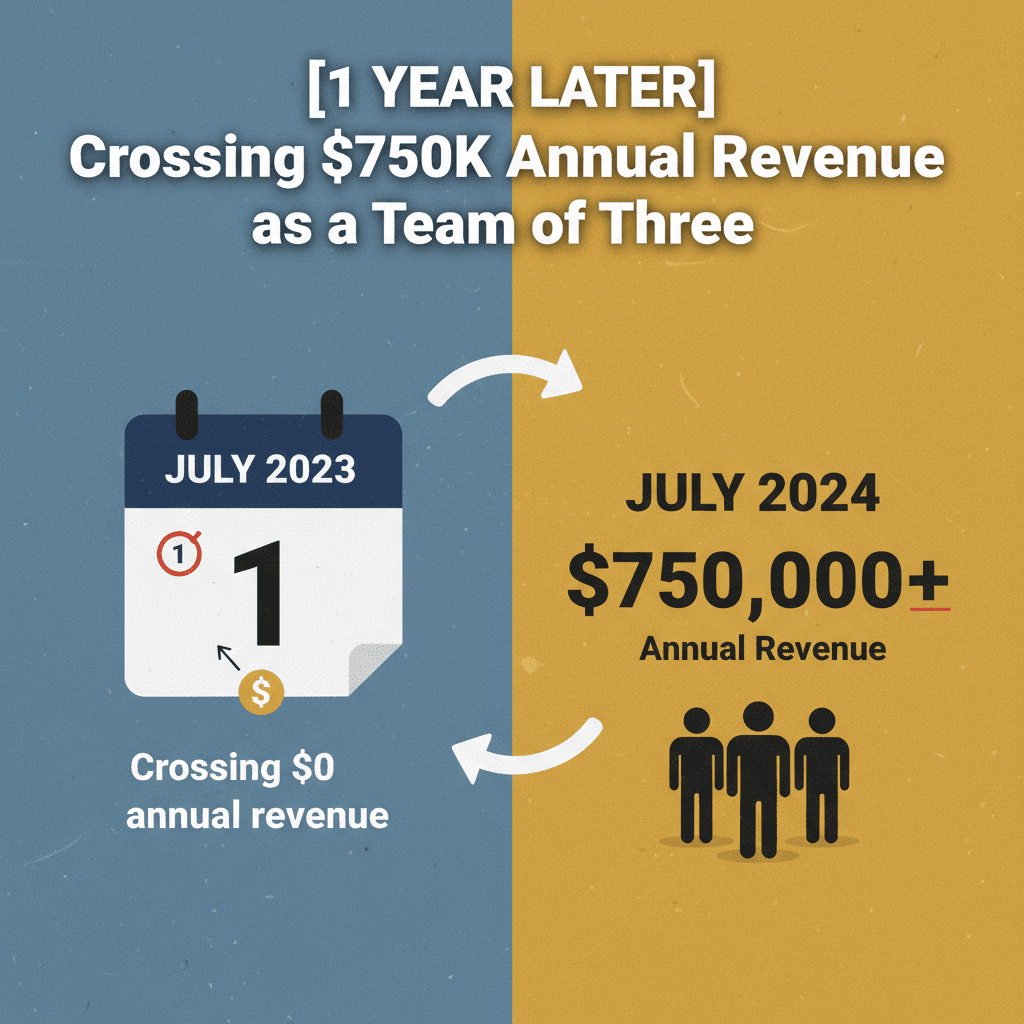
Within that hour, we scrapped the home page, pulled our “offer stack” doc into a single one-pager, and wrote an email to seven people who fit a clear pattern: operators with ownership, wrestling with a painful, measurable bottleneck we could remove in under six weeks. No splashy threads, no public announcements, no ad spend. We sent those seven emails and got five replies. Two turned into paid discovery. One became a pilot. Three months later, that pilot transformed into our first six-figure annual relationship. Twelve months later, we closed the year at $758,400 in revenue as a team of three, without promoting in public.
The point of the story is not heroic persistence. It’s a quieter lesson: constraints can become the strategy. We had limited time, limited attention, and no appetite to become content creators. So we built a growth engine that did not require virality or paid acquisition. We built it out of conversations, clarity, and compounding delivery. The playbook that follows is a summary of what we did, what we learned from real discussions with buyers and peers, and what you can apply this month.
Key takeaway from real discussions: When we stopped asking “how do we get more awareness?” and started asking “what would make this a yes for one person this week?” people told us exactly what to build, how to price it, and how to deliver it. The signal was always in the room—just quieter than the noise.
What $750k looks like for a team of three
The simple math behind the number
We did not invent new math. We did redefine our units. The year broke down roughly like this: recurring retainers (about 60%), defined-scope projects (about 30%), and a small slate of experiments (about 10%) that became our pipeline for future offerings. The change that unlocked stability was treating everything as an outcome with a clock. We only sold outcomes we could deliver in under six weeks, renewed in rolling increments, and spoke in terms of business impact—not deliverables.
On any given week, our capacity was about 120 person-hours. We set a firm threshold: no more than 70% of the team on delivery, 15% on pipeline, 10% on internal assets, and a 5% buffer for the chaos tax. That simple discipline forced choices. It also made work lighter, better, and faster.
Roles that overlap on purpose
We did not have formal titles. Practically, we had three seats: customer outcomes, systems and scale, go-to-market and partner orchestration. Each person owned a lane and maintained a secondary skill that overlapped with someone else’s primary. That way, vacations and spikes didn’t break us. The unsexy truth: stable businesses are built on redundancy, not heroics.
Pricing and scope that protect the team
We stopped pricing time. We priced confidence. A typical package had three parts: a high-trust diagnostic, a timeboxed first outcome, and clearly defined optional layers. We used “points” for internal capacity planning but never mentioned them externally. The quote fit on one page. The cancellation clause fit on one line. Because we weren’t flooding the top of the funnel, every conversation had to count—and simplicity does the heavy lifting.
Key takeaways from real discussions with buyers:
- “We don’t need everything. We need one thing to work by a date.” Translate scope into a calendar and a single success metric.
- “If I can’t explain it upward in two sentences, I can’t buy it.” Write your proposal so your champion can resell it without you.
- “I’m afraid of being trapped.” Make off-ramps clear and painless; safety accelerates yes.
- “We’ve been burned by fancy frameworks.” Lead with proof of velocity and real examples; frameworks are seasoning, not the meal.
The scoreboard we used
We tracked five things weekly:
- Number of high-intent conversations booked (target: 3 per founder per week)
- Average time-to-first-value in days (target: under 14)
- Renewal/expansion rate by quarter (target: 80%+)
- Asset reuse rate across clients (target: 50%+ of deliverables templated)
- Unplanned work ratio (target: under 10% of weekly hours)
By watching the right numbers, we felt less compelled to chase the wrong ones. Annual revenue is a trailing signal. Leading signals—conversations, velocity, reusability—told us whether the engine was compounding.
The no-promo growth engine: conversations over campaigns
Why we chose not to promote
We tried the usual: content calendars, scheduled threads, a brand-new newsletter. It diluted our energy and created a second business. The day we stopped “promoting,” we started allocating that time to deliberate conversations. That didn’t mean hiding. It meant putting our point of view in front of people already living the problem, one room at a time.
Where the conversations came from
- Warm intros from happy clients who understood our one-sentence promise
- Peer groups, operator dinners, and invite-only Slack communities where we showed up to be helpful, not to pitch
- Former colleagues who had moved into new roles and needed a quick win
- Adjacent partners (agencies, consultants, fractional leaders) who wanted to look good by bringing us in
- Past prospects who had said “not now” and appreciated a specific check-in with a smaller, faster option
The message that worked
We distilled our promise into a “razor statement”—one line that eliminated ambiguity:
“We help ops-led teams remove one revenue bottleneck in six weeks or less, with a pilot that pays for itself or you walk away clean.”
Every word earned its place. “Ops-led” told people who we serve. “One bottleneck” constrained scope. “Six weeks” set the clock. “Pilot” lowered risk. “Pays for itself” set an outcome. “Walk away clean” made safety explicit. When we used this line, rooms leaned in. When we didn’t, rooms drifted.
How we ran the calls
Our first conversations followed a simple cadence:
- Context in five minutes: where revenue is stuck and why now
- Bottleneck mapping in ten minutes: what is the smallest lever with the biggest lift
- Feasibility in five minutes: what makes this hard and what gets it unblocked
- Offer in three minutes: the exact pilot, dates, and decision criteria
- Debrief in two minutes: “What would make this a no?”
We never shared screens in the first call. We took notes on outcomes, not artifacts. We asked permission to summarize in a one-pager within 24 hours. That one-pager did more selling than any deck we had ever made. It included a calendar, a cost, and a definition of done. No fluff.
What buyers told us behind closed doors
Key takeaways from real discussions:
- “I don’t need education. I need a safe way to say yes.” Safety beats persuasion. Put a cap on cost, time, and scope. Offer a reversible path.
- “Your specificity made me think you’ve done this before.” Specific promises signal competence. Vague promises signal risk.
- “You listened for constraints, not just goals.” Mirroring constraints builds trust. Repeat back exact numbers, dates, and guardrails.
- “I forwarded your one-pager to my CFO; they liked the exit clause.” Write for the invisible stakeholders. They decide deals you never see.
Referrals without asking for favors
We built a partner flywheel that felt like service, not extraction:
- After a successful pilot, we sent a three-slide “how to tell this story” summary our champion could share. It made them look good and made referrals easy.
- We created a private “problem index” and matched clients to complementary partners. We made intros without asking for reciprocation; reciprocity followed anyway.
- We hosted a quarterly small-room session for five operators on a single topic (e.g., “Cutting time-to-value in half”). Zero sales. Those rooms birthed our best deals.
Without public promotion, our calendar stayed predictably full. The engine wasn’t loud, but it was reliable—and reliability allowed us to plan.
Actionable takeaways
- Write your razor statement. Remove adjectives. Add a clock. Add a safety mechanism.
- Replace your deck with a one-page pilot plan: calendar, outcome, price, exit.
- Book three conversations a week through warm channels and peer rooms. Track conversion to paid discovery, not to closed-won.
- Make a partner list of 12 who serve your buyer before or after you. Send them a “how we make you look good” note with concrete examples.
- Design a reversible pilot and rehearse the “walk away clean” line until it feels natural.
Delivery that compounds: systems, scope, and sanity
Time-to-value beats everything
Our happiest clients had one thing in common: they saw visible progress in the first 10 business days. That meant we front-loaded demonstrations of value. We shipped a diagnostic artifact on day three, a first working slice on day seven, and a measurable impact on day ten. The artifact was often simple—a dashboard that finally answered a nagging question, a checklist that made handoffs clean, or a workflow that eliminated two manual steps. Small wins buy big trust.
Definition of done and error budgets
We wrote a “definition of done” for every promise. It fit on one screen and answered three questions:
- What will exist that does not exist now?
- How will we know it works (including edge cases)?
- What is explicitly out of scope for this phase?
We paired it with an error budget: a pre-agreed tolerance for defects or misses. By naming imperfection upfront, we created a shared language for trade-offs. That kept us away from scope creep and toward momentum.
Templates, then tools
We resisted buying our way out of problems. First, we templated repeatable work: kickoff agendas, testing checklists, data mapping sheets, handover scripts, post-mortem guides. Only then did we decide whether a tool would improve speed or quality. This sequence mattered: a mediocre process with a new tool becomes an expensive mediocre process. A tight process plus a simple tool creates leverage.
The 6x rule for reusable assets
If something would help at least six clients, we invested in turning it into a reusable asset. Not everything needed polish; many assets lived as rough internal playbooks. But we always asked, “Will we want to reuse this?” If the answer was yes, we made the next time easier: variables, checklists, examples, defaults.
How we stayed sane
None of this works if you burn out. We set hard edges around our calendar: no late-night firefights, standard working hours, and a weekly “no meeting” half-day for deep work. We also built in a Friday debrief ritual that took 30 minutes and saved us hours the following week. The agenda never changed: what moved, what didn’t, what we learned, what we’ll test next.
What clients admitted later
Key takeaways from real discussions:
- “You told us what not to do.” Saying no to “just one more thing” increased trust. Boundaries prove you’re protecting the outcome, not your billable hours.
- “You moved before everything was perfect.” Shipping working progress beat long waits for polish. Transparency trumped theatrics.
- “Your handovers felt like upgrades.” We gave clients clear, navigable assets they could run without us—ironic, maybe, but it created more demand.
Actionable takeaways
- Create a definition-of-done template. Use it on every promise. Share it before you start.
- Front-load visible progress: commit to one artifact on day three and one measurable improvement by day ten.
- Adopt the 6x rule. If an asset will help six clients, invest in making it reusable this month.
- Schedule a Friday 30-minute debrief. Ask the same four questions every week and decide one experiment for the next week.
- Write your “not doing now” list at kickoff. Show it to the client. Keep it updated.
Your next 30 days: turn insights into revenue
Week 1: Sharpen the point of view
- Write your razor statement. Make it one sentence. Aim for painful specificity and a clock.
- Design a reversible, six-week pilot with a single, measurable outcome. Price it so it can “pay for itself” in a reasonable, conservative scenario.
- Create your one-pager template: calendar dates, definition of done, price, exit clause, and optional expansion path.
- List 15 people you can help right now (past clients, peers, operators you’ve met). Draft individualized emails that reference their real constraints and offer a pilot conversation.
Week 2: Book and run conversations
- Schedule at least six calls from your list. Keep them tight and focused on constraints.
- Practice your five-part call cadence. Don’t share screens. Take notes on outcomes and constraints.
- Send a one-pager within 24 hours of each call. Ask, “What would make this a no?” to surface hidden blockers.
- Invite one partner to a joint working session where you solve a small problem live for a prospect. Make them look excellent.
Week 3: Deliver visible progress
- For any accepted pilot, ship your day-three artifact. Create a feedback loop with a single question: “Is this obviously moving the needle?”
- Track your time-to-first-value. Trim anything that does not accelerate it. Push polish to later phases.
- Template one repeatable checklist or playbook you’ve used twice this month. Add variables and examples. Store it where you can find it.
- Host a small-room session with four operators on a concrete topic tied to your promise. Zero slides. Show a live example.
Week 4: Compound and reflect
- Measure leading indicators: conversations booked, conversion to paid discovery, time-to-first-value, asset reuse rate, and unplanned work.
- Write one internal page: what you learned from real discussions. Include exact phrasing clients used. Refine your razor statement accordingly.
- Document a renewal/expansion path for each live pilot. Determine the next concrete outcome and the simplest way to get there.
- Send your champion a “how to tell this story internally” summary. Offer to join their internal pitch if helpful, but make them look strong either way.
What to keep doing if it works
- Protect the calendar blocks that generated conversations. Treat them like non-negotiable client work.
- Invest in assets that reduce time-to-value and increase reuse. Defer tool purchases until the process proves it needs them.
- Say no when a request jeopardizes velocity or clarity. Clients will test your boundaries; every no strengthens your yes.
- Keep the business smaller than your appetite. It is easier to add scope than to recover trust.
Call to action: Choose one bottleneck you can remove for one person in the next six weeks. Send the email today. Then build your engine around that yes. If you want a nudge, reply to three people you trust with your one-sentence promise and ask, “Does this make you think of anyone specific?” Your next year won’t be built by promotion—it’ll be built by precise conversations, delivered outcomes, and compounding trust.
Where This Insight Came From
This analysis was inspired by real discussions from working professionals who shared their experiences and strategies.
- Source Discussion: Join the original conversation on Reddit
- Share Your Experience: Have similar insights? Tell us your story
At ModernWorkHacks, we turn real conversations into actionable insights.
![[Workflow Included] A simple 5-node Instagram posting workflow for beginners](https://modernworkhacks.com/wp-content/uploads/2026/04/workflow-included-a-simple-5-node-instagram-posting-workflow-for-beginners-1024x675.png)




0 Comments