
Discover actionable insights.
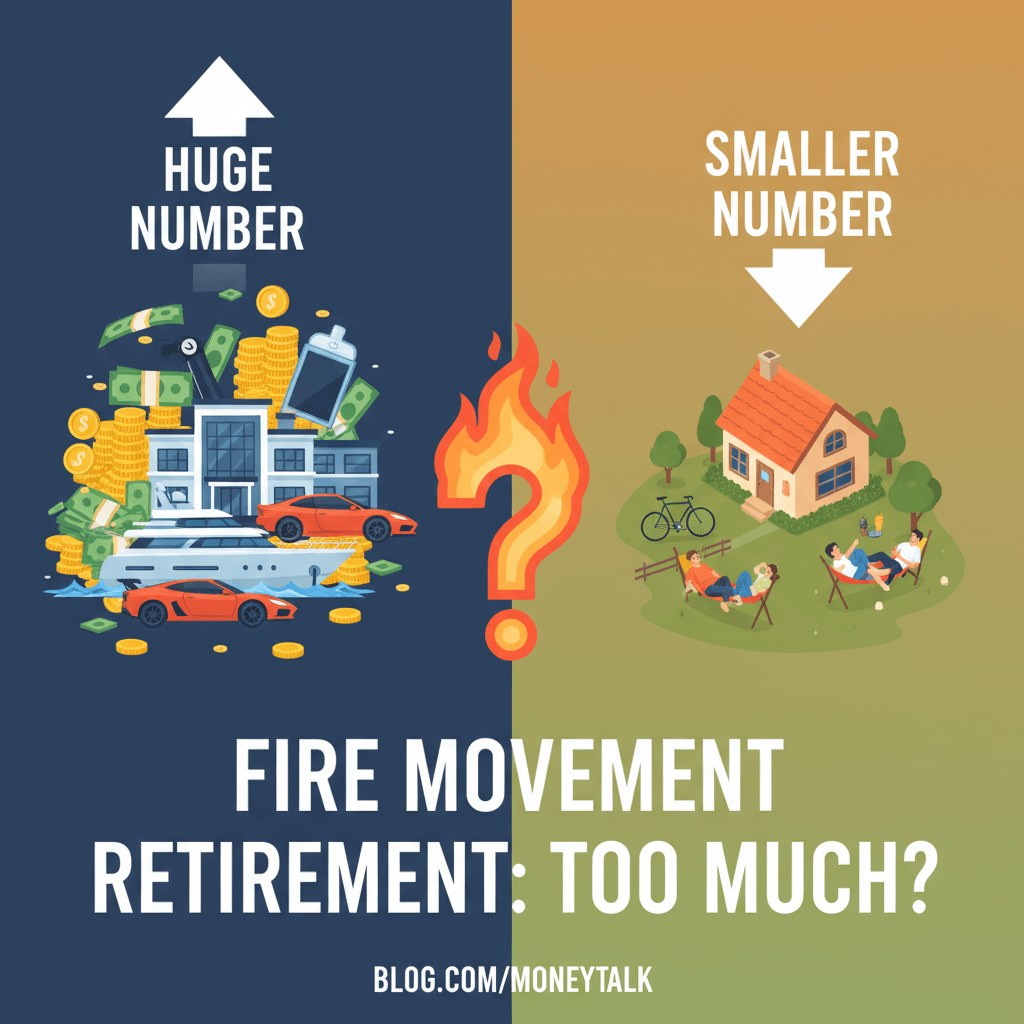
Maya and Luis used to joke that their relationship began with compound interest. They met at a community investing class, bonded over a spreadsheet that modeled mortgage payoffs, and eventually fell in love over cheap tacos and the dream of a work-optional life by age 45. The plan was simple: save 25 times their annual spending, invest in a diversified portfolio, and draw 4% a year forever. They accepted that “the number” was almost sacred in FIRE circles—a rite of passage that separated dabblers from the committed. They hustled, trimmed expenses, negotiated salaries, and raced toward a goal that occasionally felt like a distant mountain that receded as they approached it.
But a few things kept nagging at them. First, their spending wasn’t static—the early years were heavy on travel and home projects, while later years would likely calm down. Second, Maya had a flexible consulting skillset that could reliably produce a few thousand dollars each month without much effort. Third, health insurance costs seemed to be the biggest wildcard, but also something they could estimate more clearly than they were told. They realized something subtle yet profound: the much-revered “25x” wasn’t a law of physics. It was a shorthand, helpful but blunt.
A meeting with their retired neighbor catalyzed the re-think. He had worked three years longer than he needed to after the 2008 crash because, as he put it, “the plan wasn’t the problem—my nerves were.” He showed them how his spending naturally declined after a high-energy first decade, how he used a cash buffer and guardrails to adapt withdrawals instead of sticking to a fixed percentage, and how Social Security was a far more useful floor than his younger self had believed.
Inspired, Maya and Luis went back to their numbers. They split their budget into core needs and flexible wants. They modeled “bridge work”—Maya’s occasional contracts—for five years. They priced health insurance across income levels and planned around subsidy cliffs. They ran what-if scenarios: a bear market in year two, a roof replacement in year five, a parent needing support in year ten. By the end, their “number” was lower than the original 25x—if they stayed flexible. But it was also higher than they first hoped if absolutely everything had to be funded from their investments with zero wiggle room.
They discovered a more useful truth: the modern FIRE movement doesn’t always overestimate or underestimate how much is needed. It does, however, often mis-specify it. One-size-fits-all rules obscure the fact that your life isn’t a study, and your spending isn’t a straight line. The best plan isn’t a single number—it’s a right-sized range backed by practical levers you can pull when reality shifts.
This article distills that lesson into concrete steps and hard-won insights pulled from real conversations, forums, and the lived experiences of people who have actually retired early. You’ll leave with a clear view of where the big numbers come from, when they are too conservative, when they’re not conservative enough, and exactly how to tailor them to your life.
The big FIRE number: what it is and what it hides
The “25x annual expenses” heuristic and its sibling, the “4% rule,” trace to research that examined historical withdrawal rates for portfolios across 30-year retirements. In the shorthand: if you withdraw 4% of your initial portfolio in year one and adjust that amount for inflation each year, a balanced stock-bond portfolio survived most historical periods. In math-speak, that produced a minimum “safe withdrawal rate” across observed history. In everyday FIRE speak: save about 25 times your expected annual spending, because 1 divided by 0.04 equals 25.
This is powerful, but it also bakes in assumptions that don’t always match early retirees:
- Time horizon: The original work focused on ~30-year retirements. Early retirees may need 40-60 years, which changes sequence-of-returns risk and the required margin for error.
- Market regime and geography: The results heavily reflect a U.S.-centric, 20th-century dataset. Valuations, interest rates, and inflation dynamics shift over time and across countries.
- Constant real spending: The model assumes you increase spending by inflation each year no matter what. Real households don’t behave like that—spending often flexes and tends to follow a “retirement spending smile,” with higher spending early, lower in mid-retirement, and some increase later on health and assistance.
- Fixed asset allocation and rules: The rule assumes a largely fixed stock-bond mix and a mechanical inflation adjustment. Many retirees vary their allocation, withdrawals, or both.
- No added income: The model ignores partial income, consulting, rental cash flow, or Social Security—factors that often arrive over time and materially change the required portfolio size.
What the “25x” heuristic gets right is a sense of scale: financial independence for most households is not five times spending, it’s a much larger multiple. But what it often hides is more important:
- One number is not a plan: A robust plan identifies the floor you must protect, the spending you can flex, the levers you can pull, and the risks you must insure or buffer.
- Sequence-of-returns risk isn’t average risk: Retiring into a bad first decade can damage a portfolio even if average returns later are fine. Managing early withdrawals dynamically matters.
- Taxes and health insurance are design variables: Your marginal tax rate and premium subsidies change with how you draw income. Good design can shrink the required gross withdrawals.
- Human capital doesn’t vanish on “retirement day”: Many early retirees continue light, optional work. Even a little income dramatically reduces the needed portfolio in practice.
Bottom line: the big number is a starting point, not a finish line. Treat it as a range you refine with better assumptions about your life.
Five reasons the target might be too high for you
Is the modern FIRE movement too conservative? For many, yes—especially when their plan assumes no flexibility, no extra income, and a fixed withdrawal that rises with inflation regardless of markets. Real households have levers, and using them safely can shrink the headline “number.” Here are five reasons your target may be higher than necessary, plus what to do about it.
1) Spending isn’t linear—and you control more than you think
Retirement spending often peaks in the first 5-10 years (travel, hobbies, home projects), declines in mid-life, and nudges up later for health and assistance. If you plan to flex discretionary categories during market drawdowns, your sustainable withdrawal rate can be higher than the strict 4% rule assumes.
- Define a floor budget (non-negotiables: housing, food, utilities, basic transport, insurance, minimal healthcare).
- Define a flex budget (travel, dining, upgrades, gifts, elective projects) that you’ll trim 10-30% when markets are down.
- Build a cash buffer of 12-24 months of floor spending to avoid selling assets in bad years.
Actionable takeaway: Test your plan with a dynamic withdrawal method that cuts back after negative returns instead of raising by inflation automatically. Many find they can start closer to 4.5-5% when they allow flex spending, especially with a cash buffer.
2) Work-optional beats work-never
Many who “retire early” still earn occasional income: tutoring, consulting, seasonal work, creative gigs, or part-time roles with benefits. Even $10,000-$20,000 per year for a few years after leaving full-time work can reduce the needed portfolio by several hundred thousand dollars.
- Identify your easy-income skill that earns with low stress and flexible hours.
- Model a bridge period of 3-5 years of light income to soften the early sequence risk.
- Consider benefits-focused part-time work to stabilize healthcare without inflating your number.
Actionable takeaway: Add a “what if I earn $1,000-$2,000 per month for 24-36 months?” scenario. You might be far closer to work-optional than your 25x target suggests.
3) Social Security and pensions are floors, not afterthoughts
For many households, later-life income from Social Security or a small pension covers a meaningful slice of core needs. Ignoring it in the headline number forces the portfolio to overfund decades it won’t need to fully carry.
- Estimate benefits at multiple claim ages and plan to delay for higher lifetime payments if your portfolio fills the early gap.
- Treat guaranteed income as a liability match to core expenses, then fund only the gap with your portfolio.
Actionable takeaway: Calculate “FI to age 70” and “FI for life” separately. A bridge strategy may reduce your required initial portfolio significantly.
4) Geographic and housing choices change the math
A paid-off home, moving to a lower-cost region, house hacking, or choosing a smaller footprint can permanently reduce your core needs. FIRE calculators that assume fixed housing costs at today’s level can quietly overstate lifetime spending.
- Decide whether you prioritize owning free and clear before full FI to reduce non-negotiable housing costs.
- Explore geo-arbitrage for 2-5 years to accelerate savings or ease early withdrawals.
Actionable takeaway: Re-run your plan with a “mortgage paid off” scenario and a “lower-cost-of-living” scenario. The shift in the target may surprise you.
5) Smart tax design reduces the gross you must withdraw
Retirement is often a lower marginal tax period. By spreading Roth conversions, harvesting capital gains in the 0% bracket, and sequencing accounts thoughtfully, you may need fewer gross dollars to create the same after-tax spending.
- Map a decade-long tax plan with brackets, conversions, and gain harvesting on a calendar.
- Use tax-efficient withdrawal sequencing to fill low brackets and avoid cliffs.
Actionable takeaway: Run after-tax, not pre-tax, spending models. The difference can shrink your required portfolio by a meaningful margin.
When FIRE targets are too low (and how to fix the plan)
There’s another side to the story. Some plans underestimate what’s needed—particularly when they gloss over healthcare, longevity, and concentrated risks. If your strategy assumes perfect markets, perfect health, and perfect discipline, you may be courting regret. Here’s where caution is warranted and what to do about it.
Healthcare: your biggest wildcard
For early retirees, premiums, deductibles, and out-of-pocket costs can vary widely with income and location. Underestimating these by a few hundred dollars per month can become a structural gap that compounds over time.
- Price plans across multiple income targets to see how subsidies change.
- Include realistic out-of-pocket maximums for at least a few bad years in your projection.
- Plan for the transition to Medicare, including potential premium surcharges tied to income levels.
Actionable takeaway: Put healthcare in its own line item with upside scenarios and test your plan at those higher costs. If the plan only works at the cheapest estimate, it isn’t robust.
Longevity and sequence risk over 40-60 years
Early retirement stretches the horizon. Even if average returns are fair, a negative early sequence can strain the portfolio. Long horizons also encounter regime changes: inflation spikes, valuation resets, and multi-decade interest rate shifts.
- Adopt a dynamic withdrawal policy with guardrails that reduce spending after poor returns and allow raises after strong ones.
- Hold diversified assets across stocks, high-quality bonds, and inflation hedges such as TIPS to cushion different regimes.
- Maintain a cash reserve to avoid forced selling during downturns.
Actionable takeaway: Stress-test your plan with a bad first five years, then normal returns. If you need to cut to the bone to survive that, rethink your start date or add a short period of bridge income.
Underrated big-ticket expenses
Roof replacements, HVAC, aging vehicles, family support, and long-term care for you or a parent rarely fit neatly into monthly budgets. They arrive as lumpy shocks.
- Create a capital reserve schedule for home and car replacements over 20 years.
- Budget for family contingencies (support, relocation, caregiving travel).
- Consider insurance and risk transfer where appropriate: umbrella liability, long-term care strategies, and adequate homeowners coverage.
Actionable takeaway: Add a “lumpy spending” fund separate from your core budget. If your plan only works without ever replacing a roof, it doesn’t work.
Policy and tax risk
Tax brackets, healthcare rules, and benefit formulas evolve. A plan that skates right on the edge of a subsidy cliff or assumes static taxes for decades has fragile foundations.
- Avoid plans that depend on single-point assumptions at cliffs; build slack into those thresholds.
- Use scenario ranges for taxes and benefits in your long-range model.
Actionable takeaway: Introduce a “policy drift” scenario that trims benefits, lifts taxes modestly, or reduces subsidy generosity. If your plan remains viable, you’ve increased its resilience.
Right-sizing your number: a practical blueprint
Rather than arguing whether 25x is too high or too low, build the number that fits your life. Use this step-by-step process to convert rules-of-thumb into a customized, flexible plan with built-in defenses.
Step 1: Separate floor from flex
- List core needs that define a dignified life: housing, food, utilities, basic transportation, healthcare, insurance, and minimal connectivity.
- List flexible wants: travel, dining, upgrades, hobbies, charitable giving above a baseline, and elective projects.
- Target a floor you will protect in all markets and a flex budget you’ll dial down 10-30% during downturns.
Step 2: Map guaranteed and likely income
- Estimate Social Security or pension payments at multiple ages; choose a claim strategy that maximizes lifetime and survivor benefits.
- List probable optional income (consulting, part-time, rentals) for the first 3-5 years to reduce early sequence risk.
- Identify benefits-driven work options that stabilize healthcare if needed.
Step 3: Price healthcare precisely
- Obtain quotes at various modified adjusted gross income levels to see how premiums and subsidies change.
- Model out-of-pocket maximums for at least several years and include dental/vision if relevant.
- Include a separate long-term care strategy (assets earmarked, insurance, or family plan) rather than ignoring the risk.
Step 4: Tax-aware withdrawal sequencing
- Create a 10-year conversion and withdrawal calendar that fills lower tax brackets with Roth conversions when wage income drops.
- Coordinate withdrawals to manage brackets, capital gains rates, and benefit-related cliffs.
Step 5: Choose your withdrawal rule
- Constant inflation-adjusted: Simple but rigid; useful as a baseline, often conservative if you’re flexible.
- Guardrails (dynamic): Start at a reasonable rate (e.g., 4.5%), cut withdrawals after poor returns, and raise after strong periods within predefined bounds.
- Flexible “floor-and-flex”: Fund the floor with stable assets and guaranteed income, flex the rest with market performance.
Step 6: Build buffers, not just bigger numbers
- Hold a cash reserve of 12-24 months of floor spending for bad markets.
- Keep a home and auto reserve for lumpy repairs and replacements.
- Maintain a skills buffer—a current resume and network—to activate light income if needed.
Step 7: Model downside, not just averages
- Test a bad-first-decade scenario: two early down years followed by a slow recovery.
- Include inflation spikes and temporary healthcare premium jumps.
- Ensure the plan survives with temporary cuts to flex spending rather than permanent lifestyle damage.
Step 8: Translate to a right-sized range
- Compute the floor gap: floor expenses minus guaranteed income. Multiply by a conservative multiple (e.g., 25-30x) because the floor is non-negotiable.
- Compute the flex gap: flex expenses minus likely optional income. Multiply by a lower multiple (e.g., 15-20x) because you will adjust.
- Add specific reserves for healthcare and lumpy capital items.
Example: If your floor is $35,000 and guaranteed income later covers $20,000, your floor gap is $15,000. At 30x, that’s $450,000. If your flex is $25,000 and you expect $10,000 in optional income for the first five years, the sustainable flex gap might be $15,000. At 18x, that’s $270,000. Add $80,000 for healthcare and $50,000 for lumpy items, and your right-sized range is roughly $850,000. Depending on how conservative you prefer, your range might be $800,000-$950,000—not a single monolithic “$1.5 million or bust” target.
Step 9: Decide your psychological margin
- Choose a sleep-well factor: an extra 1-3 years of floor expenses or a stronger cash buffer if market volatility rattles you.
- Recognize that behavior beats precision. A slightly larger cushion you’ll stick with is better than a razor-thin plan you’ll abandon.
Step 10: Put it on rails
- Commit to quarterly check-ins to rebalance, review guardrails, and adjust flex spending.
- Document a playbook for market downturns: what you’ll cut, what you’ll pause, and when you’ll consider temporary income.
- Automate tax moves and cash refills to reduce decision fatigue.
Actionable takeaway: Replace the single-number mindset with a floor-and-flex range plus buffers and rules. You’ll likely find your plan is achievable sooner—and more resilient.
Key takeaways from real discussions
Read through the stories on financial independence forums, long-running retirement blogs, and community meetups and a few patterns emerge. Here are distilled lessons from those real conversations, stripped of hype and grounded in lived experience.
- Most people overshoot without realizing: Fear of the unknown leads many to keep working 2-5 years after they’ve crossed a work-optional threshold. The extra cushion helps, but it’s often a hedge against uncertainty that could also be achieved with dynamic withdrawals and buffers.
- Healthcare anxiety is justified—but model it: People who price multiple plans, include out-of-pocket ceilings, and track income relative to subsidy thresholds feel far more confident and often spend less than the worst-case they feared.
- “Retirement” rarely means zero income: A large share of early retirees report some ongoing income—coaching, consulting, seasonal work, or rentals. Even sporadic income meaningfully reduces portfolio strain, particularly in bad markets.
- Spending flex is real: Households routinely trim travel, home upgrades, or vehicle purchases in down years without feeling deprived. Having a pre-agreed list of “easy trims” makes cuts painless.
- Home equity is both cushion and risk: A paid-off home lowers floor needs, but big repairs surprise many. Those who set aside a dedicated capital reserve avoid painful drawdowns at the wrong time.
- Guardrails reduce regret: Dynamic withdrawal rules—cutting by a set percentage after negative returns, raising after positive ones—lead to high success rates with more spending joy in good years.
- Purpose matters: People who retire to something (projects, learning, community) report more satisfaction and less impulsive spending. Purpose lowers the urge to solve boredom by buying things.
- Taxes are a frequent unforced error: Retirees who ignore bracket management, Roth conversions, and capital gains harvesting later kick themselves. Those who plan a decade of tax moves upfront often unlock thousands per year in extra spending.
- Sequence risk is behavioral as much as financial: The hardest part of a bad first year isn’t the math—it’s sticking to the plan. Cash buffers, preset cuts, and community support help people avoid panic selling.
- Adjustment doesn’t mean failure: Many report making small, temporary changes—delaying a car purchase, taking a part-time contract—during shocks. These tweaks preserve the long-term plan without drama.
In short: The community’s collective wisdom says the classic headline number is often a blunt overestimate for flexible, engaged households—and a risky underestimate for those who require absolute certainty, zero income, and no spending adjustments. The right target depends on who you intend to be after you quit, not just who you are today.
Putting it all together: Is FIRE overestimating your needs?
So, do I believe the modern FIRE movement overestimates how much is needed for retirement? Often, yes—especially when it treats a 25x multiple as a universal finish line and ignores flex spending, human capital, and guaranteed income. But the better frame is this:
- If you demand zero-change living and zero income forever, the classic targets may be appropriate or even low, because you’re asking your portfolio to shoulder every risk.
- If you’re willing to adapt—within reason—and design your taxes, healthcare, and withdrawal rules with intention, a more nuanced plan can deliver work-optional life earlier with equal or higher confidence.
What matters is not whether the movement is “overestimating” in the abstract. It’s whether your plan is mis-specified for the way you’ll actually live. Choose the levers you’re comfortable pulling. Build buffers for the risks you can’t or won’t flex. Then let your personal number emerge from your realities—not from someone else’s spreadsheet.
Actionable mini-checklist
- Split your budget into floor and flex. Multiply them by different factors (e.g., 30x and 18x) rather than using a single 25x across the board.
- Model a 3-5 year bridge with optional income, especially if you’re retiring in a high-valuation or high-uncertainty environment.
- Price healthcare across multiple income levels and include out-of-pocket maxima in your plan.
- Adopt a guardrails withdrawal policy and a 12-24 month cash buffer for floor spending.
- Build a capital reserve schedule for home and car replacements.
- Create a tax calendar for Roth conversions, gain harvesting, and bracket management.
- Run a bad-first-decade scenario. If your plan only works with perfect markets, adjust it now.
If you follow these steps, you’ll often find that your real-world, right-sized number is lower than the rigid textbook target—and your confidence higher.
Call to action: Block two hours this week to right-size your FIRE plan. Start by listing your floor and flex budgets, pricing healthcare at multiple incomes, and drafting a simple guardrails policy. Then share your findings with a trusted partner or community, and commit to one concrete action: scheduling a tax-planning session, testing a bridge-income idea, or topping up your cash buffer. Your work-optional life doesn’t hinge on a magic multiple. It hinges on a plan you can live with—come what may.
Where This Insight Came From
This analysis was inspired by real discussions from working professionals who shared their experiences and strategies.
- Share Your Experience: Have similar insights? Tell us your story
At ModernWorkHacks, we turn real conversations into actionable insights.
![[Workflow Included] A simple 5-node Instagram posting workflow for beginners](https://modernworkhacks.com/wp-content/uploads/2026/04/workflow-included-a-simple-5-node-instagram-posting-workflow-for-beginners-1024x675.png)




0 Comments