
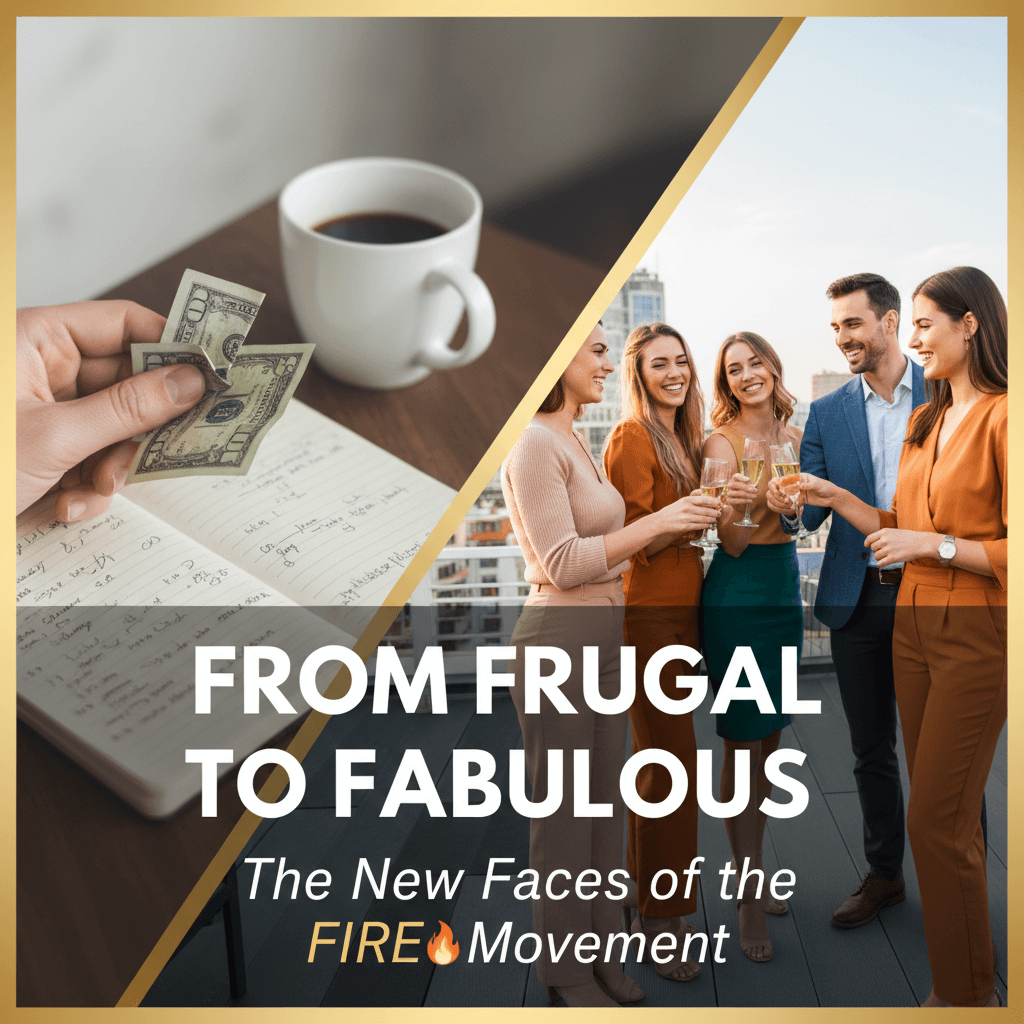
I still remember the first time I stumbled into a FIRE subreddit late one night. Someone had posted a spreadsheet showing how they planned to retire at 35 by living on $25,000 a year. The comments were equal parts admiration and disbelief. “I could never give up travel,” one person wrote. “This isn’t living,” said another. Fast-forward a decade, and that same online space is now debating whether a $5 million net worth is enough to feel “safe” in early retirement.
This tension captures the heart of today’s FIRE conversation. Is financial independence about extreme frugality and minimalist living, or can it coexist with luxury, comfort, and indulgence? My thesis is simple: the FIRE movement hasn’t abandoned its roots—it’s diversifying. But that evolution raises real questions about sustainability, values, and whether lifestyle inflation is quietly eroding the very freedom FIRE promises.
The Original FIRE Blueprint: Freedom Through Frugality
Where It All Began
The FIRE movement, as many of us know it, gained mainstream traction in the early 2010s, heavily influenced by thinkers like Mr. Money Mustache and the principles laid out in the book Your Money or Your Life. The formula was straightforward: save aggressively (often 50–70% of income), invest in low-cost index funds, and reduce expenses to the bare essentials.
This approach wasn’t about deprivation for its own sake. It was about trading consumerism for autonomy. By lowering the amount of money needed to live, you reduced the number of years you had to sell your time.
Why Frugality Was the Superpower
Frugality worked because it attacked the problem from two sides. You saved more, and you needed less. According to Vanguard data, households with savings rates above 30% could realistically reach financial independence in under 15 years, assuming moderate market returns.
More importantly, frugality created psychological resilience. When your happiness isn’t tied to spending, market downturns and job instability lose much of their power.
- Actionable takeaway: Calculate your “freedom number” based on current spending, not idealized future expenses.
- Actionable takeaway: Experiment with frugal months to stress-test how little you truly need.
- Actionable takeaway: Reframe frugality as skill-building, not sacrifice.
The Rise of “Fabulous FIRE” and Lifestyle-Driven Independence
When FIRE Met Instagram
As FIRE gained popularity, it also became more visible. Instagram accounts showcasing beachfront rentals, first-class flights, and chic home offices began to appear under the FIRE banner. Suddenly, early retirement didn’t look like biking to the library; it looked like sipping espresso in Lisbon.
This shift coincided with rising incomes in tech and finance. A software engineer earning $250,000 a year could save aggressively without giving up luxury. For them, FIRE wasn’t about cutting lattes—it was about optimizing investments.
The Numbers Behind Luxury FIRE
Data from the Federal Reserve’s 2022 Survey of Consumer Finances shows that households in the top income quintile account for over 70% of total U.S. retirement assets. Unsurprisingly, many modern FIRE voices come from this demographic.
The debate isn’t whether luxury FIRE is possible. It clearly is. The real question is whether it’s replicable—or responsible—to present it as the norm.
- Actionable takeaway: Separate FIRE principles from FIRE aesthetics when consuming online content.
- Actionable takeaway: If pursuing high-spend FIRE, model multiple market return scenarios.
- Actionable takeaway: Be honest about whether income, not strategy, is doing the heavy lifting.
Community Tensions: What Reddit Debates Reveal
Frugal vs. Fabulous in Real Time
Reddit remains the town square of the FIRE movement. Posts arguing that “FIRE has lost its way” often rack up thousands of comments. One popular thread questioned whether a couple targeting $10 million before retiring could even be considered FIRE.
The pushback was swift. Supporters argued that FIRE simply means financial independence, not financial minimalism. Critics countered that without intentional constraints, FIRE becomes indistinguishable from traditional wealth accumulation.
Why Engagement Is So High
These debates resonate because they reflect broader anxieties: rising housing costs, uncertain markets, and a generation questioning traditional retirement timelines. A Pew Research study found that 56% of adults under 40 doubt Social Security will be available to them, amplifying the appeal of FIRE in any form.
- Actionable takeaway: Use online debates as prompts for self-reflection, not validation.
- Actionable takeaway: Ask whether your FIRE plan increases or decreases optionality.
- Actionable takeaway: Engage with dissenting views to stress-test your assumptions.
Is Lifestyle Inflation Undermining Financial Independence?
The Silent Risk of “Just a Little More”
Lifestyle inflation is subtle. A nicer apartment becomes the baseline. Business class feels “reasonable” after a few promotions. Over time, your FIRE number creeps higher, often faster than your satisfaction.
Research from the Journal of Consumer Psychology shows that happiness gains from income plateau relatively quickly, while expectations continue to rise. In FIRE terms, this means you might be running on a treadmill that never stops.
Sustainability vs. Status
Luxury FIRE plans are also more sensitive to market volatility. A 4% withdrawal rate on a $10 million portfolio sounds safe, but higher fixed expenses reduce flexibility during downturns.
I’ve spoken with readers who reached their FIRE number twice—once before lifestyle inflation, and once after. Only the first version actually delivered peace of mind.
- Actionable takeaway: Track happiness alongside spending to identify diminishing returns.
- Actionable takeaway: Build variable expenses into your FIRE plan.
- Actionable takeaway: Revisit your “enough” number annually.
Hybrid FIRE Models: Designing a Life, Not a Label
Barista FIRE, Coast FIRE, and Beyond
In response to these tensions, hybrid models have emerged. Barista FIRE involves part-time work for benefits and fulfillment. Coast FIRE focuses on investing early, then easing off aggressive saving once compounding does the rest.
These approaches acknowledge that life isn’t static. Careers change. Families grow. Desires evolve.
Case Study: A Balanced Path
Consider Maya, a product manager who saved aggressively in her 20s, hitting Coast FIRE by 33. Instead of pushing for full retirement, she took a lower-stress role and spends freely on travel. Her portfolio grows quietly in the background.
Maya’s story illustrates a key insight: FIRE is a tool, not an identity.
- Actionable takeaway: Explore hybrid FIRE paths that align with your energy levels.
- Actionable takeaway: Design work you’d choose even without financial pressure.
- Actionable takeaway: Treat FIRE milestones as checkpoints, not finish lines.
Redefining Success in the Modern FIRE Era
From Net Worth to Life Worth
The most compelling FIRE voices today are shifting the conversation from numbers to narratives. Success isn’t just retiring early; it’s having control over your time, values, and attention.
A 2023 Gallup survey found that autonomy is a stronger predictor of life satisfaction than income beyond a certain threshold. FIRE, at its best, delivers autonomy.
A Personal Challenge to Readers
I believe the future of FIRE lies in intentionality. Frugality and luxury are tools, not virtues or vices. What matters is whether your financial plan supports the life you actually want to live.
So here’s my challenge: write down what “enough” looks like for you—financially, emotionally, and socially. Then build a FIRE plan that serves that vision, not someone else’s highlight reel.
- Actionable takeaway: Define success in non-financial terms.
- Actionable takeaway: Audit your FIRE influences and unfollow those that trigger comparison.
- Actionable takeaway: Start a conversation in your community about values, not just numbers.
The FIRE movement isn’t broken. It’s growing up. And like any maturing idea, it’s being tested, stretched, and reinterpreted. Whether you lean frugal or fabulous, the real win is reclaiming choice. That, more than any dollar figure, is what financial independence was always meant to deliver.
Where This Insight Came From
This analysis was inspired by real discussions from working professionals who shared their experiences and strategies.
- Share Your Experience: Have similar insights? Tell us your story
At ModernWorkHacks, we turn real conversations into actionable insights.
![[Workflow Included] A simple 5-node Instagram posting workflow for beginners](https://modernworkhacks.com/wp-content/uploads/2026/04/workflow-included-a-simple-5-node-instagram-posting-workflow-for-beginners-1024x675.png)




0 Comments