
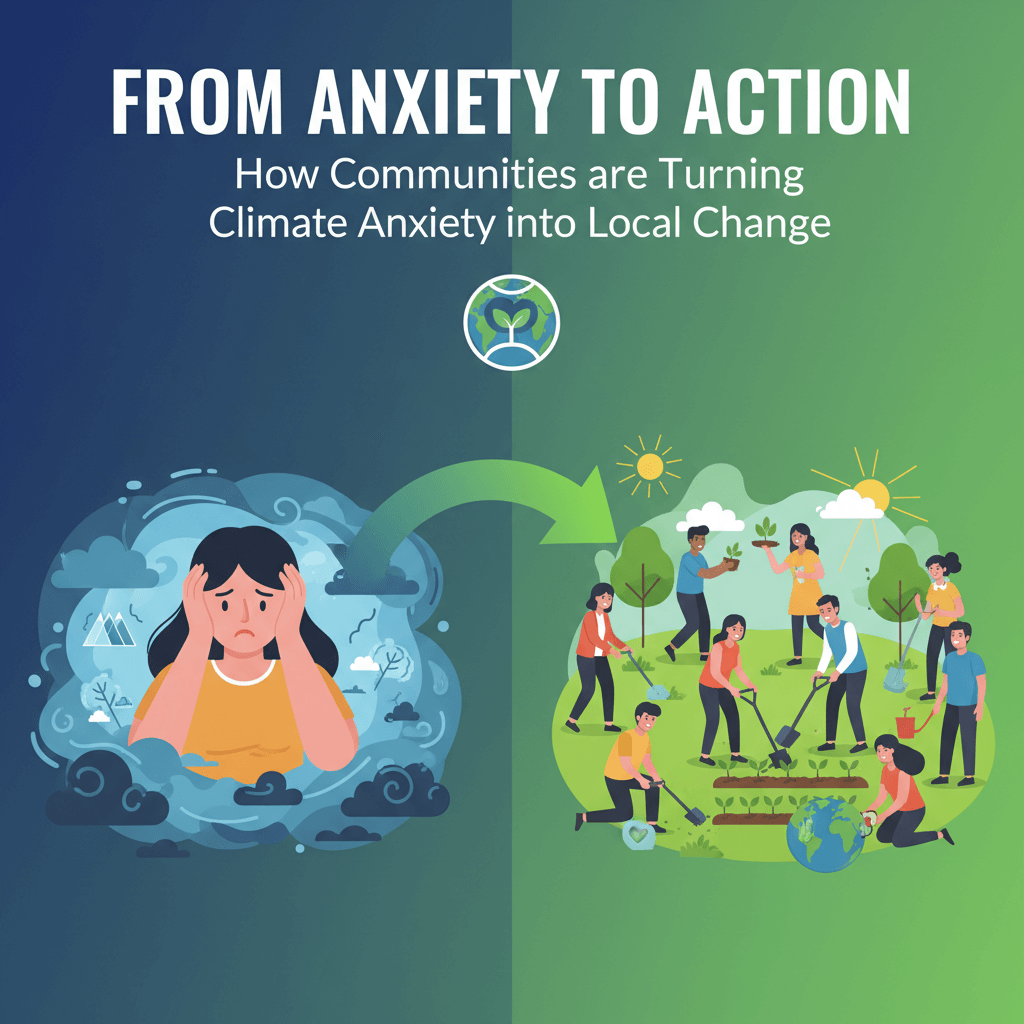
I still remember the first time climate anxiety felt physical. I was standing in a grocery store aisle, staring at rows of plastic-wrapped produce, while a news alert buzzed on my phone about record-breaking heat. My chest tightened—not because I didn’t care, but because I cared deeply and felt powerless. That feeling, I’ve since learned, is far from unique. Across the world, people are grappling with a mix of fear, guilt, and grief about climate change. Yet something remarkable is happening in response. Instead of freezing, many communities are transforming that anxiety into action—local, tangible, and deeply human.
The thesis is simple: while climate change is a global crisis, some of the most powerful antidotes to climate anxiety are emerging at the community level, where people are reclaiming agency through homesteading, gardening, mutual aid, and grassroots sustainability projects.
The Rise of Climate Anxiety—and Why It’s Different This Time
Understanding Climate Anxiety
Climate anxiety isn’t just worry; it’s a chronic stress response to environmental threats. A 2021 Lancet survey of 10,000 young people across 10 countries found that nearly 60% felt “very” or “extremely” worried about climate change, and over 45% said it affected their daily functioning. Unlike other anxieties, this one is grounded in reality, reinforced by headlines, personal experiences of extreme weather, and scientific consensus.
What’s different now is how visible and shared this anxiety has become. On platforms like Reddit, entire communities—such as r/ClimateAnxiety and r/CollapseSupport—exist to process fear collectively. These spaces are raw, but they’re also incubators for change.
From Paralysis to Possibility
Left unaddressed, climate anxiety can lead to disengagement. But when acknowledged and shared, it often becomes a catalyst. I’ve seen countless posts that start with dread and end with determination: “I can’t fix everything, but I can fix something.”
- Name the feeling: Acknowledge climate anxiety as rational, not pathological.
- Find community: Shared concern reduces isolation and sparks collaboration.
- Shift focus: Move from global overwhelm to local influence.
Why Local Action Feels So Powerful
The Psychology of Control
Psychologists note that a sense of agency is one of the strongest buffers against anxiety. When people compost, garden, or install rain barrels, they experience immediate feedback: soil improves, food grows, waste shrinks. These small wins matter.
Research from the American Psychological Association shows that pro-environmental behaviors can improve mental well-being when they’re connected to values and community, rather than guilt.
Local Impact, Real Results
Consider Totnes, England, birthplace of the Transition Towns movement. What began as a small community response to peak oil has grown into a global network of over 1,000 initiatives, focusing on local food, energy resilience, and skill-sharing. Emissions reductions aside, participants consistently report increased hope and belonging.
- Start where you live: Local projects offer visible, measurable outcomes.
- Build resilience: Community systems buffer against climate disruptions.
- Reconnect socially: Shared work rebuilds trust and cooperation.
Homesteading and Gardening as Acts of Resistance
From Hobby to Movement
Gardening has exploded in popularity since 2020. According to the National Gardening Association, over 18 million new gardeners emerged in the U.S. during the early pandemic years, many citing food security and climate concerns as motivations.
On Reddit’s r/homestead and r/gardening, users openly discuss how growing food helps them cope with climate dread. One user wrote, “I can’t control the weather, but I can grow tomatoes.” That mindset is quietly radical.
Case Study: The Phoenix Backyard Food Network
In Phoenix, Arizona—a city synonymous with extreme heat—neighbors began converting lawns into edible landscapes. By sharing shade structures, water-saving techniques, and harvests, they reduced water use by an estimated 30% while improving local food access. More importantly, participants described feeling “less afraid of the future.”
- Start small: Even container gardens build confidence.
- Share knowledge: Swap seeds, tools, and techniques locally.
- Design for climate: Native and drought-tolerant plants matter.
Grassroots Sustainability Beyond the Garden
Energy, Waste, and Mutual Aid
Not everyone can garden, but everyone can contribute. Community solar co-ops, tool libraries, and repair cafés are thriving examples. In Minneapolis, a neighborhood-led solar cooperative helped over 200 households access renewable energy at reduced costs, cutting emissions and bills simultaneously.
Meanwhile, zero-waste groups are tackling consumption head-on. The Zero Waste Europe network reports that community-led reuse and repair initiatives can reduce household waste by up to 20% annually.
Mutual Aid as Climate Action
Mutual aid networks—once seen as emergency responses—are becoming long-term climate resilience strategies. During floods, heatwaves, and power outages, these networks distribute food, water, and information faster than centralized systems.
- Map local skills: Identify who can fix, grow, cook, or organize.
- Pool resources: Shared tools reduce consumption.
- Plan for extremes: Preparedness lowers fear and harm.
The Role of Online Communities in Offline Change
Reddit as a Climate Incubator
Reddit’s climate-focused subreddits aren’t just echo chambers—they’re planning rooms. Threads about anxiety often evolve into practical guides: how to start a compost bin, organize a neighborhood meeting, or lobby a city council.
One widely upvoted post on r/ClimateAction detailed how a single user turned despair into a monthly community cleanup, now attended by over 50 neighbors. Digital connection became physical change.
Bridging the Gap Between Talk and Action
The key is translation. Online spaces lower the barrier to entry, but impact happens offline. Successful communities intentionally bridge that gap with meetups, shared documents, and accountability.
- Use online tools strategically: Plan, educate, then act locally.
- Celebrate wins publicly: Visibility inspires replication.
- Moderate for hope: Balance realism with possibility.
What the Research Says About Hope and Action
Hope Is Not Denial
There’s a misconception that hope minimizes the crisis. Research suggests the opposite. A 2020 study in Nature Climate Change found that “constructive hope”—grounded in action—correlates with higher engagement and lower distress.
When people see themselves as contributors rather than spectators, anxiety shifts from paralyzing to motivating.
Collective Efficacy Matters
Sociologists emphasize collective efficacy—the belief that a group can effect change—as a predictor of sustained action. Local wins, however small, reinforce this belief.
- Track progress: Measure what your group achieves.
- Tell stories: Narrative reinforces meaning.
- Stay connected: Long-term engagement reduces burnout.
From Anxiety to Action: A Personal and Collective Challenge
When I stopped trying to “solve” climate change and started asking, “What can we do here, together?” everything shifted. Anxiety didn’t disappear, but it became fuel instead of fog.
The synthesis is clear: climate anxiety is not a sign of weakness; it’s evidence of care. Communities that harness that care through local action are building resilience, hope, and real environmental impact.
Here’s my challenge to you:
- Pick one local action—gardening, energy, waste, or mutual aid—and commit for 30 days.
- Invite others—anxiety shrinks when shared purpose grows.
- Document and share—your story might be someone else’s turning point.
The climate crisis is vast, but so is our capacity for creativity and care. One backyard, one block, one community at a time, people are proving that action is not just possible—it’s already happening.
Where This Insight Came From
This analysis was inspired by real discussions from working professionals who shared their experiences and strategies.
- Share Your Experience: Have similar insights? Tell us your story
At ModernWorkHacks, we turn real conversations into actionable insights.
![[Workflow Included] A simple 5-node Instagram posting workflow for beginners](https://modernworkhacks.com/wp-content/uploads/2026/04/workflow-included-a-simple-5-node-instagram-posting-workflow-for-beginners-1024x675.png)



0 Comments