
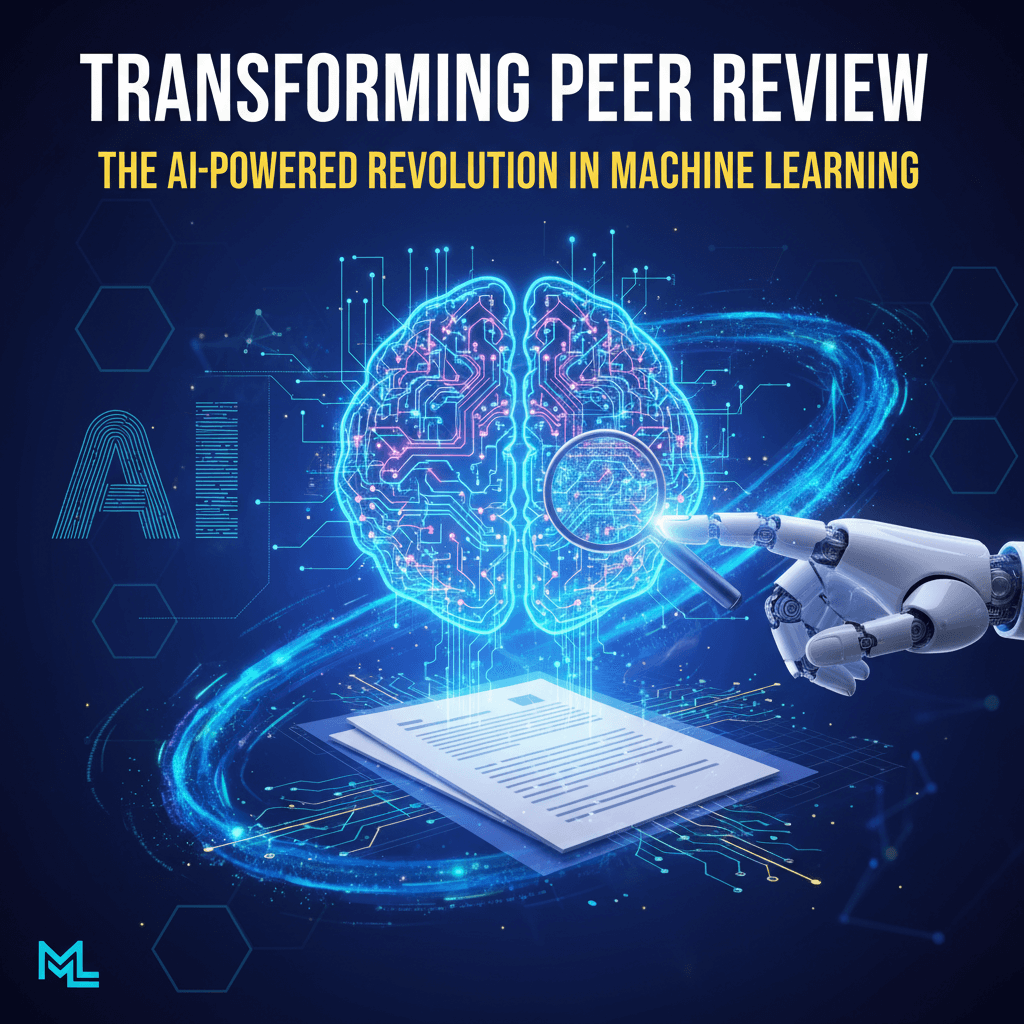
I still remember the first time I submitted a machine learning paper to a top-tier conference. Months of late nights, failed experiments, and incremental breakthroughs led to that upload button. Then came the wait. Twelve weeks later, the reviews arrived: one thoughtful and detailed, one curt and dismissive, and one that seemed to misunderstand the core contribution entirely. The final decision? Rejection. Not because the idea lacked merit, but because the process felt inconsistent, opaque, and, frankly, human in all the wrong ways.
This experience is not unique. Across Reddit threads, conference hallway conversations, and editorial board meetings, the same question keeps surfacing: Could AI be the key to overhauling the peer review process? As machine learning reshapes industries from healthcare to finance, it is now turning inward—challenging how its own research is evaluated, validated, and shared.
In this article, I explore how AI-powered peer review systems are emerging, why they matter, and what they could mean for the future of academic publishing in machine learning. More importantly, I examine what we, as researchers, reviewers, and institutions, must do to ensure this transformation improves rigor without sacrificing trust.
The Breaking Point of Traditional Peer Review
Why the Current System Is Struggling
Peer review has long been considered the gold standard of academic quality control. Yet, in machine learning, its cracks are becoming increasingly visible. Submission volumes to conferences like NeurIPS, ICML, and ICLR have grown exponentially. NeurIPS alone received over 13,000 submissions in 2023, compared to fewer than 2,000 a decade earlier.
This growth has outpaced the availability of qualified reviewers, leading to rushed evaluations, uneven expertise alignment, and reviewer burnout. Studies published by the National Academy of Sciences have shown that reviewer agreement rates are often barely above chance, raising uncomfortable questions about consistency.
Actionable takeaways from this reality include:
- Acknowledge capacity limits: Conference organizers must recognize that scaling volume without scaling review infrastructure degrades quality.
- Track reviewer performance: Simple metrics on timeliness and depth can already improve accountability.
- Design for triage: Not every paper requires the same level of human scrutiny at the initial stage.
The Human Bias Problem
Beyond volume, bias remains a persistent concern. Research has shown that author reputation, institutional affiliation, and even writing style can influence outcomes, despite double-blind review. A 2018 study in Nature Human Behaviour found that prestigious affiliations significantly increased acceptance likelihood, even when content quality was controlled.
While human judgment is essential, its limitations are becoming harder to ignore—especially in a field dedicated to building systems that outperform humans in pattern recognition.
Enter AI: From Reviewer Assistance to Systemic Change
What AI Can Actually Do Today
AI in peer review is not a futuristic fantasy. It is already here, albeit quietly. Tools powered by natural language processing are being piloted to:
- Check for plagiarism and redundant submissions across venues.
- Flag missing citations or weak methodological descriptions.
- Assess clarity, structure, and reproducibility signals in manuscripts.
For example, Elsevier and Springer Nature have experimented with AI-based screening tools that reduce editorial desk rejection time by up to 30%. In machine learning conferences, tools like PaperMatcher already assist in reviewer assignment using semantic similarity models.
Practical actions institutions can take now:
- Deploy AI as a first-pass filter: Let machines handle mechanical checks so humans focus on substance.
- Use AI to match expertise: Better reviewer-paper alignment improves review quality almost immediately.
- Collect structured feedback: AI can prompt reviewers with targeted questions, improving consistency.
What AI Should Not Do
It is tempting to imagine AI replacing reviewers entirely. That would be a mistake. Evaluation of novelty, ethical implications, and scientific taste still require human judgment. The goal is augmentation, not automation.
As one Reddit commenter succinctly put it: “If AI rejects my paper, I want to know which human agrees with it.” That sentiment captures the trust challenge perfectly.
Case Studies: Early Experiments in AI-Driven Review
Conference-Level Innovations
ICLR has been a testing ground for peer review innovation. Its open review model, combined with AI-assisted reviewer matching, has increased transparency and community engagement. Preliminary analysis shows that papers receiving early, high-quality feedback are more likely to be improved and accepted in later iterations.
Meanwhile, the ACL community has piloted automatic reproducibility checks, where code submissions are analyzed for completeness and basic functionality. These tools do not judge correctness but flag high-risk submissions.
Lessons from these cases include:
- Transparency reduces resistance: When authors understand how AI is used, trust increases.
- Incremental rollout works: Small, well-defined AI roles face less backlash.
- Community feedback is essential: Open forums surface edge cases quickly.
Journal-Level Adoption
At the journal level, publishers like Wiley have reported reductions in reviewer fatigue after introducing AI-assisted triage. Editors receive structured summaries highlighting potential strengths and weaknesses, allowing them to make faster, more informed decisions about review allocation.
Importantly, these systems are trained on historical data, raising questions about reinforcing past biases. Which brings us to the next challenge.
The Bias Paradox: Can AI Make Review Fairer?
Bias In, Bias Out
AI systems learn from existing data. If historical peer review decisions reflect bias, AI may amplify it. A 2020 study from MIT demonstrated that language models trained on academic text could replicate gender and geographic biases in evaluation tasks.
This does not mean AI should be abandoned. It means it must be designed with safeguards.
Concrete mitigation strategies include:
- Diverse training data: Include rejected papers and post-publication impact metrics.
- Regular audits: Measure outcomes across demographics and institutions.
- Human override mechanisms: Editors must retain final authority.
Opportunities for Fairness
Paradoxically, AI may be our best tool for exposing bias. By systematically analyzing review language, sentiment, and decision patterns, AI can reveal disparities invisible at the individual level.
Imagine a dashboard that alerts organizers when acceptance rates for early-career researchers drop below expected baselines. That is not science fiction; prototypes already exist.
What This Means for Researchers and Reviewers
Adapting as an Author
As AI becomes part of peer review, authors must adapt. Clear writing, well-documented methods, and reproducible code are no longer just best practices—they are machine-readable signals.
Actionable steps for authors:
- Structure papers clearly: Headings, summaries, and explicit contributions help both humans and machines.
- Emphasize reproducibility: Well-documented code reduces risk flags.
- Anticipate automated checks: Run your own tools before submission.
Evolving the Reviewer Role
For reviewers, AI can be a relief rather than a threat. Automated summaries and checklists free up time for deep thinking. The reviewer of the future is less a gatekeeper and more a mentor.
I have personally found that AI-assisted prompts help me write more balanced, constructive reviews—something early-career researchers particularly appreciate.
The Bigger Picture: Redefining Scientific Trust
Why This Moment Matters
Peer review is not just an administrative process; it is the backbone of scientific trust. In machine learning, where research rapidly translates into real-world systems, flawed review has tangible consequences.
Reddit discussions reveal a community hungry for change but wary of shortcuts. The message is clear: speed without rigor is unacceptable, but rigor without scalability is unsustainable.
Key principles to guide the transition:
- Human-centered AI: Design systems that support, not replace, judgment.
- Transparency by default: Make processes inspectable and explainable.
- Continuous iteration: Treat peer review as a system that can be improved.
A Call to Action
We stand at a rare inflection point. The machine learning community has both the technical expertise and the ethical responsibility to reinvent how knowledge is evaluated. But this will not happen by default.
I challenge researchers to engage in review reform discussions, reviewers to experiment with AI-assisted tools, and organizers to pilot bold but thoughtful innovations. Ask not whether AI should be part of peer review—it already is. Ask instead how we can shape it to reflect our best scientific values.
If we get this right, future researchers may look back at today’s peer review struggles as a necessary growing pain—and see this moment as when we finally practiced what we preached about intelligent systems improving human decision-making.
Where This Insight Came From
This analysis was inspired by real discussions from working professionals who shared their experiences and strategies.
- Share Your Experience: Have similar insights? Tell us your story
At ModernWorkHacks, we turn real conversations into actionable insights.
![[Workflow Included] A simple 5-node Instagram posting workflow for beginners](https://modernworkhacks.com/wp-content/uploads/2026/04/workflow-included-a-simple-5-node-instagram-posting-workflow-for-beginners-1024x675.png)


0 Comments