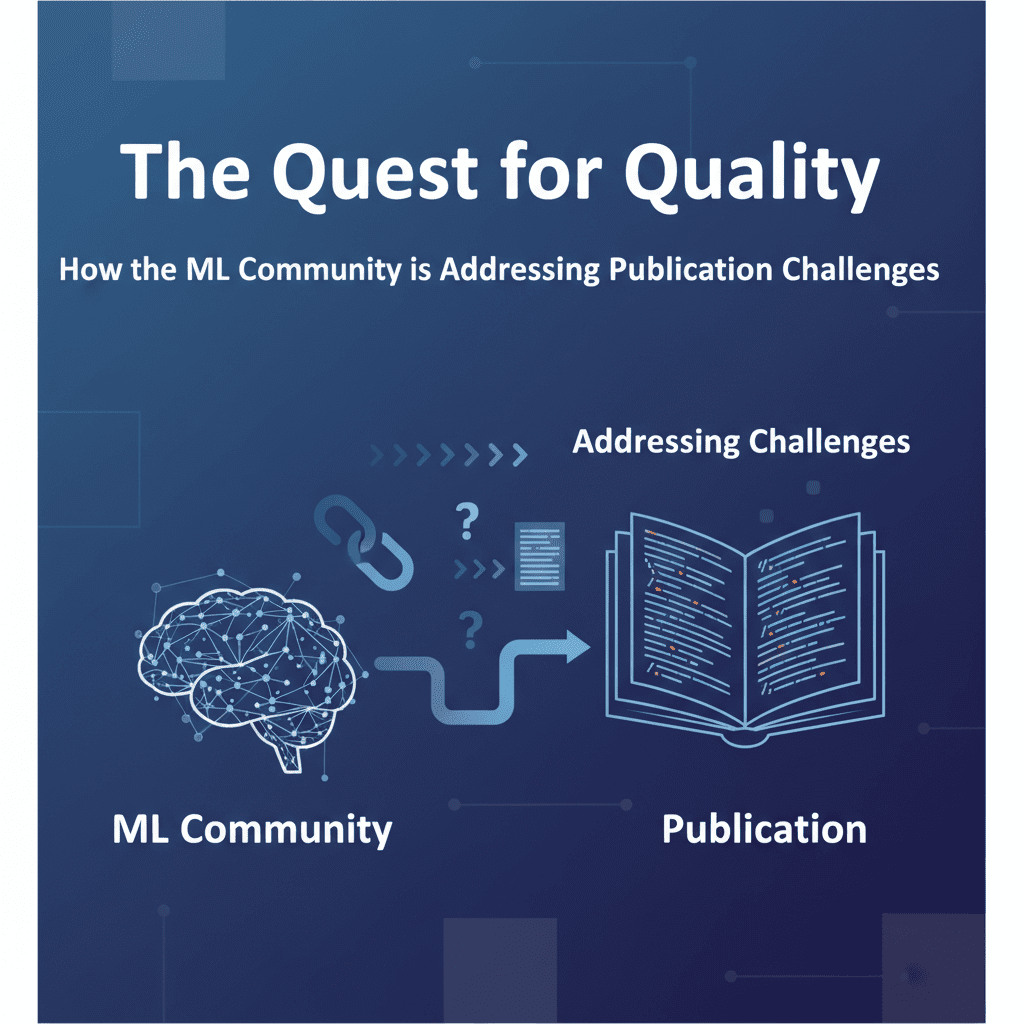
I still remember the moment vividly. It was late at night, and I was scrolling through Reddit after a long day of reviewing machine learning papers. A post caught my eye: a frustrated PhD student venting about how their carefully designed experiment had been rejected, while a loosely validated paper with flashy results had been accepted elsewhere. The comment section exploded. Senior researchers chimed in. Industry practitioners nodded in recognition. Somewhere between the memes and the earnest advice, a deeper truth surfaced: as machine learning evolves at breakneck speed, the field is struggling to balance quality with quantity.
This article explores that tension. The machine learning community is producing more research than ever before, yet concerns about reproducibility, peer review overload, and incentive misalignment are growing louder. At the same time, promising efforts—from revamped review processes to community-led norms—are taking shape. By examining these initiatives and grounding them in real examples, including debates around innovations like Linear Attention, we can better understand how the field is striving to protect its intellectual foundations.
The Publication Explosion: When Growth Becomes a Strain
An Unprecedented Volume of Research
Over the past decade, machine learning publications have grown exponentially. Conferences like NeurIPS, ICML, and ICLR now receive tens of thousands of submissions annually. According to publicly shared statistics, NeurIPS submissions grew from around 2,000 in 2014 to over 13,000 by the early 2020s. That kind of growth is a testament to the field’s vitality—but it also creates immense pressure.
Reviewers are stretched thin, area chairs juggle impossible workloads, and authors compete in an increasingly noisy arena. The result? Shorter reviews, inconsistent standards, and a creeping sense that novelty sometimes outweighs rigor.
Why this matters: When review capacity doesn’t scale with submissions, even well-intentioned systems can fail to catch flawed assumptions or irreproducible results.
- Actionable takeaway: If you submit to top-tier venues, invest extra effort in clarity and reproducibility—clear ablations and open code reduce reviewer burden.
- Actionable takeaway: As a reviewer, be honest about your bandwidth and decline reviews when necessary; overloaded reviewers help no one.
The Rise of “Paper Inflation”
Another consequence of rapid growth is what some researchers call “paper inflation.” Incremental improvements are sliced thinly into multiple publications, sometimes with marginal real-world impact. This is not unique to machine learning, but the speed of the field amplifies the effect.
On Reddit and Twitter, practitioners frequently question whether every new transformer variant or loss function warrants a full paper. These discussions aren’t anti-research; they’re pro-standards.
- Actionable takeaway: Ask yourself before submitting: does this work change how others think or build, or is it primarily a metric bump?
- Actionable takeaway: Consider consolidating related ideas into a single, stronger contribution.
Peer Review Under Pressure
The Human Limits of Review Systems
Peer review is a human process, and humans have limits. A typical reviewer may be assigned 4–6 papers in a tight window, often on top of teaching, research, or industry responsibilities. Under such constraints, deep engagement with each paper becomes difficult.
I’ve spoken with reviewers who admit they sometimes rely heavily on abstracts, figures, and reputation cues—not out of laziness, but necessity. This reality raises uncomfortable questions about fairness and thoroughness.
- Actionable takeaway: Authors should design papers for skimmability without sacrificing depth—clear figures and summaries help reviewers engage meaningfully.
- Actionable takeaway: Institutions should recognize reviewing as real scholarly labor, factoring it into evaluations.
Experiments with New Review Models
In response, several conferences are experimenting with new models. OpenReview, for example, has introduced transparency by allowing public comments and discussions. Some workshops test rolling reviews or journal-style revisions.
These experiments aren’t perfect, but they represent a willingness to adapt. Transparency can discourage low-effort reviews and empower community feedback beyond a small committee.
- Actionable takeaway: Engage constructively in open reviews—thoughtful public comments can elevate the entire discourse.
- Actionable takeaway: If you’re organizing a workshop, consider alternative review timelines to reduce crunch.
Case Study: Linear Attention and the Demand for Rigor
Why Linear Attention Became a Flashpoint
Linear Attention methods emerged as a promising response to the quadratic complexity of traditional attention mechanisms. The idea was elegant: approximate attention in a way that scales linearly with sequence length. Papers proposing these methods gained rapid traction, citations, and implementations.
But as adoption grew, so did scrutiny. Practitioners noticed discrepancies between reported benchmarks and real-world performance. Some Reddit threads dissected these gaps line by line, questioning experimental setups and hidden assumptions.
This wasn’t backlash—it was quality control in action.
- Actionable takeaway: When proposing efficiency gains, benchmark across diverse settings, not just curated datasets.
- Actionable takeaway: Document trade-offs transparently; speedups often come with accuracy or stability costs.
Community-Led Validation
What’s encouraging is how the community responded. Follow-up papers replicated results, clarified limitations, and proposed refinements. Some authors openly acknowledged earlier oversights, strengthening trust.
This iterative process illustrates a healthier publication culture—one where initial excitement is tempered by collective validation.
- Actionable takeaway: View replication not as criticism, but as contribution.
- Actionable takeaway: Share negative or neutral results when they inform practical use.
Institutional Efforts to Raise the Bar
Stricter Reproducibility Requirements
Many conferences now require code submission, dataset documentation, and reproducibility checklists. NeurIPS’ reproducibility checklist, for example, asks authors to detail hyperparameters, data splits, and computational resources.
While some initially saw this as bureaucratic overhead, evidence suggests it improves clarity and reduces ambiguity.
- Actionable takeaway: Treat reproducibility checklists as design tools, not compliance chores.
- Actionable takeaway: Archive code and data with clear licenses to enable long-term access.
Reevaluating Incentives in Academia and Industry
Publication pressure is often rooted in incentives. Hiring committees, grant panels, and promotion boards still emphasize quantity and venue prestige. Some institutions are beginning to shift, valuing impact, openness, and collaboration.
Industry labs, in particular, are experimenting with fewer but deeper publications, complemented by open-source releases.
- Actionable takeaway: If you’re in a leadership role, explicitly reward quality-focused behaviors.
- Actionable takeaway: As an early-career researcher, document impact beyond citations—adoption, tooling, and community use matter.
The Role of Online Communities and Public Discourse
Reddit as a Quality Signal
Reddit discussions, especially in ML-focused subreddits, have become informal peer-review layers. Papers are summarized, critiqued, and stress-tested by practitioners who often bring deployment experience.
The high engagement around publication quality reflects a collective desire for trustworthy research. These conversations can be blunt, but they surface issues formal reviews may miss.
- Actionable takeaway: Monitor community feedback to identify blind spots in your work.
- Actionable takeaway: Engage respectfully; public discourse shapes reputations.
From Critique to Culture Change
When enough voices raise the same concerns, norms shift. Today, it’s increasingly acceptable to question benchmark-chasing or demand stronger baselines. That cultural evolution is slow but meaningful.
- Actionable takeaway: Amplify thoughtful critiques rather than dismissing them as negativity.
- Actionable takeaway: Model the standards you want to see in your own publications.
Reclaiming Quality Without Slowing Progress
The challenge facing machine learning is not whether to move fast or slow down. It’s how to move fast responsibly. Quality and velocity are not opposites; they reinforce each other when aligned.
I believe the current moment is pivotal. The community is large enough to self-correct, but only if individuals, institutions, and platforms commit to shared standards. Every careful review, transparent experiment, and honest discussion contributes to a healthier ecosystem.
My challenge to you: the next time you write, review, or discuss a paper, ask not just “Is this new?” but “Is this solid?” If enough of us ask that question—and act on the answer—the quest for quality will become less of a struggle and more of a defining strength of the field.
Where This Insight Came From
This analysis was inspired by real discussions from working professionals who shared their experiences and strategies.
- Share Your Experience: Have similar insights? Tell us your story
At ModernWorkHacks, we turn real conversations into actionable insights.
![[Workflow Included] A simple 5-node Instagram posting workflow for beginners](https://modernworkhacks.com/wp-content/uploads/2026/04/workflow-included-a-simple-5-node-instagram-posting-workflow-for-beginners-1024x675.png)



0 Comments