A few months ago, a friend of mine—let’s call him Daniel—called me late on a Tuesday night. He works at a well-known AI startup, one of those companies whose valuation seemed to double every time a new press release hit LinkedIn. That night, his voice was unsteady. Rumors of budget freezes were circulating internally, hiring had stopped overnight, and senior leadership was suddenly talking about “runway” instead of “growth.” Daniel had done everything right professionally: top-tier skills, strong network, impressive resume. But financially? He admitted he hadn’t saved more than two months of expenses.
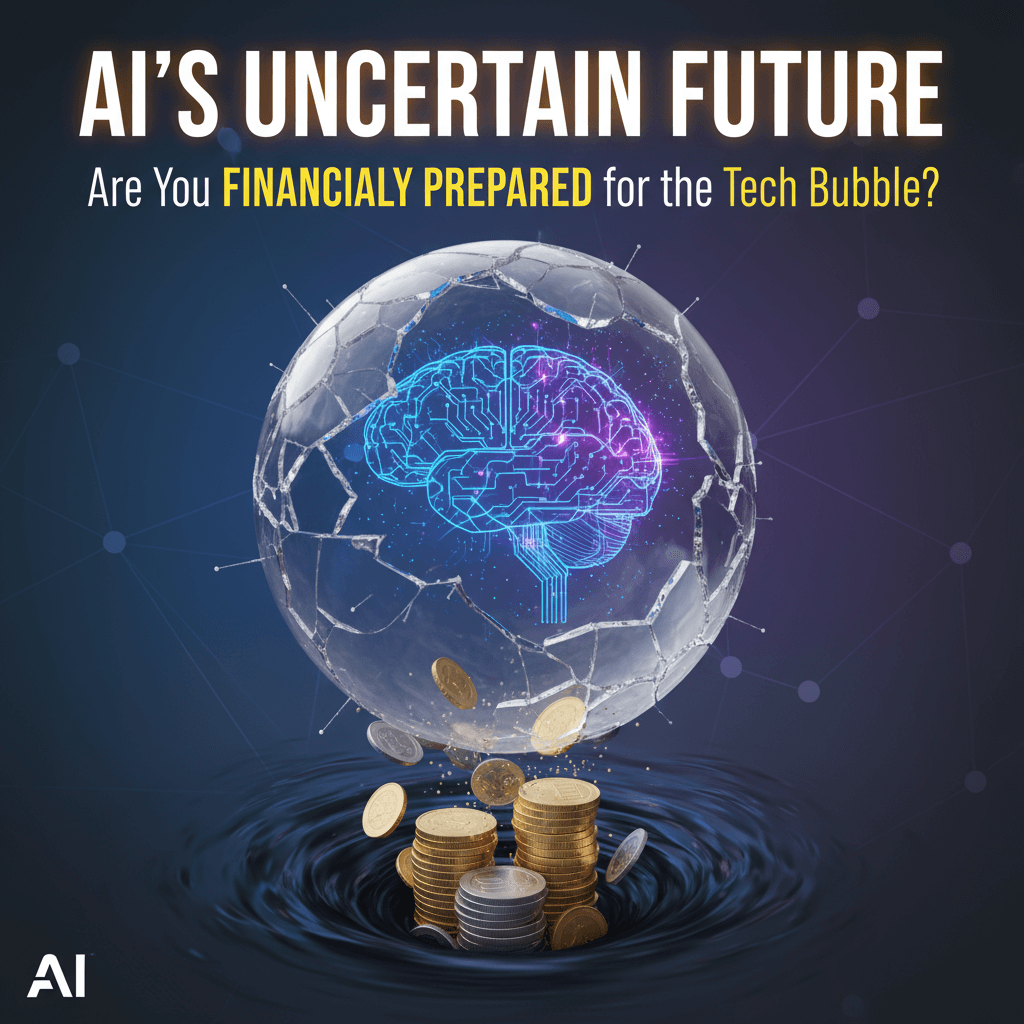
That conversation stuck with me. Not because Daniel is reckless—he’s not—but because his story is becoming increasingly common. As the AI bubble shows signs of volatility, financial preparedness may be the difference between resilience and panic. In this article, I want to explore what’s really happening beneath the hype, why so many people are anxious, and how you can proactively protect yourself before the next industry shift hits.
The AI Boom—and the Cracks Beneath the Surface
Artificial intelligence has dominated headlines for years. From generative models to automation tools, AI has been framed as the next industrial revolution. Venture capital flooded in. Valuations soared. Job titles with “AI” in them commanded premium salaries.
But history has taught us that rapid growth often comes with hidden fragility.
Why Some Experts Are Warning About an AI Bubble
In 2024 alone, global AI investment surpassed $200 billion, according to multiple industry trackers. At the same time, profitability lagged far behind valuation for many companies. This disconnect has raised familiar alarms, echoing the dot-com era.
Economists and analysts point to several warning signs:
- Overvaluation of startups with limited revenue models.
- Redundant products competing in saturated markets.
- Heavy reliance on cheap capital during years of low interest rates.
Reddit threads in r/technology and r/personalfinance are filled with firsthand accounts of hiring freezes, rescinded offers, and sudden layoffs. While not every concern signals a crash, collective anxiety often reflects underlying instability.
Actionable Takeaways from This Reality
- Don’t anchor your financial plans to industry optimism. Growth narratives can change quickly.
- Track macro signals like interest rates, venture funding trends, and layoffs—not just company announcements.
- Assume volatility as the baseline when working in fast-scaling tech sectors.
Job Security in the Age of Intelligent Machines
One of the most ironic aspects of the AI boom is that the very technology promising efficiency is also threatening stability—especially for knowledge workers.
Who Is Most at Risk?
Contrary to early assumptions, it’s not just repetitive or entry-level roles under pressure. Mid-level engineers, data analysts, marketers, and even product managers are seeing tasks automated or consolidated.
A 2023 study by the World Economic Forum estimated that while AI would create 97 million new roles globally, it could displace 85 million existing ones. That transition is rarely smooth or evenly distributed.
From Reddit AMAs to anonymous Blind posts, workers describe a common fear: “I’m well-paid now, but I don’t know if this role exists in five years.”
Actionable Takeaways for Career Resilience
- Build transferable skills that apply beyond a single tool or platform.
- Maintain an updated resume and portfolio, even when happily employed.
- Invest in continuous learning outside your employer’s tech stack.
Financial preparedness starts with accepting that job continuity is no longer guaranteed—even in “hot” fields.
Financial Literacy as Your First Line of Defense
When volatility increases, financial literacy stops being a “nice to have” and becomes essential. Yet many high earners in tech lack foundational money skills.
The Knowledge Gap in High-Income Tech Workers
I’ve coached professionals earning six figures who couldn’t explain how their stock options were taxed or how long their savings would last if income stopped. This isn’t ignorance—it’s exposure. Many people simply never had to think about downside risk.
According to a FINRA survey, fewer than 40% of Americans could correctly answer basic questions about inflation, interest, and risk diversification.
Actionable Takeaways to Strengthen Financial Literacy
- Learn your true burn rate: know exactly what it costs to live each month.
- Understand your compensation structure, including equity, vesting, and tax implications.
- Use volatility as motivation to educate yourself, not as a source of fear.
Knowledge doesn’t eliminate risk, but it dramatically improves decision-making under pressure.
The Power of an Emergency Fund in Uncertain Times
If there’s one financial tool that consistently separates panic from calm, it’s an emergency fund.
How Much Is “Enough” in a Volatile Industry?
Traditional advice suggests three to six months of expenses. In tech, especially AI-heavy sectors, I now advocate for six to twelve months if possible.
Consider Daniel again. After his call, he spent six months aggressively saving. When his company eventually laid off 20% of staff—including him—he had options. He took time to interview selectively instead of jumping at the first offer.
Actionable Takeaways for Building Your Safety Net
- Start small but start now: even one extra month of expenses matters.
- Keep funds liquid, not tied up in volatile investments.
- Automate contributions so saving isn’t dependent on willpower.
An emergency fund buys you time, clarity, and negotiating power.
Diversified Investments: Avoiding the “All-In” Tech Trap
Another common vulnerability I see is overexposure to the tech sector itself.
When Your Job, Equity, and Portfolio All Depend on AI
Many tech workers hold company stock, industry ETFs, and retirement funds heavily weighted toward technology. If the AI bubble deflates, losses can compound quickly.
During the dot-com crash, employees at companies like Pets.com lost both their jobs and their investments simultaneously. That lesson remains painfully relevant.
Actionable Takeaways for Smarter Diversification
- Audit your total exposure across salary, equity, and investments.
- Rebalance regularly to avoid concentration risk.
- Consider assets with low correlation, such as bonds or international markets.
Diversification doesn’t mean abandoning tech—it means not betting your entire future on it.
Psychological Preparedness: The Overlooked Asset
Financial shocks are as much emotional as they are numerical.
Why Anxiety Amplifies Financial Damage
Research from behavioral economics shows that stress leads to poor financial decisions—panic selling, impulsive career moves, and avoidance behaviors.
I’ve seen people drain retirement accounts prematurely or accept deeply underpaid roles simply to escape uncertainty.
Actionable Takeaways for Mental Resilience
- Rehearse worst-case scenarios calmly, on your own terms.
- Separate identity from employment to reduce emotional shock.
- Build community with peers who openly discuss money and career transitions.
Confidence isn’t pretending risk doesn’t exist—it’s knowing you can handle it.
What the Reddit Conversations Get Right
One reason this topic resonates so strongly on Reddit is authenticity. People aren’t posturing; they’re comparing notes in real time.
Across thousands of comments, a few themes consistently emerge:
- No one feels “safe,” regardless of seniority.
- Those with savings sleep better.
- Proactivity beats prediction.
These aren’t academic insights—they’re lived experiences.
Bringing It All Together: Your Challenge Going Forward
The future of AI is neither guaranteed collapse nor endless growth. It’s uncertainty. And uncertainty rewards preparation.
I don’t believe in fear-based financial planning. But I do believe in respect for cycles, history, and human psychology. Whether the AI bubble bursts dramatically or deflates slowly, the individuals who thrive will be the ones who planned for multiple outcomes.
Your challenge is simple but not easy:
- Calculate your true financial runway this week.
- Identify one concrete step to reduce concentration risk.
- Commit to improving one area of financial literacy this month.
If AI delivers on its promise, you’ll be glad you’re stable enough to seize new opportunities. If it doesn’t, you’ll be grateful you prepared anyway.
Either way, financial readiness isn’t pessimism—it’s freedom.
Where This Insight Came From
This analysis was inspired by real discussions from working professionals who shared their experiences and strategies.
- Share Your Experience: Have similar insights? Tell us your story
At ModernWorkHacks, we turn real conversations into actionable insights.
![[Workflow Included] A simple 5-node Instagram posting workflow for beginners](https://modernworkhacks.com/wp-content/uploads/2026/04/workflow-included-a-simple-5-node-instagram-posting-workflow-for-beginners-1024x675.png)



0 Comments