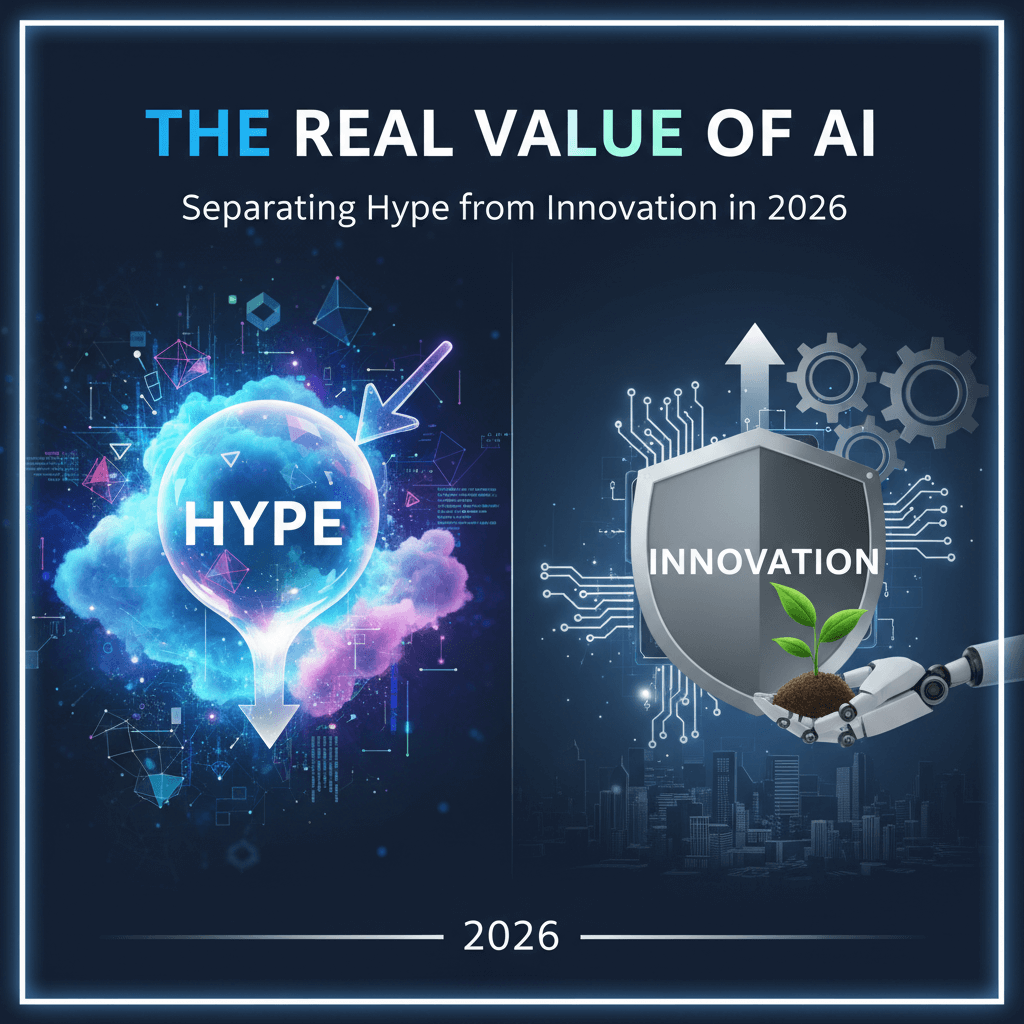
Not all that glitters is AI gold.
In late 2025, I watched a product manager I admire present a shiny new AI tool to her team. The demo was flawless: instant summaries, automated insights, predictive charts that seemed to read the future. Two weeks later, over coffee, she admitted something quietly unsettling. “We turned it off,” she said. “It looked brilliant in the demo, but it slowed us down.” That moment stuck with me because it captures the strange emotional arc many of us have experienced with AI: awe, adoption, and then—sometimes—disillusionment.
As we move into 2026, artificial intelligence is everywhere. It drafts emails, designs logos, screens resumes, writes code, and promises to optimize nearly every corner of work and life. Yet beneath the noise, skepticism is growing. Reddit threads overflow with brutally honest postmortems of AI tools that didn’t deliver. Leaders are asking harder questions. Individual contributors are quietly reverting to spreadsheets and manual workflows.
This article is about separating the signal from the noise. The real value of AI in 2026 is not found in flashy demos or inflated pitch decks, but in quieter, more durable innovations. Some AI tools will become as indispensable as spreadsheets. Others will fade as expensive experiments. My goal is to help you tell the difference.
The Hype Cycle Is Catching Up With Us
From Wonder to Weariness
AI’s recent boom followed a familiar pattern. Breakthroughs in large language models sparked public fascination, venture capital flooded in, and startups rushed to label everything “AI-powered.” According to PitchBook, global AI startup funding peaked in 2024, with over $120 billion invested. By mid-2025, funding slowed, not because AI failed, but because expectations became more grounded.
On Reddit, particularly in communities like r/ProductManagement, r/Entrepreneur, and r/MachineLearning, users began sharing stories of tools that promised transformation but delivered friction. The sentiment shifted from “This changes everything” to “Does this actually help me do my job?” That shift matters.
- Actionable takeaway: When evaluating AI tools, ask whether they remove friction or add new layers of complexity.
- Actionable takeaway: Track not just adoption rates, but abandonment rates within your team.
The Cost of Overpromising
Overhyped AI doesn’t just waste money; it erodes trust. When employees are forced to use tools that don’t meaningfully improve outcomes, they become skeptical of future innovations. A 2025 Gartner report found that nearly 40% of enterprise AI pilots were discontinued within 12 months, often due to unclear ROI or poor integration.
The lesson here is not that AI is failing, but that unchecked enthusiasm is. The organizations succeeding with AI are the ones treating it as infrastructure, not magic.
- Actionable takeaway: Demand clear success metrics before rolling out AI internally.
- Actionable takeaway: Treat pilot programs as experiments, not PR opportunities.
Where AI Actually Delivers Real Value
Augmentation Beats Automation
The most durable AI innovations in 2026 share a common trait: they augment human judgment instead of replacing it. Consider GitHub Copilot. Early skepticism centered on code quality and security, yet by 2025, internal GitHub data showed developers completing tasks up to 30% faster when using it as a suggestion engine, not an autopilot.
The same pattern appears in writing, data analysis, and customer support. Tools that assist, suggest, and accelerate outperform those that attempt full automation.
- Actionable takeaway: Use AI as a co-pilot, not an autopilot.
- Actionable takeaway: Design workflows where humans retain final decision-making authority.
Invisible AI Wins
The most valuable AI is often the least visible. Fraud detection algorithms in fintech, demand forecasting in supply chains, and anomaly detection in cybersecurity rarely make headlines, yet they save billions annually. For example, Mastercard reported that AI-driven fraud prevention systems reduced false declines by over 20% in 2024, directly improving customer trust and revenue.
These systems work because they are tightly scoped, data-rich, and continuously refined. They don’t pretend to be general intelligence; they do one thing exceptionally well.
- Actionable takeaway: Look for AI that solves a specific, recurring problem at scale.
- Actionable takeaway: Prioritize tools embedded into existing systems rather than standalone platforms.
The Tools Likely to Fade Away
Generic AI Wrappers
One of the loudest criticisms on Reddit in 2025 centered on “AI wrappers”: products that simply repackage existing models with minimal differentiation. These tools often charge subscription fees without offering proprietary data, unique workflows, or defensible advantages.
As base models improve and prices drop, many of these startups struggle to justify their existence. Users notice when the value isn’t there.
- Actionable takeaway: Ask what makes an AI tool defensible beyond the underlying model.
- Actionable takeaway: Be wary of tools that can be replicated with a few API calls.
One-Size-Fits-All AI
Another category at risk is generic AI designed to “do everything.” In practice, these tools often do many things poorly. Businesses are realizing that domain-specific AI—trained on relevant data and tuned for specific contexts—outperforms generalized solutions.
Healthcare offers a clear example. AI diagnostic tools trained broadly struggled with accuracy, while specialized models trained on narrow datasets showed measurable improvements in outcomes.
- Actionable takeaway: Favor domain-specific AI over broad, generalized platforms.
- Actionable takeaway: Evaluate performance in real-world conditions, not just demos.
The Human Factor Everyone Underestimates
AI Fails Without Culture Change
One uncomfortable truth: many AI initiatives fail not because of technology, but because of people. Tools are rolled out without training, context, or alignment with existing incentives. Employees resist, quietly bypass, or misuse them.
A McKinsey study from 2024 found that organizations investing equally in change management and AI technology were nearly twice as likely to report significant value creation.
- Actionable takeaway: Invest in training that explains not just how to use AI, but when not to.
- Actionable takeaway: Align AI adoption with performance metrics and incentives.
Trust, Transparency, and Accountability
As AI systems influence decisions about hiring, lending, and healthcare, trust becomes non-negotiable. Users want to understand how outputs are generated and who is accountable when things go wrong.
In 2026, regulatory pressure is increasing, but user expectations are moving faster. Transparency is no longer optional; it’s a competitive advantage.
- Actionable takeaway: Choose AI tools that offer explainability and audit trails.
- Actionable takeaway: Clearly define human accountability for AI-assisted decisions.
How to Evaluate AI in 2026: A Practical Framework
Ask Better Questions
Instead of asking “Is this AI impressive?” ask “Does this meaningfully change outcomes?” In my own work, I now evaluate AI tools against three criteria: time saved, error reduced, or insight gained. If a tool doesn’t move at least one of those needles, it doesn’t stay.
- Actionable takeaway: Measure AI impact in hours saved or errors prevented.
- Actionable takeaway: Run small, time-boxed trials before full adoption.
Plan for Evolution, Not Perfection
The best AI implementations improve over time. They collect feedback, adapt to changing data, and evolve alongside users. Static tools, no matter how impressive at launch, fall behind quickly.
- Actionable takeaway: Choose vendors with clear roadmaps and update cycles.
- Actionable takeaway: Build internal processes for continuous evaluation.
Conclusion: The Quiet Power of Real Innovation
As we head into 2026, the real value of AI is becoming clearer precisely because the hype is fading. What remains are tools that quietly, consistently make work better. They don’t demand belief; they earn trust through results.
The challenge for all of us—leaders, builders, and users—is to resist the shimmer of novelty and focus on substance. Ask harder questions. Share honest experiences. Learn from the Reddit threads filled with both frustration and hard-won wisdom.
My call to action is simple: the next time you encounter a new AI tool, don’t ask what it can do. Ask what problem it truly solves, for whom, and at what cost. In that answer lies the difference between hype and lasting innovation.
Where This Insight Came From
This analysis was inspired by real discussions from working professionals who shared their experiences and strategies.
- Share Your Experience: Have similar insights? Tell us your story
At ModernWorkHacks, we turn real conversations into actionable insights.
![[Workflow Included] A simple 5-node Instagram posting workflow for beginners](https://modernworkhacks.com/wp-content/uploads/2026/04/workflow-included-a-simple-5-node-instagram-posting-workflow-for-beginners-1024x675.png)


0 Comments