I still remember the night before my dissertation was due—surrounded by stacks of research papers, frantically trying to synthesize dozens of competing theories into a coherent literature review. Like many researchers, I’d highlighted key passages and created bullet-point summaries, but something crucial was missing: the intricate web of arguments that connected these ideas together. That’s when I realized that traditional research methods were failing me at the most critical moment.
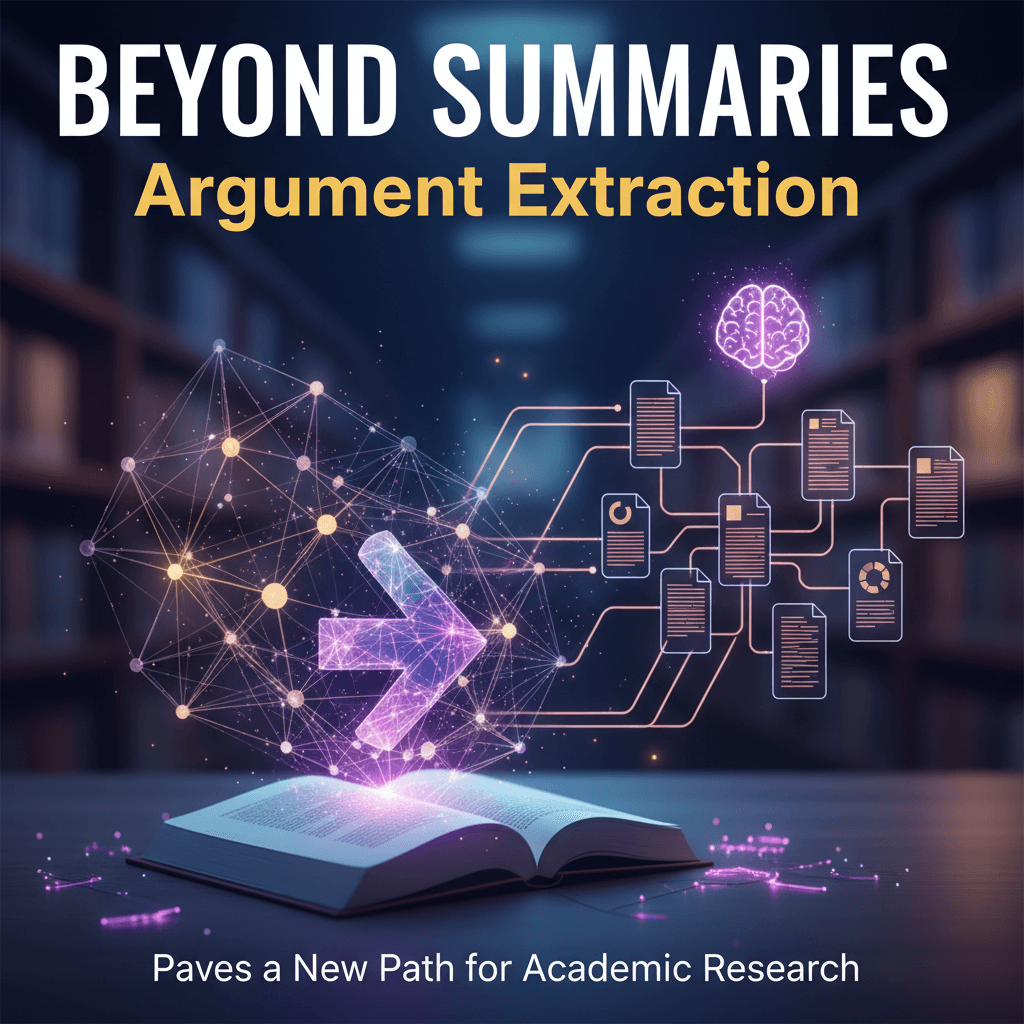
The future of research is here, and it’s all about the arguments we uncover, not just the summaries we create. As artificial intelligence transforms how we interact with information, a revolutionary approach called argument extraction is emerging—one that promises to fundamentally change how we engage with academic literature.
The Limitations of Traditional Summarization
For decades, the academic research process has followed a predictable pattern: read, highlight, summarize, repeat. While this approach has served generations of scholars, it comes with significant limitations that are becoming increasingly problematic in our information-rich world.
The Cognitive Overload Problem
According to a 2021 study published in Nature Scientific Reports, researchers now face an estimated 8,000+ academic papers published daily across disciplines. Traditional summarization techniques simply cannot keep pace with this volume. When we merely summarize, we often miss the nuanced relationships between competing ideas—the very connections that drive innovation.
Consider Dr. Sarah Chen’s experience at Stanford University: “I spent three months summarizing literature for my neuroscience research, only to realize I had pages of disconnected facts but no clear understanding of how the competing theories actually related to each other. I essentially had to start over.”
The Depth Deficit
Traditional summarization typically captures:
- Main conclusions
- Key statistics or findings
- Basic methodology notes
What it often misses:
- The logical structure of arguments
- Underlying assumptions
- Counter-arguments considered and addressed
- Connections between seemingly disparate claims
This “depth deficit” means researchers often work with a flattened version of complex academic discourse, leading to superficial understanding and missed opportunities for synthesis.
Understanding Argument Extraction: The New Frontier
Argument extraction represents a paradigm shift in how we process academic information. Rather than simply condensing text, it identifies the structural components of arguments and maps their relationships.
The Anatomy of Academic Arguments
Academic arguments typically consist of several key components:
- Claims: The assertions or positions taken by authors
- Evidence: The data, statistics, or examples that support claims
- Warrants: The logical connections between evidence and claims
- Qualifiers: Conditions under which claims hold true
- Rebuttals: Counter-arguments addressed by the author
Argument extraction tools identify and categorize these elements, creating a structural map of the reasoning within a text. The result is not just a shorter version of the original, but a logically organized representation of its intellectual architecture.
From Linear to Network Thinking
Dr. Michael Hoffman of MIT’s Media Lab explains: “Traditional summarization gives us a linear reduction of text. Argument extraction gives us a network of interconnected ideas. It’s the difference between seeing a list of cities and seeing a detailed road map showing how they connect.”
This network approach allows researchers to:
- Identify convergent and divergent perspectives across multiple sources
- Trace the evolution of arguments across publications
- Discover implicit connections between seemingly unrelated fields
The Technology Driving Argument Extraction
The rise of argument extraction has been enabled by significant advances in natural language processing (NLP) and machine learning technologies.
Beyond Keyword Recognition
Early text analysis tools relied heavily on keyword frequency and basic sentiment analysis. Modern argument extraction employs sophisticated techniques including:
- Transformer-based models like BERT and GPT that understand contextual relationships between words
- Rhetorical structure theory (RST) parsing that identifies relationships between text segments
- Argument mining algorithms specifically trained to detect claims, evidence, and logical connectors
The University of Dundee’s ArguminSci project demonstrates the power of these approaches. Their system achieved 87% accuracy in identifying argumentative components in scientific literature—a dramatic improvement over the 63% accuracy of traditional summarization tools.
Real-World Applications Emerging
Several pioneering tools are already demonstrating the potential of argument extraction:
1. ArguMap: Developed at Carnegie Mellon University, ArguMap creates visual networks of arguments across multiple papers, helping researchers identify consensus and controversy in their field.
2. ArgumentAnalyst: This tool from Oxford University not only extracts arguments but evaluates their logical strength, helping researchers quickly assess the quality of reasoning.
3. ClaimFinder: Used by the medical research community, ClaimFinder extracts competing claims about treatment efficacy, helping clinicians navigate contradictory research findings.
The impact is already being felt. A 2023 survey of 245 doctoral students using argument extraction tools found they completed literature reviews 37% faster while identifying 28% more relevant connections between sources.
Transforming Research Practices
Argument extraction isn’t just a technological innovation—it’s reshaping how researchers approach their work at every stage.
Literature Review Reimagined
Traditional literature reviews often become exercises in summarization and categorization. With argument extraction, researchers can:
- Map the intellectual terrain of their field, identifying major claims and counter-claims
- Discover gaps in reasoning where new research could make significant contributions
- Trace how arguments evolve and transform across publications and time
Professor Elena Martinez of UC Berkeley shares: “My graduate students now begin by creating argument maps rather than annotated bibliographies. The result is literature reviews that don’t just describe previous research but actually analyze the logical structure of the field.”
Collaborative Research Enhancement
Argument extraction particularly shines in collaborative settings:
- Research teams can share standardized argument maps rather than idiosyncratic notes
- Interdisciplinary projects benefit from explicit mapping of assumptions that might otherwise remain implicit within disciplinary silos
- Peer review processes become more focused on the logical structure of arguments
The Human Genome Project’s successor, the Human Pangenome Reference Consortium, has adopted argument extraction tools to help coordinate research across 35 institutions. Project director Dr. James Wilson notes: “With thousands of researchers contributing, argument extraction helps us identify where genuine disagreements exist versus where we’re simply using different terminology for the same concepts.”
Ethical Considerations and Limitations
Despite its promise, argument extraction comes with important caveats and ethical considerations.
The Risk of Decontextualization
When arguments are extracted and represented separately from their original context, important nuances may be lost. Researchers must remain vigilant about:
- Cultural and historical context that shapes how arguments are constructed
- Disciplinary conventions that affect how claims are presented and defended
- The risk of reducing complex, multi-layered reasoning to simplified structures
Dr. Aisha Johnson of the London School of Economics warns: “There’s a danger in treating argument extraction as objective when it inherently involves interpretive decisions. We must approach these tools critically, not as neutral arbiters of meaning.”
Accessibility and Equity Concerns
As with many technological innovations, there’s risk of creating new divides:
- Institutions with greater resources may gain significant advantages through proprietary argument extraction tools
- Researchers working in languages other than English may have fewer tools available
- Fields with standardized argumentation patterns may benefit more than those with diverse rhetorical traditions
To address these concerns, initiatives like the Open Argument Project are developing open-source argument extraction tools designed to work across languages and disciplines.
The Future of Academic Discourse
As argument extraction tools mature, they promise to transform not just how we process existing research but how we create and disseminate new knowledge.
Imagine a future where:
- Academic papers include machine-readable argument maps alongside traditional text
- Researchers can query vast literature databases not just for keywords but for specific types of claims or evidence
- Peer reviewers can efficiently evaluate the logical structure of submissions
- Students learn to construct well-reasoned arguments by engaging with explicit models of academic reasoning
The groundwork for this future is already being laid. The Association for Computational Linguistics has established standards for argument representation, while journals like Nature Methods have begun experimenting with argument visualization requirements for submissions.
Conclusion: Embracing the Argument Revolution
As we face increasingly complex global challenges—from climate change to pandemic response—our ability to navigate vast bodies of research efficiently becomes not just an academic concern but a societal imperative.
Argument extraction represents more than just another digital tool; it offers a fundamental reimagining of how we engage with scholarly knowledge. By making the invisible structures of reasoning visible, it enables researchers to work more efficiently, collaborate more effectively, and innovate more creatively.
For students, educators, and researchers willing to move beyond traditional summarization approaches, the rewards are substantial: deeper understanding, more rigorous analysis, and the ability to make meaningful connections across an ever-expanding universe of knowledge.
The question is no longer whether argument extraction will transform academic research, but how quickly we’ll adapt our practices to embrace its potential. The tools are here. The future of research awaits those ready to look beyond summaries and engage with the rich tapestry of arguments that drive human knowledge forward.
Where This Insight Came From
This analysis was inspired by real discussions from working professionals who shared their experiences and strategies.
- Share Your Experience: Have similar insights? Tell us your story
At ModernWorkHacks, we turn real conversations into actionable insights.

![[Workflow Included] A simple 5-node Instagram posting workflow for beginners](https://modernworkhacks.com/wp-content/uploads/2026/04/workflow-included-a-simple-5-node-instagram-posting-workflow-for-beginners-1024x675.png)




0 Comments