
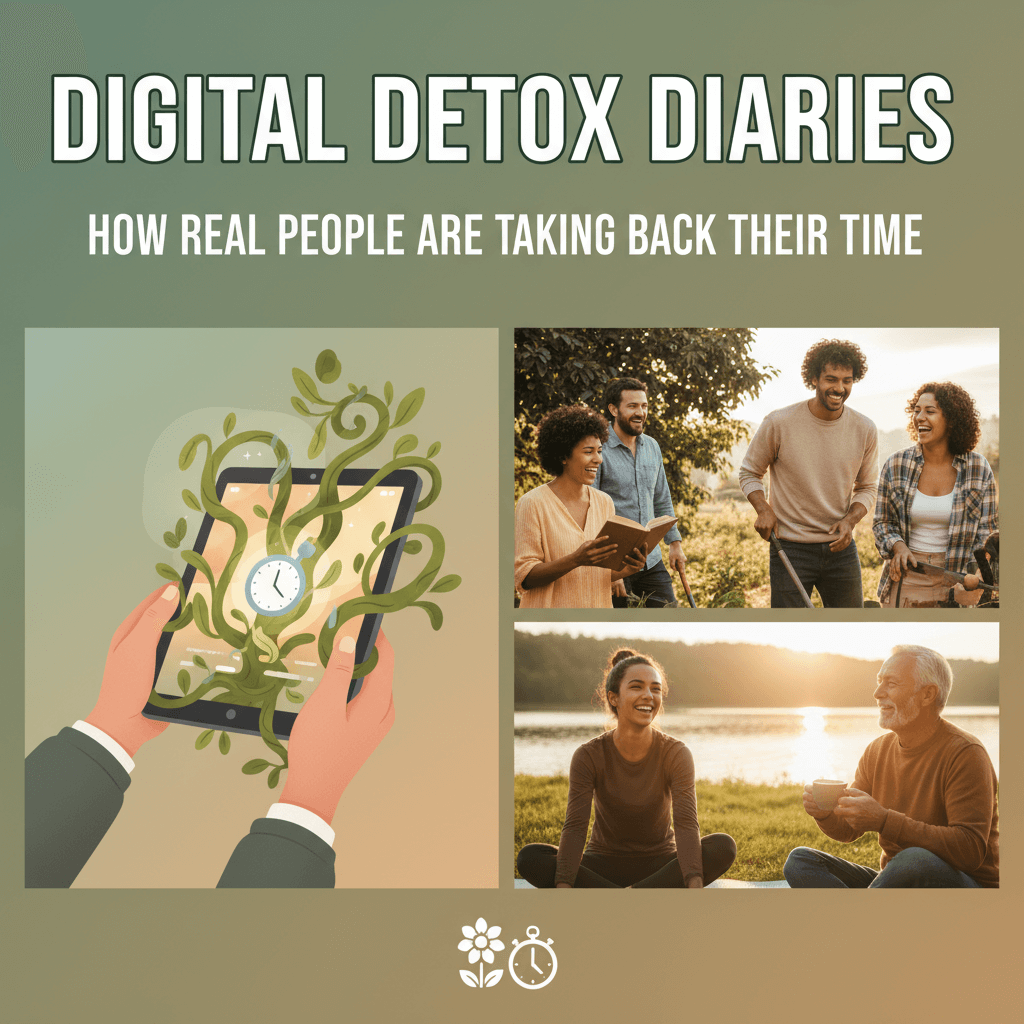
My friend Sarah used to sleep with her phone under her pillow. “Just in case,” she’d say with a nervous laugh when I pointed out how unhealthy it seemed. Three months ago, she joined a local “Phone-Free Fridays” group that meets weekly for dinner—devices collected in a basket at the door. “It was terrifying at first,” she told me recently. “But now? Those are the hours I look forward to most all week. And the crazy part is, I’ve started leaving my phone in another room when I sleep.”
Sarah isn’t alone. Across the country, people are waking up to a startling reality: our relationship with technology has become increasingly unbalanced, with the average American checking their phone 96 times daily—once every 10 minutes. But rather than struggling in isolation, a powerful trend is emerging: community-supported digital detoxing, where groups of friends, colleagues, and even strangers are banding together to reclaim their attention and time.
The Collective Awakening: Why People Are Detoxing Together
When James Harkin, a 34-year-old software developer from Portland, realized he was spending over seven hours daily on his devices, he tried multiple apps to limit his screen time. Nothing worked. “The turning point wasn’t another app,” he explains. “It was sitting in a room with six other people who were all struggling with the same thing, all admitting they felt powerless.”
The Science of Shared Accountability
Research from the University of Chicago found that people attempting habit changes with a partner had a 95% higher success rate than those going solo. Dr. Anna Lembke, addiction psychiatrist and author of “Dopamine Nation,” explains why: “The accountability of community creates external motivation when our internal motivation fails. Plus, the shared experience normalizes the withdrawal symptoms that can make digital detox so challenging.”
This principle is what makes community-based approaches so effective compared to individual willpower. Consider these real-world applications:
- Detox Buddy Systems – Partners who check in daily and report screen time statistics to each other
- Digital Sabbath Groups – Communities that collectively disconnect for 24 hours weekly
- Screen-Free Challenges – Structured programs where participants gradually reduce usage together
From Shame to Solidarity
Emily Chen, a teacher from Chicago who founded a parents’ digital detox group, notes another crucial benefit: “When you’re trying to cut back alone, there’s often shame involved—like you should be able to control yourself better. In a group, that transforms into solidarity. We’re all acknowledging this is genuinely difficult, which is incredibly freeing.”
Environmental Design: Creating Spaces That Support Disconnection
Marcus Lee, a 29-year-old graphic designer, tried for years to reduce his social media use with limited success. “The game-changer wasn’t willpower—it was redesigning my environment,” he says. Marcus and his roommates created a “phone parking lot” by their front door—a beautiful wooden box where devices go when they enter the apartment.
The Physical Barriers Approach
Environmental design leverages our natural tendency to follow the path of least resistance. Real people are finding success with these physical interventions:
- Charging stations outside bedrooms – Mia Winters, a financial analyst, reports her sleep quality improved 40% after implementing this simple change
- Tech-free zones – Families designating certain rooms (often dining rooms and bedrooms) as completely device-free
- Time-lock containers – Products like Kitchen Safe allow users to lock devices away for predetermined periods
According to behavioral scientist BJ Fogg, founder of the Stanford Behavior Design Lab, “The environment is stronger than willpower. When people struggle with behavior change, I always recommend they manipulate their environment first.”
Community-Designed Spaces
This principle extends beyond homes. In Seattle, a coffee shop called “Analog” hosts weekly three-hour “digital detox sessions” where patrons check devices at the door and receive conversation prompt cards instead. Owner Tessa Rodriguez reports these events consistently sell out.
“What’s fascinating,” Rodriguez says, “is watching strangers connect when the phones are gone. People actually look at each other. They laugh louder. The energy completely transforms.”
Success Stories: The Transformation Chronicles
The Family Reconnection
The Patel family in New Jersey implemented “Tech-Free Tuesdays” after their 12-year-old daughter expressed feeling ignored when everyone was on devices. “The first few weeks were awkward,” admits father Raj. “We didn’t know how to just sit and talk anymore.” Three months later, their Tuesday dinners stretch for hours with board games and conversations. “My daughter said something that floored me,” Raj shares. “She said Tuesday is now her favorite day of the week.”
Their approach included:
- A physical “phone basket” with a playful “surrender your weapons” sign
- Pre-planned alternative activities to fill the void
- Gradually extending tech-free time from just dinner to the entire evening
The Workplace Revolution
Meridian Design, a small architecture firm in Austin, implemented “Deep Work Wednesdays” where all notifications, emails, and internal messaging are paused for four-hour blocks. “Productivity increased by 27% on those days,” reports CEO Lauren Mitchell. “But more importantly, employee satisfaction scores rose significantly. People rediscovered how it feels to actually complete a thought.”
Their implementation strategy included:
- Collective calendar blocking to ensure no meetings during deep work time
- Visual indicators (small desk flags) showing when someone is in “deep work mode”
- Celebration of outcomes produced during these sessions to reinforce their value
The Relapse Reality: How Communities Handle Backsliding
Alex Donovan, who runs a digital detox support group in Minneapolis, emphasizes that setbacks are part of the process. “In our group, we explicitly talk about relapse as normal. When someone shares they fell back into old habits, we don’t shame them—we problem-solve together.”
Structured Forgiveness Protocols
Successful digital detox communities incorporate specific approaches to handle inevitable backsliding:
- Relapse sharing circles where members can discuss struggles without judgment
- Pattern identification to determine specific triggers (stress, boredom, social anxiety)
- Incremental resets rather than all-or-nothing approaches
Jessica Timmons, a psychologist specializing in technology habits, explains: “The research on habit formation shows that consistency matters more than perfection. Groups that normalize occasional backsliding actually see better long-term adherence than those with rigid expectations.”
The Data Tracking Paradox
Interestingly, many successful detoxers use technology to monitor their technology use. The “Screen Time Sisters,” a group of five women in their 30s, share their weekly screen time reports with each other. “There’s something powerful about having to report your numbers to the group,” explains member Dana Williams. “But we celebrate improvement, not perfection.”
Starting Your Own Digital Detox Community
Inspired to create your own support system? Here’s how successful groups have launched:
The Micro-Community Approach
Start small with these proven steps:
- Recruit 3-5 committed participants – Research shows this is the optimal size for initial accountability groups
- Establish clear protocols – Decide on communication methods, meeting frequency, and specific goals
- Create a shared agreement – Document what everyone is committing to and have all members sign
Carlos Mendez started with just two coworkers in their lunch break “phone stacking” ritual (phones in the center of the table, first to grab theirs pays for lunch). Six months later, it evolved into a company-wide initiative with 30 participants and executive support.
Digital Platforms for Digital Detoxing
Ironically, online communities can provide support for offline living. Reddit’s r/nosurf community (with over 200,000 members) serves as both resource hub and support group. Member surveys indicate that 68% of active participants successfully reduced screen time by at least 30% within three months.
Local options include:
- Meetup.com groups specifically focused on digital wellness
- Library-hosted digital detox workshops (increasingly common in urban areas)
- Community center programs that combine digital detox with other wellness activities
The Bigger Picture: Beyond Individual Habits
While individual and community efforts are powerful, many detoxers recognize the need for broader cultural change. Tristan Harris, former Google design ethicist and co-founder of the Center for Humane Technology, argues that “this isn’t just about personal willpower—we’re up against thousands of engineers specifically designing to capture our attention.”
Some communities are taking collective action:
- Parent groups lobbying schools for stricter phone policies
- Workplace coalitions developing “right to disconnect” policies
- Community advocacy for tech-free public spaces
As Maya Lewis, organizer of a neighborhood digital sabbath group, puts it: “What started as just wanting my own kids to look up from their screens has become something much bigger. We’re questioning fundamental assumptions about connectivity and availability.”
Your Next Steps: From Reading to Doing
As you consider your own relationship with digital devices, remember that community support can be the difference between temporary change and lasting transformation. Consider these starting points:
- Identify just one person who might share your concerns and propose a mutual accountability arrangement
- Redesign one physical space in your home to discourage mindless scrolling
- Join an existing online community focused on digital wellness as a stepping stone
The most powerful insight from all these digital detox diaries isn’t about technology at all—it’s about human connection. When we step away from screens together, we rediscover something essential that no digital experience can replicate: the irreplaceable value of being fully present with each other.
As Sarah told me at the end of our conversation: “I didn’t realize how much I was missing until I put the phone down. The irony is that I was using it to feel connected, but I’ve never felt more connected than I do now—without it.”
What small step will you take today? And more importantly—who will you invite to join you?
Where This Insight Came From
This analysis was inspired by real discussions from working professionals who shared their experiences and strategies.
- Share Your Experience: Have similar insights? Tell us your story
At ModernWorkHacks, we turn real conversations into actionable insights.
![[Workflow Included] A simple 5-node Instagram posting workflow for beginners](https://modernworkhacks.com/wp-content/uploads/2026/04/workflow-included-a-simple-5-node-instagram-posting-workflow-for-beginners-1024x675.png)





0 Comments