
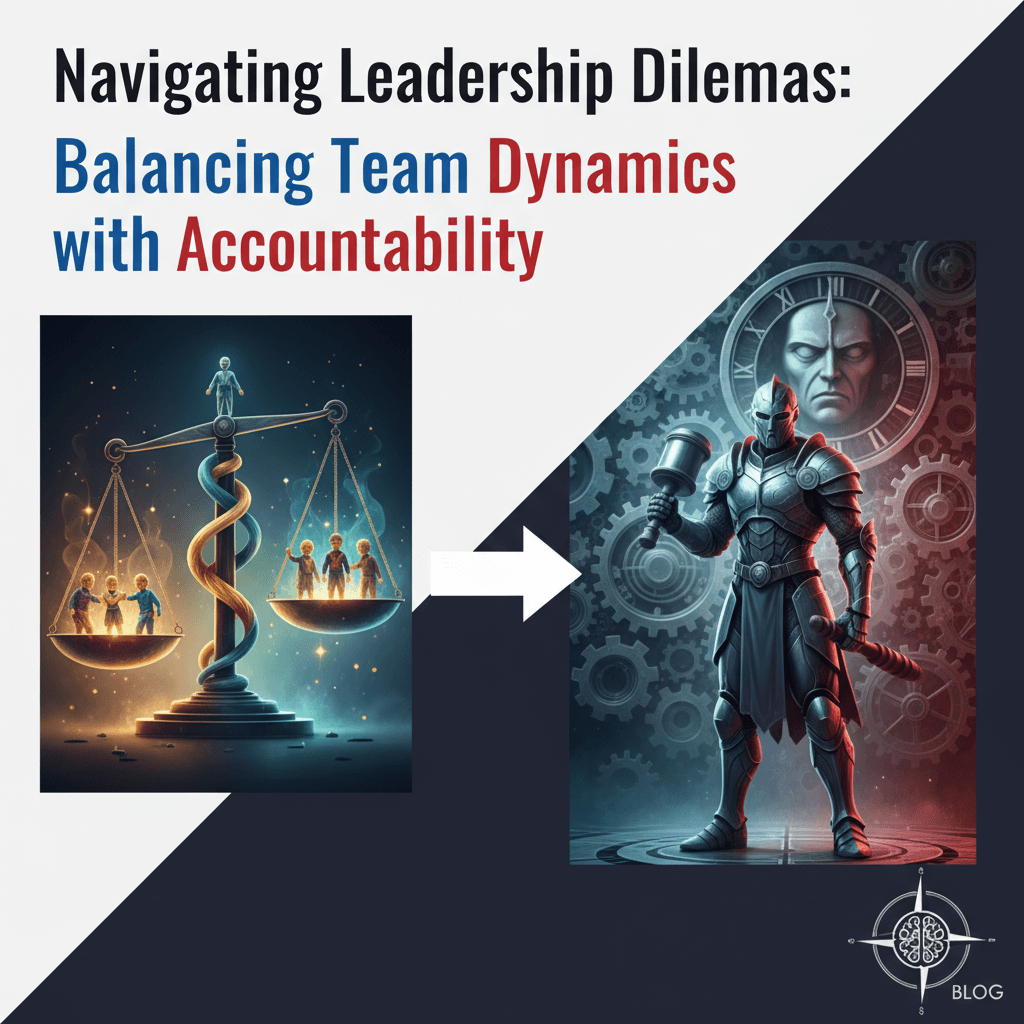
Sarah faced a leadership challenge that kept her awake at night. As the director of a marketing team, she needed to address Jason’s consistent underperformance. The problem? Jason was universally loved—the team’s social glue who organized happy hours and remembered everyone’s birthdays. When Sarah finally placed him on a performance improvement plan, the team’s morale plummeted overnight, with whispers of “unfair treatment” spreading through the office.
This scenario represents one of leadership’s most delicate balancing acts: maintaining team cohesion while upholding performance standards. How do you hold beloved team members accountable without fracturing trust? When does empathy cross the line into enabling? And how can leaders create cultures where accountability strengthens rather than damages team dynamics?
The Accountability Paradox: When Popular Employees Underperform
A 2021 Gallup study revealed that teams with high accountability but low psychological safety experience 27% higher turnover, while those with high psychological safety but low accountability show 23% decreased productivity. This data highlights our central dilemma: leaders need both elements to thrive.
When popular employees underperform, the ripple effects extend beyond productivity metrics. Their social capital can inadvertently create a protection shield that makes accountability conversations more difficult and more visible to the entire team.
Why We Avoid Accountability Conversations
I’ve interviewed dozens of leaders about this challenge, and three common barriers emerge:
- The fear of damaging team culture – Leaders worry that addressing performance issues with socially connected employees will damage morale and create division.
- Conflict avoidance – Many leaders struggle with confrontation, especially when they anticipate emotional responses or social fallout.
- Uncertainty about fair assessment – Without clear metrics, leaders question whether their judgment of underperformance is objective or influenced by other factors.
Case in point: When Michael, a software development manager at a mid-sized tech company, finally addressed long-standing quality issues with his team’s most charismatic developer, he faced immediate pushback from team members who perceived the feedback as a personal attack rather than a professional assessment.
“I knew I needed to address the issues,” Michael shared, “but I wasn’t prepared for how quickly the team divided into camps. What started as a performance conversation became interpreted as a popularity contest.”
Creating the Foundation: Performance Clarity Before Crisis
The key to navigating these situations successfully lies in establishing clear expectations long before performance issues arise. Research from the Society for Human Resource Management shows that organizations with well-defined performance standards experience 38% fewer conflicts during accountability conversations.
Establishing Objective Performance Metrics
Leaders who successfully balance team dynamics with accountability follow these practices:
- Define success metrics collaboratively – Involve team members in establishing performance standards to increase buy-in and understanding.
- Document expectations clearly – Ensure role expectations and performance standards exist in writing and are regularly reviewed.
- Create visibility around performance – Implement systems where team members can track their own performance against established metrics.
Eliza, a product director at a financial services company, implemented quarterly “expectations workshops” where team members collectively reviewed and refined their performance standards. “When we later had to have difficult conversations about performance,” she noted, “they were grounded in criteria the team themselves had helped establish. This removed much of the perceived subjectivity.”
Regular Feedback Loops
The most effective accountability systems feature:
- Weekly check-ins focused on progress and obstacles
- Monthly performance reviews against established metrics
- Peer feedback mechanisms that distribute accountability across the team
By normalizing frequent feedback, leaders remove the emotional charge from performance conversations. When feedback becomes routine rather than exceptional, it’s less likely to be perceived as personal or punitive.
The Difficult Conversation: Addressing Underperformance While Preserving Dignity
Even with clear metrics and regular feedback, addressing underperformance remains challenging. A study from the Harvard Business Review found that 44% of managers delay giving negative feedback for over a week, while 21% avoid it entirely.
The Conversation Framework
When the time comes to address performance issues with socially influential team members, successful leaders follow this approach:
- Private setting, focused conversation – Create a space where the employee can process feedback without public exposure.
- Lead with observed behaviors and impact – Frame the conversation around specific examples rather than character judgments.
- Connect to agreed-upon standards – Reference the previously established performance metrics to maintain objectivity.
- Collaborative problem-solving – Involve the employee in developing an improvement plan.
When Priya, a retail operations director, needed to address performance issues with her assistant manager (who was also the team’s unofficial social coordinator), she approached it as a problem to solve together rather than a verdict to deliver.
“I started by acknowledging his contributions to team morale, which were genuine and valuable,” Priya explained. “Then I shared specific examples of where his core job responsibilities weren’t being met, and how that impacted both customers and colleagues. By approaching it as ‘how can we solve this together?’ rather than ‘you’re failing,’ we maintained respect while still addressing the performance gap.”
Managing Team Perceptions
Research from organizational psychologists shows that how leaders communicate about accountability impacts team perception more than the accountability itself. Consider these approaches:
- Reinforce that performance standards apply equally to everyone
- Avoid discussing specific personnel matters with the broader team
- Demonstrate consistent application of standards across different team members
The goal is to create what Amy Edmondson of Harvard Business School calls “psychological safety with accountability” – an environment where team members understand that feedback is about improving work, not diminishing worth.
Building Accountability into Team Culture
The most effective leaders don’t view accountability as occasional interventions but as cultural cornerstones. A 2022 Deloitte study found that teams with strong accountability cultures outperformed their peers by 32% on key performance indicators.
Peer Accountability Systems
Leaders can distribute accountability across the team through:
- Team-based goals with shared metrics – Create interdependence that naturally encourages mutual accountability.
- Structured peer feedback processes – Implement systems where feedback comes from multiple sources, not just leadership.
- Recognition of accountability behaviors – Publicly acknowledge when team members demonstrate ownership and follow-through.
At Zappos, teams implemented “accountability partners” – peer relationships specifically designed to help each other meet commitments and improve performance. This system distributed responsibility across the organization rather than concentrating it solely with managers.
Separating Performance from Popularity
Effective leaders help teams understand the difference between social connection and professional effectiveness by:
- Creating separate recognition for team building and performance excellence
- Addressing the cognitive bias that likable people are automatically high performers
- Modeling the ability to give direct feedback to team members they personally like
“We created two distinct recognition programs,” explained Carlos, a manufacturing team leader. “Our ‘Community Builder’ awards acknowledge those who strengthen our culture, while our ‘Excellence’ awards focus purely on performance metrics. This helped the team understand that both contributions matter, but they’re evaluated separately.”
When Improvement Doesn’t Happen: The Ultimate Accountability Decision
Despite best efforts, sometimes performance doesn’t improve. The Society for Human Resource Management reports that 76% of managers have regretted delaying termination decisions, with the average manager waiting 10 weeks too long.
Making the Difficult Decision
When facing potential termination of a well-liked but underperforming employee, effective leaders:
- Document the improvement process thoroughly – Maintain records of all feedback, support provided, and progress measured.
- Consult with HR and leadership peers – Ensure the decision follows organizational policy and passes the “reasonable person” test.
- Prepare for team communication – Develop a clear, respectful explanation that protects the departing employee’s dignity while reinforcing organizational values.
When Terrence, a nonprofit director, ultimately had to terminate his charismatic but chronically underperforming development officer, he approached the team communication with careful preparation.
“I acknowledged that we would miss many things about having her on the team, while also reinforcing our commitment to our mission and the performance standards required to achieve it,” Terrence shared. “By focusing on organizational values rather than individual failings, we maintained team cohesion through a difficult transition.”
The Leadership Balance: Compassion with Clarity
The most effective leaders don’t see accountability and team dynamics as competing priorities but as complementary forces. Research from Google’s Project Aristotle found that high-performing teams demonstrate both psychological safety and clear performance expectations.
Ultimately, true leadership requires the courage to have difficult conversations while maintaining deep respect for team members’ dignity. By establishing clear expectations, providing regular feedback, addressing issues promptly, and building accountability into team culture, leaders create environments where both people and performance can thrive.
As you reflect on your own leadership approach, consider: Are you avoiding necessary accountability conversations out of fear of damaging relationships? Or are you perhaps emphasizing performance at the expense of psychological safety? The most effective leaders continuously calibrate these elements, recognizing that both are essential for sustainable team success.
The next time you face the challenge of addressing underperformance with a well-liked team member, remember that the most respectful action isn’t avoiding the conversation—it’s having it with clarity, compassion, and a commitment to both individual growth and team excellence. Your team deserves nothing less.
Where This Insight Came From
This analysis was inspired by real discussions from working professionals who shared their experiences and strategies.
- Share Your Experience: Have similar insights? Tell us your story
At ModernWorkHacks, we turn real conversations into actionable insights.
![[Workflow Included] A simple 5-node Instagram posting workflow for beginners](https://modernworkhacks.com/wp-content/uploads/2026/04/workflow-included-a-simple-5-node-instagram-posting-workflow-for-beginners-1024x675.png)



0 Comments