
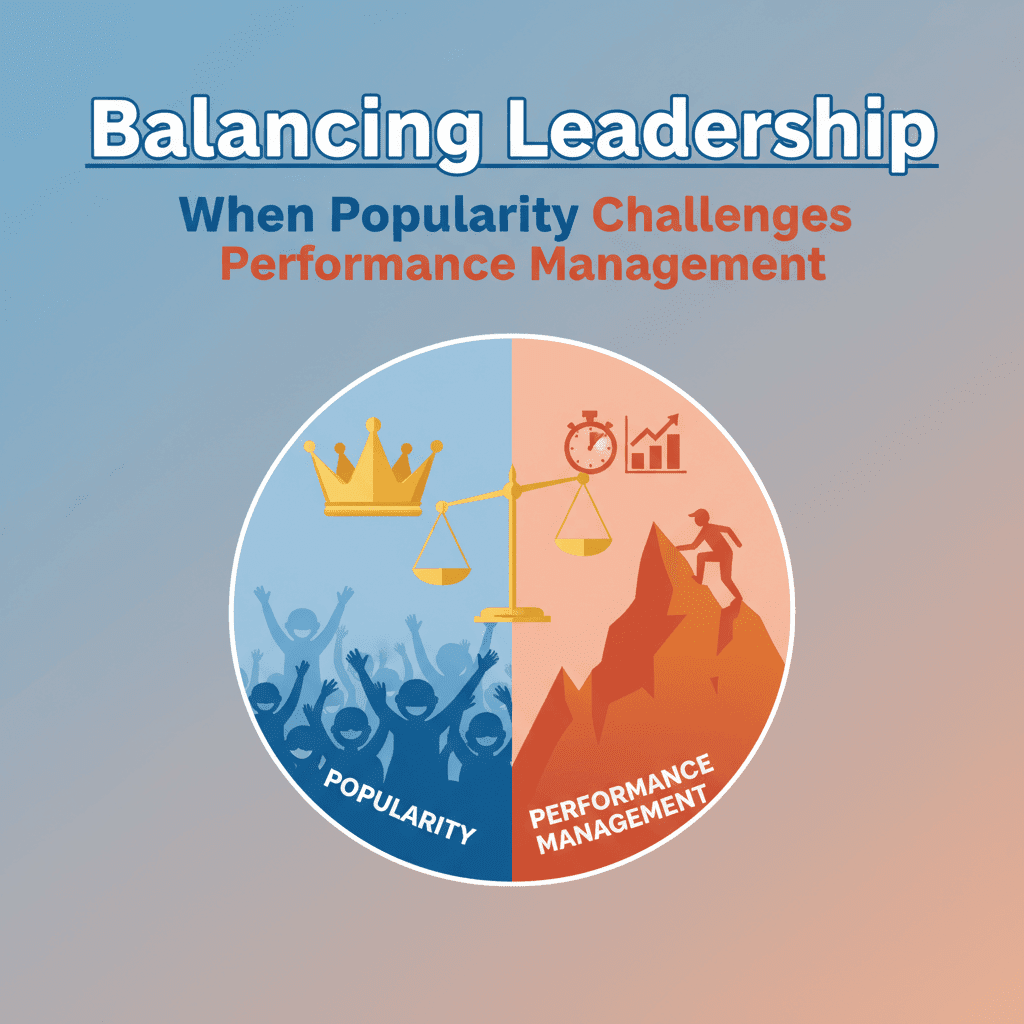
I still remember the knot in my stomach as I prepared to have that conversation with Rachel, one of my most personable team members. Everyone loved working with her—she brought energy to meetings, organized the best team events, and never failed to remember a birthday. She was, without question, the most well-liked person on the team. She was also consistently missing deadlines and delivering work that required substantial revision.
For three months, I’d avoided addressing these issues directly. I told myself I was “collecting more data” or “choosing the right moment,” but the truth was simpler and more uncomfortable: I was afraid of becoming the villain in a workplace where Rachel was the beloved protagonist.
This scenario plays out in workplaces everywhere. According to a 2022 survey by Gallup, 65% of managers admit to avoiding giving negative feedback, even when warranted. The question haunting many leaders is painfully straightforward: Can likeability overshadow accountability in effective team management? And if so, how do we navigate this treacherous terrain?
The Popularity Paradox in Leadership
Leadership has never been a popularity contest, yet research consistently shows that likeable leaders often achieve better results. A study from the Harvard Business Review found that leaders with higher likeability scores had teams that demonstrated 8.9% higher productivity. However, this creates a paradox when performance issues arise.
The Science Behind Likeability Bias
Our brains are wired to prefer working with people we like. Neurologically, positive interactions trigger dopamine release, creating a reward system that makes us seek more interactions with likeable individuals. This creates what psychologists call the “halo effect”—when we like someone, we tend to view all their attributes more positively.
This bias creates a significant challenge when addressing performance issues. As Dr. Tasha Eurich, organizational psychologist and author of “Insight,” explains: “We often confuse being liked with being effective, but they’re separate dimensions of leadership. The most successful leaders understand this distinction and operate accordingly.”
The Cost of Avoiding Difficult Conversations
When leaders prioritize popularity over performance management, the costs are substantial:
- Declining team standards as underperformance becomes tacitly accepted
- Resentment from high performers who notice the double standard
- Lost development opportunities for the underperforming employee
James, a senior manager at a marketing agency, learned this lesson the hard way: “I had this incredibly charismatic team member everyone adored. His work was consistently mediocre, but he was so well-liked that I kept making excuses. Six months later, I lost two top performers who felt their contributions weren’t valued compared to his social currency. That was an expensive lesson in the cost of avoiding tough conversations.”
The Accountability-Likeability Balance
Contrary to popular belief, accountability and likeability aren’t mutually exclusive. Research from the Center for Creative Leadership indicates that the most effective leaders score high on both dimensions.
Reframing Accountability as Care
The fundamental shift begins with how we conceptualize accountability. Rather than viewing it as punitive, effective leaders frame performance management as an act of care—both for the individual and the team.
Kim Scott, author of “Radical Candor,” articulates this approach perfectly: “Challenging directly while caring personally is the sweet spot of effective feedback.” This mindset shift transforms potentially adversarial conversations into collaborative growth opportunities.
Actionable approaches include:
- Explicitly stating your positive intent at the beginning of difficult conversations
- Focusing feedback on specific behaviors rather than personality traits
- Collaboratively developing improvement plans that demonstrate investment in the person’s success
Building a Culture Where Feedback Isn’t Personal
Organizations that excel at balancing accountability and likeability have one thing in common: they’ve normalized feedback as part of their operational DNA.
Satya Nadella transformed Microsoft’s culture by introducing a growth mindset framework where feedback is viewed as a gift rather than a threat. This cultural shift didn’t happen overnight but was built through consistent modeling and reinforcement.
To create this culture:
- Normalize bidirectional feedback by regularly asking for input on your own performance
- Celebrate examples of people who received difficult feedback and improved
- Remove the stigma by separating performance discussions from character assessments
The Transparency Solution
Perhaps the most powerful tool in balancing popularity and performance management is radical transparency—not just in individual conversations but in system-wide approaches to performance.
Clear Expectations as the Foundation
A 2021 study by Gallup found that only 50% of employees strongly agree they know what is expected of them at work. This ambiguity creates a perfect environment for popularity to override performance in evaluation.
Effective leaders combat this by:
- Documenting specific, measurable performance expectations for all roles
- Regularly revisiting and updating these expectations as priorities shift
- Ensuring all team members understand how their performance will be evaluated
Elena, a director at a healthcare technology company, implemented quarterly expectation-setting sessions with her team. “Before we started this practice, performance conversations were emotionally charged because they felt subjective. Now, when I need to address performance issues, I can point to the expectations we agreed upon together, which makes the conversation about the work, not the person.”
Democratizing Performance Data
When performance metrics are visible and objective, the likeability factor becomes less influential in assessment. Companies like Buffer have taken this approach to the extreme with fully transparent salaries and performance metrics.
While that level of transparency isn’t right for every organization, there are scalable approaches:
- Team dashboards that track key performance indicators
- Regular performance reviews using consistent, objective criteria
- Peer feedback systems that gather multiple perspectives
Navigating the Emotional Landscape
Even with systems in place, addressing performance issues with well-liked team members remains emotionally challenging. Leaders must develop emotional intelligence to navigate these waters effectively.
Managing Your Own Emotions First
Before addressing someone else’s performance, effective leaders do their own emotional work. This includes:
- Acknowledging your own discomfort and examining its source
- Separating your desire to be liked from your responsibility to lead
- Preparing for the conversation with clear talking points focused on behaviors and impacts
Dr. Susan David, author of “Emotional Agility,” emphasizes the importance of this internal work: “Leaders who haven’t confronted their own emotional reactions to conflict will struggle to have productive conversations about performance. The first step is always to acknowledge your own emotions without being controlled by them.”
Creating Psychological Safety During Difficult Conversations
Google’s extensive Project Aristotle research identified psychological safety as the most important factor in team effectiveness. This becomes especially important during performance conversations.
Techniques for creating safety include:
- Private settings for feedback conversations
- Balanced feedback that acknowledges strengths while addressing concerns
- Collaborative problem-solving rather than one-way criticism
“I always start by asking questions,” explains Marcus, a senior engineering manager. “Even when I’m addressing clear performance issues, I’ll ask, ‘What challenges are you facing with these projects?’ This approach often reveals underlying issues I hadn’t considered and makes the person feel heard rather than attacked.”
When Popularity and Performance Collide: Real-World Strategies
Sometimes, despite our best efforts, addressing performance issues with popular team members creates tension. Here are strategies for navigating these challenging scenarios:
The Ripple Effect Conversation
One powerful approach is to help the person understand how their performance affects others. Research from the Neuroleadership Institute shows that people are often more motivated to change when they understand the impact of their actions on colleagues they care about.
This conversation might sound like: “I know you care deeply about the team. I wanted to share how the missed deadlines are creating stress for Alex and Jordan, who can’t start their work until yours is complete.”
The Team Standards Approach
Another effective strategy is to frame performance expectations as team standards rather than individual criticisms. This shifts the conversation from “you versus me” to “all of us upholding our shared commitments.”
A leader at Pixar described their approach: “We talk about ‘the work’ as something separate from the person. We say things like, ‘The storyboard isn’t serving the story yet’ rather than ‘Your storyboard isn’t good enough.’ This subtle shift makes feedback feel less personal and more collaborative.”
The Path Forward: Integrating Popularity and Performance
The most effective leaders don’t choose between being liked and driving performance—they integrate these dimensions by building authentic relationships based on mutual respect and growth.
Research from the Center for Creative Leadership found that leaders who score high on both warmth and competence are significantly more effective than those who excel in only one dimension. This “integrative leadership” approach creates environments where difficult conversations strengthen rather than damage relationships.
As I discovered in my conversation with Rachel, addressing performance issues directly—with care and clarity—actually deepened our working relationship rather than damaging it. Six months later, she thanked me for having the courage to be honest when others had avoided the conversation.
The question isn’t whether likeability can overshadow accountability—it’s how we can develop leadership approaches that honor both dimensions. By establishing clear expectations, creating cultures of feedback, managing our own emotions, and approaching performance conversations with genuine care, we transform what feels like an either/or choice into a both/and opportunity.
The next time you feel that knot in your stomach before a difficult conversation, remember: true leadership isn’t about being liked or feared—it’s about being respected enough that people know your feedback, however challenging, comes from a place of genuine care for both the individual and the team.
What difficult conversation have you been avoiding? Perhaps the most caring thing you can do today is to have it—with clarity, compassion, and courage.
Where This Insight Came From
This analysis was inspired by real discussions from working professionals who shared their experiences and strategies.
- Share Your Experience: Have similar insights? Tell us your story
At ModernWorkHacks, we turn real conversations into actionable insights.
![[Workflow Included] A simple 5-node Instagram posting workflow for beginners](https://modernworkhacks.com/wp-content/uploads/2026/04/workflow-included-a-simple-5-node-instagram-posting-workflow-for-beginners-1024x675.png)




0 Comments