
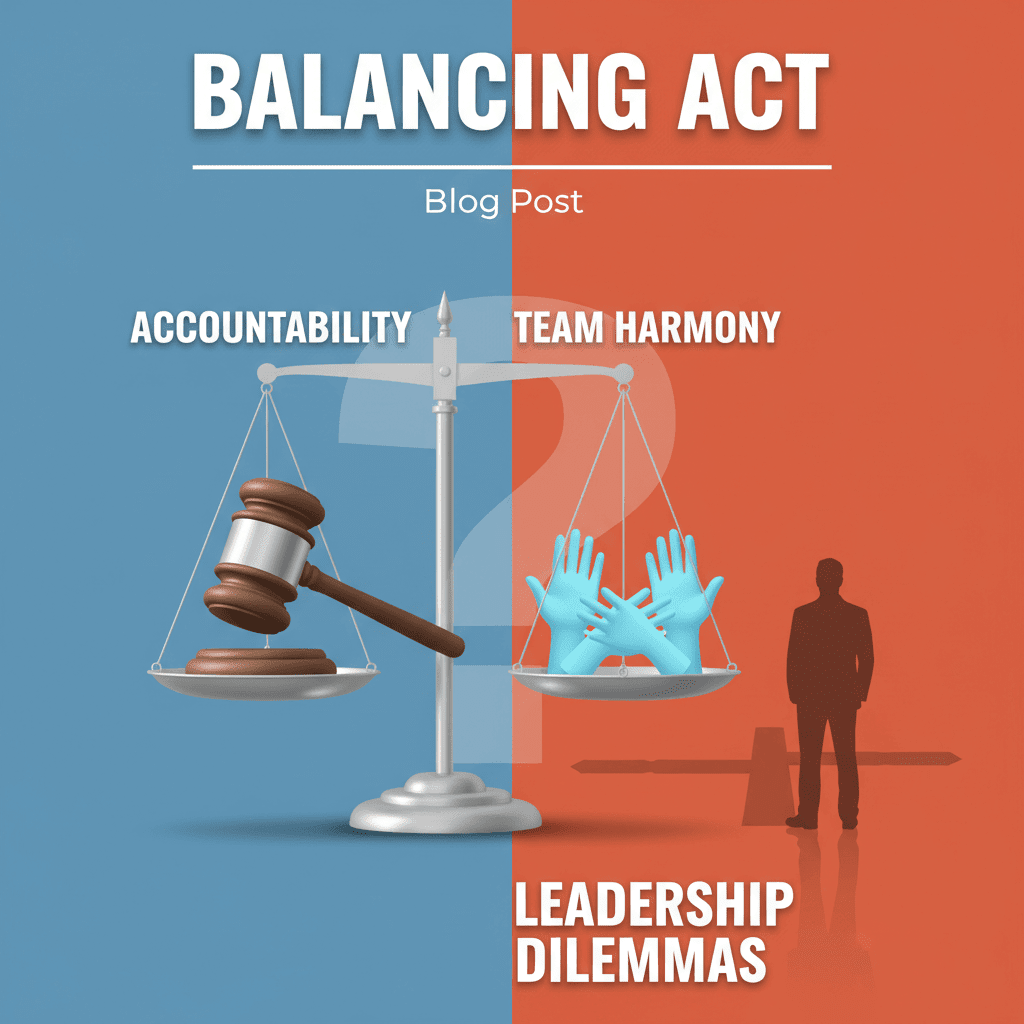
I watched silently from across the conference room as Marcus, our CEO, wrestled with a decision that would affect our entire marketing department. Sarah, our social media manager, was beloved by everyone—the first to organize happy hours, remember birthdays, and boost team morale during difficult stretches. She was also consistently missing deadlines and delivering work that required substantial revisions. For the third quarter in a row, her performance metrics were well below expectations.
“If I let this continue, I’m sending a message that results don’t matter. If I come down hard, I risk fracturing the team culture we’ve carefully built,” Marcus confided after the meeting. This scenario—the popular yet underperforming team member—represents one of leadership’s most persistent and challenging dilemmas.
The Leadership Tightrope: Understanding the Core Dilemma
Every leader eventually faces this predicament: how to maintain accountability without damaging team cohesion. A 2022 Gallup study found that 65% of managers report struggling with addressing underperformance, especially when the employee in question is socially integrated and well-liked. This hesitation is understandable—research from the Society for Human Resource Management shows that team conflict can reduce productivity by up to 20% and increase turnover intention by 25%.
Yet the cost of avoiding accountability is equally steep. According to leadership consultant Joseph Grenny, co-author of “Crucial Accountability,” teams with poor accountability experience 50% higher project failure rates and significantly lower trust in leadership over time.
The False Dichotomy Trap
Many leaders fall into what organizational psychologist Adam Grant calls the “false dichotomy trap”—believing they must choose between being respected for maintaining standards or being liked for preserving relationships. The most effective leaders reject this premise entirely.
Actionable insight: Reframe the challenge from “accountability versus harmony” to “accountability and harmony.” This mental shift opens the door to solutions that serve both goals simultaneously.
The Cost of Avoidance: Why Addressing Underperformance Matters
When Brenda took over as CTO at a mid-sized software company, she inherited a team with “Jake”—a charismatic developer who was chronically behind schedule. Previous managers had avoided confrontation because of Jake’s popularity and institutional knowledge. Six months later, Brenda faced a near-mutiny from Jake’s teammates who had been silently compensating for his performance gaps.
“What I learned was that by trying to avoid disrupting team harmony, I was actually undermining it,” Brenda explained. “The high performers felt their extra effort was unrecognized, while standards gradually eroded across the department.”
The Ripple Effects of Selective Accountability
Ignoring underperformance creates several destructive patterns:
- The performance contagion effect – Research from the Harvard Business Review shows that when underperformance goes unaddressed, overall team standards drop by an average of 15% within six months
- Trust erosion – Team members lose faith in leadership’s commitment to fairness and excellence
- Resentment buildup – High performers become frustrated when carrying additional workload without recognition
As executive coach Marshall Goldsmith notes, “What you permit, you promote.” Every unaddressed performance issue becomes your new standard.
Strategies for Maintaining Standards While Preserving Relationships
When David Nadler took over as regional director for a retail chain, he faced a dilemma with “Maria,” a store manager whose location consistently underperformed despite her popularity with staff. Rather than immediately disciplining or transferring Maria, Nadler took a different approach.
“I started by getting curious instead of critical,” Nadler recalls. “I discovered Maria had never received proper training on inventory management systems, which was the root cause of her store’s profitability issues.”
The Clarity-Compassion Framework
Successful leaders navigate this terrain by balancing clear expectations with genuine concern:
- Begin with data, not judgment – Present specific performance metrics rather than subjective assessments
- Separate performance from personality – Make it clear you value the person while addressing specific behaviors
- Create shared understanding before seeking solutions – Ensure alignment on the gap between expectations and current performance
Research from the Center for Creative Leadership found that leaders who combine high standards with high support achieve 22% better outcomes in performance improvement situations than those who emphasize only one dimension.
Communication Techniques That Maintain Dignity
The language leaders use can determine whether accountability conversations build or break relationships:
Instead of: “Your performance is bringing down the team.”
Try: “I’ve noticed gaps between our expectations and recent outcomes. I’d like to understand what’s happening and how we can support improvement.”
Instead of: “You need to start meeting your targets or there will be consequences.”
Try: “The team relies on each member meeting their commitments. What would help you consistently hit these targets?”
These approaches maintain accountability while preserving dignity—a combination that organizational psychologist Amy Edmondson’s research shows increases the likelihood of behavioral change by more than 60%.
Building Systems That Balance Accountability and Harmony
When Satya Nadella took over as Microsoft CEO in 2014, the company was known for its stack-ranking evaluation system that pitted employees against each other. Nadella transformed this approach to focus on individual growth and contribution while maintaining clear performance standards. The result? Microsoft’s market cap grew from $300 billion to over $2 trillion, while employee satisfaction scores increased by 55%.
Creating Transparent Performance Frameworks
Leaders who successfully navigate the accountability-harmony balance typically implement systems with these characteristics:
- Objective metrics – Clear, measurable performance indicators that leave little room for subjective interpretation
- Regular feedback loops – Frequent check-ins that prevent small issues from becoming major problems
- Team-level transparency – Appropriate visibility into expectations and outcomes across the team
Kim Scott, author of “Radical Candor,” advocates for what she calls “caring personally while challenging directly.” Her research with tech companies shows that teams with this approach outperform those with high care/low challenge or high challenge/low care by significant margins across innovation, execution, and retention metrics.
When Difficult Decisions Become Necessary
Sometimes, despite best efforts, performance gaps persist. Carlos Brito, former CEO of Anheuser-Busch InBev, faced this situation with a popular but consistently underperforming executive. After six months of clear feedback, coaching, and support produced minimal improvement, Brito made the difficult decision to replace the executive.
“What surprised me was the team’s reaction,” Brito shared. “Rather than the backlash I feared, I received private messages from top performers thanking me for finally addressing what everyone knew was an issue. Our quarterly results improved within three months.”
Making and Communicating Tough Choices
When leaders must take more serious action regarding a well-liked but underperforming team member, research from the Center for Talent Innovation suggests these approaches minimize team disruption:
- Ensure the decision follows a transparent, fair process that has been consistently applied
- Communicate with authenticity while respecting the individual’s privacy
- Focus team discussions on moving forward rather than dwelling on the past
A study of 450 organizations by Leadership IQ found that 78% of employees reported increased trust in leadership after difficult but necessary personnel decisions—provided those decisions were handled with transparency and respect.
The Path Forward: Integration Rather Than Compromise
Returning to Marcus and his dilemma with Sarah, the social media manager, I witnessed a masterclass in balancing accountability with harmony. Rather than compromising on either dimension, Marcus integrated them.
He began with a private, data-focused conversation about specific performance gaps. He expressed genuine appreciation for Sarah’s contributions to team culture while being clear that performance standards were non-negotiable. Together, they developed a 60-day improvement plan with weekly checkpoints and specific support resources.
Marcus also took a broader step: he initiated a department-wide conversation about how the team defines success, making explicit that both results and relationships matter. He instituted regular peer feedback sessions where team members could recognize both performance achievements and cultural contributions.
The outcome? Sarah initially struggled but ultimately rose to meet expectations. The team’s overall performance metrics improved by 18% over the following quarter, while their engagement scores remained stable. Most importantly, the false dichotomy between accountability and harmony was replaced with a more mature understanding that true team excellence requires both.
Your Leadership Challenge
As you face your own version of this leadership dilemma, consider these questions:
- Where have you been avoiding necessary accountability conversations out of fear of disrupting team harmony?
- How might your current approach to performance issues be undermining the very team culture you’re trying to protect?
- What systems could you implement that would make accountability more transparent and less personal?
The most respected leaders aren’t those who choose between standards and relationships, but those who demonstrate that genuine care includes holding people accountable to their best potential. In doing so, they create teams that achieve exceptional results while maintaining the human connections that make work meaningful.
True team harmony doesn’t come from avoiding difficult conversations—it comes from creating an environment where everyone is supported in meeting clear standards of excellence. That’s not just good leadership; it’s the foundation of sustainable organizational success.
Where This Insight Came From
This analysis was inspired by real discussions from working professionals who shared their experiences and strategies.
- Share Your Experience: Have similar insights? Tell us your story
At ModernWorkHacks, we turn real conversations into actionable insights.
![[Workflow Included] A simple 5-node Instagram posting workflow for beginners](https://modernworkhacks.com/wp-content/uploads/2026/04/workflow-included-a-simple-5-node-instagram-posting-workflow-for-beginners-1024x675.png)




0 Comments