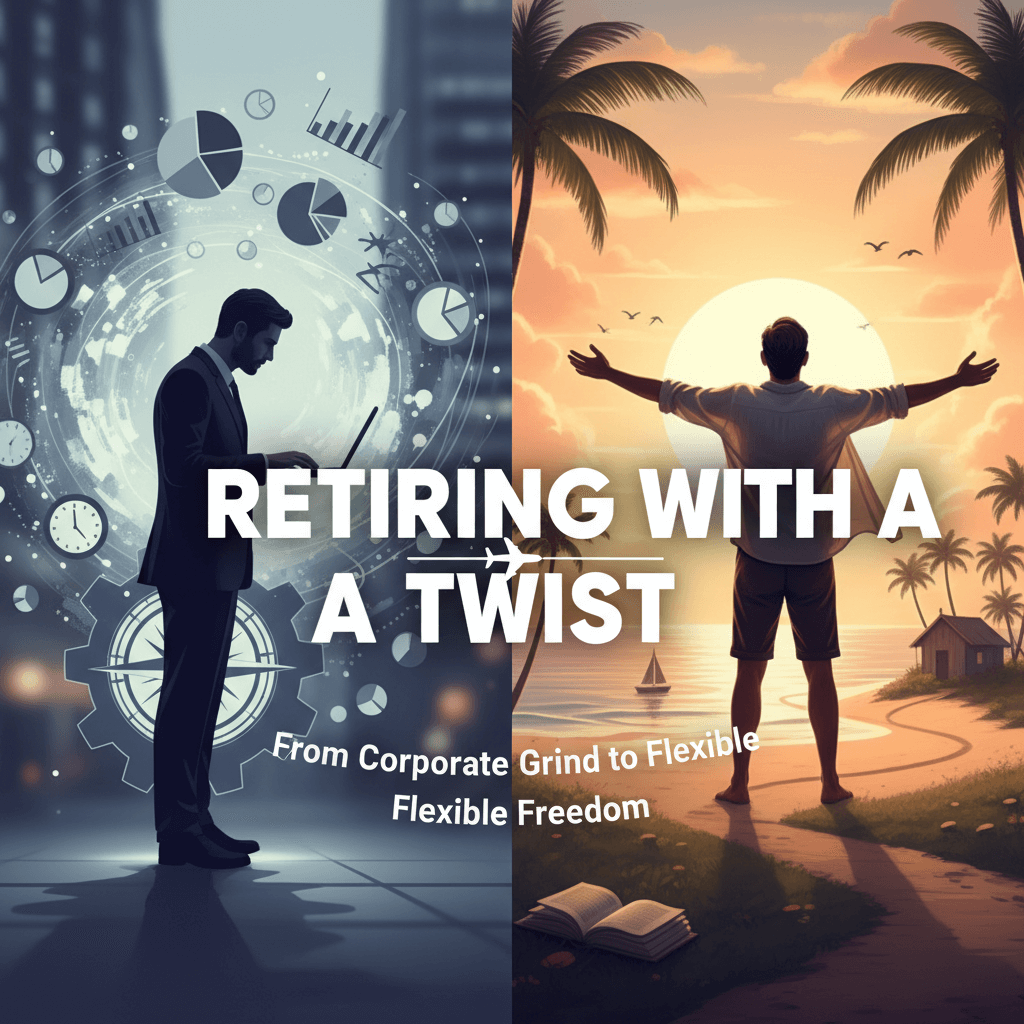
Sarah’s alarm blared at 5:30 AM, just as it had for the past 27 years. The familiar knot in her stomach formed as she contemplated another day of back-to-back meetings, impossible deadlines, and the two-hour round-trip commute. At 58, she wasn’t ready to fully retire—financially or emotionally—but the corporate hamster wheel was crushing her spirit. Three months later, Sarah negotiated a part-time consulting role with her employer: three days a week, mostly remote, with health benefits intact. Today, she sleeps until 7 AM, spends Mondays and Fridays pursuing photography, and feels more productive during her working hours than ever before.
Sarah’s story represents a growing revolution in retirement planning. The traditional cliff-edge retirement—working full-time one day and stopping completely the next—is rapidly becoming obsolete. Instead, professionals are increasingly crafting personalized “retirement with a twist”: maintaining income and purpose while reclaiming their time and freedom. This phased approach isn’t just a temporary trend; it’s reshaping how an entire generation thinks about their final working years.
The Great Retirement Reimagining
The concept of retirement is undergoing a profound transformation. According to a 2022 survey by the Employee Benefit Research Institute, 70% of workers now expect to work for pay in retirement, up from 56% in 2019. This isn’t just about financial necessity—though that’s certainly a factor for many—it’s about redefining what later-career success looks like.
Why Traditional Retirement Is Losing Appeal
A recent Reddit thread with over 12,000 upvotes and 3,000 comments revealed a common sentiment: complete retirement often creates an identity vacuum. “I watched my father retire after 40 years at the same company,” wrote one user. “Within six months, he seemed lost. His social circle shrank, and he struggled with purpose. I’m determined to avoid that cliff-edge scenario.”
The financial reality also can’t be ignored. With longer lifespans, market volatility, and concerns about Social Security, many professionals can’t afford to stop earning completely. A 2023 Transamerica Center for Retirement Studies report found that 42% of Baby Boomers have less than $100,000 saved for retirement.
But perhaps most compelling is the desire for autonomy. After decades of corporate constraints, professionals are seeking the freedom to design their own schedules while maintaining financial stability.
The Rise of the “Flexirement” Movement
The “flexirement” approach—blending part-time work with increased leisure—is gaining momentum. Consider these actionable paths that professionals are taking:
- Negotiating reduced hours with current employers (often 2-3 days per week)
- Transitioning to consulting roles within their industry
- Developing portfolio careers with multiple part-time income streams
Mark Johnson, a former marketing executive at a Fortune 500 company, told me: “I proposed a 20-hour workweek to my employer at age 62. They were initially resistant but realized they’d lose decades of institutional knowledge if I left completely. Now I work Tuesdays through Thursdays, mentor younger staff, and still contribute to major campaigns—but I’ve reclaimed my life.”
Negotiating Your Exit Strategy: Keeping What Matters
The transition from full-time corporate work to flexible arrangements requires careful planning and negotiation. The goal is to shed the aspects of work that drain you while retaining the benefits that enhance your life.
Benefits You Can (Often) Keep
One of the most-discussed topics in retirement-focused online communities is how to maintain crucial benefits during a transition. Here’s what’s often negotiable:
- Health insurance – Many companies offer pro-rated benefits for employees working 20+ hours weekly
- Retirement contributions – Though reduced, employer matching often continues for part-time employees
- Professional development – Access to training, conferences, and skill-building opportunities
According to a 2023 Society for Human Resource Management survey, 64% of large companies now offer some form of phased retirement program, up from 39% in 2019. This trend reflects employers’ recognition of the value in retaining experienced workers, even part-time.
The Art of the Proposal
Successfully negotiating a flexible arrangement requires strategic preparation. When proposing a transition to your employer, consider these approaches:
- Document your institutional knowledge and create a transition plan
- Propose specific projects where your expertise adds unique value
- Suggest a trial period to demonstrate the arrangement’s viability
Elena Ramirez, a former HR director who now works three days weekly as a talent development specialist, shared her approach: “I created a detailed presentation outlining how my reduced schedule would benefit the company—including cost savings, knowledge transfer opportunities, and my availability for critical projects. I emphasized that they’d get my most focused hours rather than my most burned-out ones.”
Setting Boundaries: The Secret to Sustainable Part-Time Work
A recurring theme in Reddit discussions about transitioning to part-time work is the challenge of boundary-setting. Without clear limits, flexible arrangements can quickly devolve into full-time work with part-time pay.
Digital Boundaries
In our hyperconnected world, establishing technological boundaries is essential. Consider these practical strategies:
- Remove work email from personal devices on non-working days
- Create an email autoresponder clearly stating your working schedule
- Utilize “Do Not Disturb” settings during non-work hours
“The first month of my part-time arrangement was essentially full-time work because I kept responding to ‘urgent’ messages,” admitted Robert Chen, a former financial analyst. “Then I implemented a strict policy: my work laptop stays closed on Mondays and Fridays. Period. My colleagues adjusted surprisingly quickly once they understood my new rhythm.”
Psychological Boundaries
Beyond the practical aspects, maintaining mental separation between work and personal time requires intention. Strategies that have worked for successful “flexiretirees” include:
- Creating distinct physical spaces for work activities
- Developing transition rituals between work and personal time
- Practicing saying “no” or “not during my working hours” without guilt
Dr. Patricia Levin, a psychologist specializing in work-life transitions, explains: “Many professionals struggle with identity boundaries when reducing their work hours. They’ve defined themselves by their careers for decades. Creating physical and temporal boundaries helps reinforce the psychological shift toward a more balanced identity.”
Financial Recalibration: Making Less Work for You
The financial aspect of transitioning to part-time work requires thoughtful planning. While income typically decreases, many “flexiretirees” find they need less than they anticipated.
Reassessing Needs vs. Wants
A fascinating trend emerged in the Reddit discussions: many professionals discovered that their previous spending patterns were driven by workplace stressors and time constraints rather than genuine fulfillment.
Consider these common financial adjustments:
- Reduced commuting costs (gas, vehicle maintenance, parking)
- Lower spending on convenience foods and stress-related purchases
- Decreased need for expensive “recovery” vacations
James Wilson, who transitioned from full-time accounting to a three-day workweek at age 60, shared: “I was shocked to discover I’m saving almost as much now as when I earned 40% more. Without the daily grind, I don’t need expensive dinners out because I’m too exhausted to cook. I don’t need costly weekend getaways to recover from workweeks. My spending is more intentional now.”
Strategic Withdrawal Strategies
For those supplementing part-time income with retirement savings, strategic withdrawal planning becomes essential:
- Consider delaying Social Security to maximize benefits
- Explore tax-efficient withdrawal sequencing from various accounts
- Investigate health insurance options, including ACA coverage if employer benefits aren’t available
Financial planner Melissa Rodriguez notes: “The part-time transition period often allows retirement accounts additional years of growth. Even a modest part-time income can significantly reduce early withdrawal needs, potentially adding years of financial security later.”
Finding Purpose Beyond the Paycheck
Perhaps the most profound aspect of the “retirement with a twist” approach is the opportunity to explore identity and purpose beyond career achievements. The extra time afforded by reduced work hours creates space for meaningful pursuits.
Rediscovering Dormant Passions
Many professionals report using their newfound time to reconnect with interests that were sidelined during demanding career years:
- Creative pursuits like writing, painting, or music
- Physical activities and outdoor adventures
- Learning new skills or languages
Thomas Rivera, who transitioned from full-time engineering management to a part-time technical advisor role, shared: “I played guitar in college but hadn’t touched one in 25 years. Now I play in a community band on Tuesdays—my day off—and it’s become the highlight of my week. This part of myself was dormant, not dead.”
Creating Legacy and Impact
Another powerful theme from the Reddit discussions was the desire to create meaningful impact during this life phase:
- Mentoring younger professionals
- Volunteering with organizations aligned with personal values
- Starting small businesses or social enterprises
“I realized I wanted to pass on what I’ve learned,” explained Maria Gonzalez, who reduced her corporate legal practice to part-time at 59. “I now spend Mondays volunteering with a legal aid clinic helping immigrants—work that feels more meaningful than anything I did in my ‘successful’ career.”
Your Next Chapter Begins Now
The retirement revolution isn’t waiting for some distant future—it’s happening now, led by professionals who refuse to accept the binary choice between all-consuming work and complete retirement. They’re creating personalized paths that blend income, purpose, and freedom in proportions that work for their unique circumstances.
As you contemplate your own transition, remember that small steps can lead to significant transformation. Begin by envisioning your ideal balance, then identify one concrete action you can take this month—whether researching your company’s part-time policies, calculating your minimum financial needs, or simply blocking time to rediscover a neglected interest.
The most powerful insight from those who’ve successfully made this transition is that it’s not about escaping from work—it’s about moving toward a more authentic expression of who you are and what matters most. Your accumulated wisdom, skills, and experience are valuable assets that can be deployed on your terms.
The corporate grind doesn’t have to be the final chapter of your professional story. With intentional planning and brave boundaries, you can write a new narrative—one where work supports your life, rather than consuming it.
What will your retirement with a twist look like?
Where This Insight Came From
This analysis was inspired by real discussions from working professionals who shared their experiences and strategies.
- Share Your Experience: Have similar insights? Tell us your story
At ModernWorkHacks, we turn real conversations into actionable insights.
![[Workflow Included] A simple 5-node Instagram posting workflow for beginners](https://modernworkhacks.com/wp-content/uploads/2026/04/workflow-included-a-simple-5-node-instagram-posting-workflow-for-beginners-1024x675.png)



0 Comments