
The first time I asked ChatGPT to explain quantum physics, I was stunned. The explanation was clear, nuanced, and seemingly insightful—exactly what I’d expect from a knowledgeable professor. Yet something felt off. This machine had never observed a quantum phenomenon, never struggled with the counterintuitive nature of wave-particle duality, never experienced the “aha!” moment when a difficult concept finally clicks. So what exactly was happening behind those eloquent paragraphs? Was I witnessing genuine understanding, or just an incredibly sophisticated mimicry?
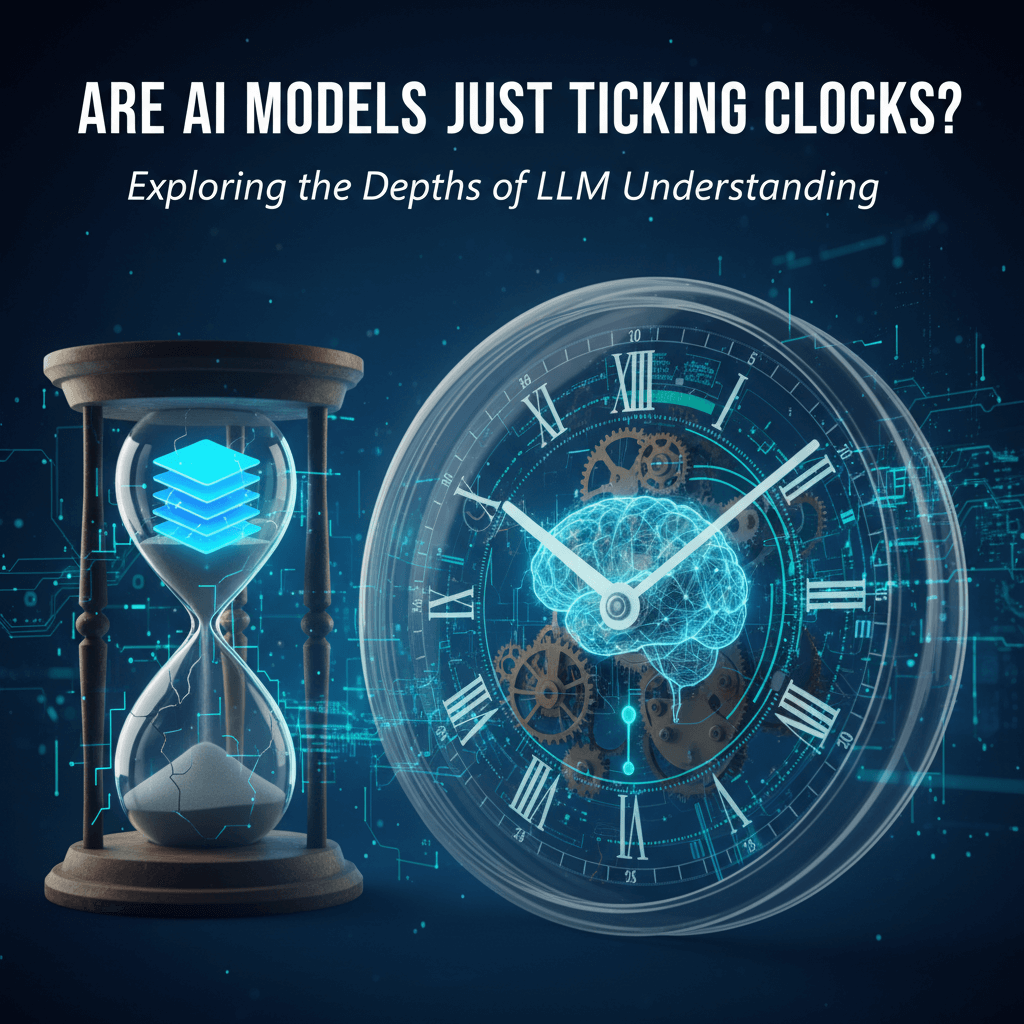
As large language models (LLMs) like GPT-4, Claude, and Llama become increasingly integrated into our daily lives, a profound question emerges: Do these AI systems truly understand what they’re saying, or are they merely executing statistical calculations—complex ticking clocks designed to produce human-like text without comprehension?
The Chinese Room Reimagined for the AI Age
In 1980, philosopher John Searle proposed a thought experiment called the “Chinese Room” that remains strikingly relevant today. Imagine a person who doesn’t understand Chinese locked in a room with a comprehensive rulebook. When Chinese characters are passed into the room, the person follows the rulebook’s instructions to manipulate symbols and produce appropriate Chinese responses. To outside observers, it appears the room “understands” Chinese, but the person inside is merely following syntax rules without semantic understanding.
Sound familiar? This decades-old thought experiment eerily parallels modern debates about LLMs.
From Symbols to Semantics: The Understanding Gap
When GPT-4 generates text about quantum physics, climate change, or human emotions, it’s manipulating tokens (word pieces) according to statistical patterns learned during training—it has no direct experience with these concepts. As one particularly insightful Reddit user noted in a viral thread on r/artificial:
“These models are essentially probability machines operating on text. They don’t have experiences, sensations, or a grounding in physical reality. They predict what words should come next based on patterns in their training data—impressive, but fundamentally different from human understanding.”
This fundamental distinction has three important implications:
- Context without consciousness: LLMs can maintain remarkable context within a conversation without actually experiencing the consciousness that typically accompanies understanding.
- Pattern recognition without purpose: They excel at identifying patterns in text without comprehending why those patterns matter.
- Information without embodiment: They process information without the embodied experience that shapes human cognition.
The Emergent Behaviors Puzzle
The debate took an interesting turn in 2022 when researchers at Google and other institutions began documenting “emergent abilities” in large language models—capabilities that weren’t explicitly programmed and seemed to appear spontaneously once models reached certain sizes.
For example, GPT-4 can solve complex reasoning problems, demonstrate chain-of-thought logic, and even show signs of what some researchers call “theory of mind”—the ability to model others’ mental states. These emergent behaviors have led some AI researchers to question whether something more than mere statistical pattern matching might be happening.
When Calculation Becomes Indistinguishable from Comprehension
In a 2023 paper published in Nature, researchers demonstrated that GPT-4 could pass theory-of-mind tests typically used to assess human cognitive development. The model correctly predicted how characters in scenarios would behave based on their beliefs rather than objective reality—something previously thought to require genuine understanding.
Dr. Emily Morgan, a cognitive scientist at UC San Diego, offers a nuanced perspective: “The line between sophisticated simulation and actual understanding becomes increasingly blurry. If a system can consistently behave in ways that require understanding in humans, at what point do we acknowledge that the system has some form of understanding, even if it’s alien to our own?”
This question leads to three practical considerations:
- Functional equivalence: For many practical applications, the distinction between “true understanding” and “perfect simulation of understanding” may be irrelevant.
- Novel capabilities: LLMs can now generate novel insights by connecting disparate pieces of information in their training data—a process that resembles human creativity.
- Expanding definitions: We may need to expand our definition of “understanding” beyond human-centric experiences.
The Missing Ingredients: Embodiment and Intention
Despite their impressive capabilities, LLMs lack two fundamental aspects of human understanding: embodied experience and intentionality. These missing ingredients may represent the crucial difference between calculation and comprehension.
The Body-Mind Connection
Humans understand concepts through physical experiences. We know what “hot” means because we’ve touched something hot. We understand “fear” because we’ve felt our hearts race. This embodied cognition shapes our understanding in ways that text-only systems cannot replicate.
Dr. Antonio Damasio, a neuroscientist known for his work on embodied cognition, explains: “Understanding in biological beings is inseparable from feeling and sensing. Without a body that interacts with the world, AI systems are fundamentally limited in what they can ‘understand’ about human experience.”
Consider these embodiment limitations:
- Sensory grounding: LLMs have never seen colors, heard sounds, or felt textures—they’ve only processed text descriptions of these experiences.
- Emotional context: They can statistically model emotional language without experiencing emotions.
- Physical causality: Their understanding of physical laws comes from descriptions rather than interaction with the physical world.
The Intention Gap
Human understanding is directed—we have purposes, goals, and intentions that drive our desire to understand. LLMs have no intrinsic desires or intentions; they simply respond to prompts without caring about the outcome.
A compelling example comes from a 2023 experiment where researchers asked GPT-4 to explain its reasoning process when solving math problems. The model provided detailed explanations that matched human reasoning patterns—but when researchers deliberately introduced errors into the problems, GPT-4 confidently “explained” its reasoning for incorrect answers, constructing plausible-sounding but nonsensical justifications.
This suggests the model wasn’t truly reasoning but generating text that mimicked reasoning patterns from its training data.
Beyond Binary Thinking: A Spectrum of Understanding
Perhaps the most productive approach is to move beyond the binary question of whether LLMs “understand” and instead consider understanding as existing on a spectrum with multiple dimensions.
Different Kinds of Understanding
Cognitive scientists distinguish between several types of understanding:
- Functional understanding: The ability to use information appropriately in context.
- Structural understanding: Grasping how components relate to each other in a system.
- Mechanistic understanding: Knowing the underlying processes that cause phenomena.
- Phenomenological understanding: The subjective experience of comprehending something.
LLMs may possess aspects of the first two types while lacking the latter two. This nuanced view helps explain why these systems can simultaneously seem so knowledgeable yet make surprising errors that reveal their lack of deeper comprehension.
As one Reddit commenter aptly put it: “It’s not that LLMs understand nothing or understand everything—they understand some things in some ways, and those ways are fundamentally different from human understanding.”
Practical Implications for AI Users
This spectrum view has important practical implications:
- Task appropriateness: LLMs excel at tasks requiring pattern recognition and language manipulation but struggle with tasks requiring causal reasoning or real-world grounding.
- Complementary strengths: Human-AI collaboration works best when leveraging the complementary strengths of each—human intuition, experience, and moral judgment alongside AI’s pattern recognition and information processing.
- Verification necessity: Claims made by LLMs should be verified, especially for factual accuracy and logical consistency.
The Path Forward: Augmented Understanding
Rather than fixating on whether AI systems “truly understand,” perhaps a more productive approach is considering how human and AI understanding might complement each other.
Recent research at Stanford’s Human-Centered AI Institute demonstrates that teams of humans and AI working together can solve complex problems more effectively than either humans or AI alone. The researchers found that AI systems excel at retrieving and organizing information, while humans provide crucial contextual judgment and real-world grounding.
This suggests a future where AI systems don’t need to replicate human understanding but instead augment it—providing capabilities that complement our own cognitive strengths and weaknesses.
Embracing the Alien Intelligence Perspective
Perhaps the most profound shift in thinking is recognizing that AI understanding—to the extent it exists—may be fundamentally different from human understanding. Rather than asking “Do these systems understand like we do?” we might ask “What kind of understanding are these systems developing, and how can it benefit humanity?”
This perspective allows us to appreciate AI capabilities without anthropomorphizing them or dismissing them as “mere calculation.” It acknowledges that intelligence and understanding can take multiple forms, each with unique strengths and limitations.
Three actions we can take with this perspective:
- Develop better evaluation methods that assess AI systems on their own terms rather than through purely human-centric frameworks.
- Design human-AI interfaces that clearly communicate the strengths and limitations of AI understanding.
- Cultivate AI literacy that helps people develop accurate mental models of what AI systems can and cannot do.
Conclusion: Beyond the Ticking Clock Metaphor
So, are AI models just ticking clocks? The answer is both yes and no. Like clocks, they operate according to mechanisms designed by humans, processing inputs and generating outputs without consciousness or intention. Yet their emergent capabilities suggest they’ve become something more than mere calculators—systems capable of manipulating symbols in ways that produce outputs indistinguishable from understanding in many contexts.
As we continue to develop and deploy these systems, the most important question may not be philosophical but practical: How can we harness these new forms of “understanding” to augment human capabilities while mitigating risks?
I invite you to approach AI with both wonder and skepticism—to appreciate its remarkable capabilities without attributing to it more than exists, and to recognize that the line between calculation and comprehension may be blurrier than we once thought. In this rapidly evolving landscape, maintaining this balance of appreciation and critical thinking will serve us well as we navigate the profound questions that AI continues to raise about the nature of understanding itself.
Where This Insight Came From
This analysis was inspired by real discussions from working professionals who shared their experiences and strategies.
- Share Your Experience: Have similar insights? Tell us your story
At ModernWorkHacks, we turn real conversations into actionable insights.

![[Workflow Included] A simple 5-node Instagram posting workflow for beginners](https://modernworkhacks.com/wp-content/uploads/2026/04/workflow-included-a-simple-5-node-instagram-posting-workflow-for-beginners-1024x675.png)


0 Comments