
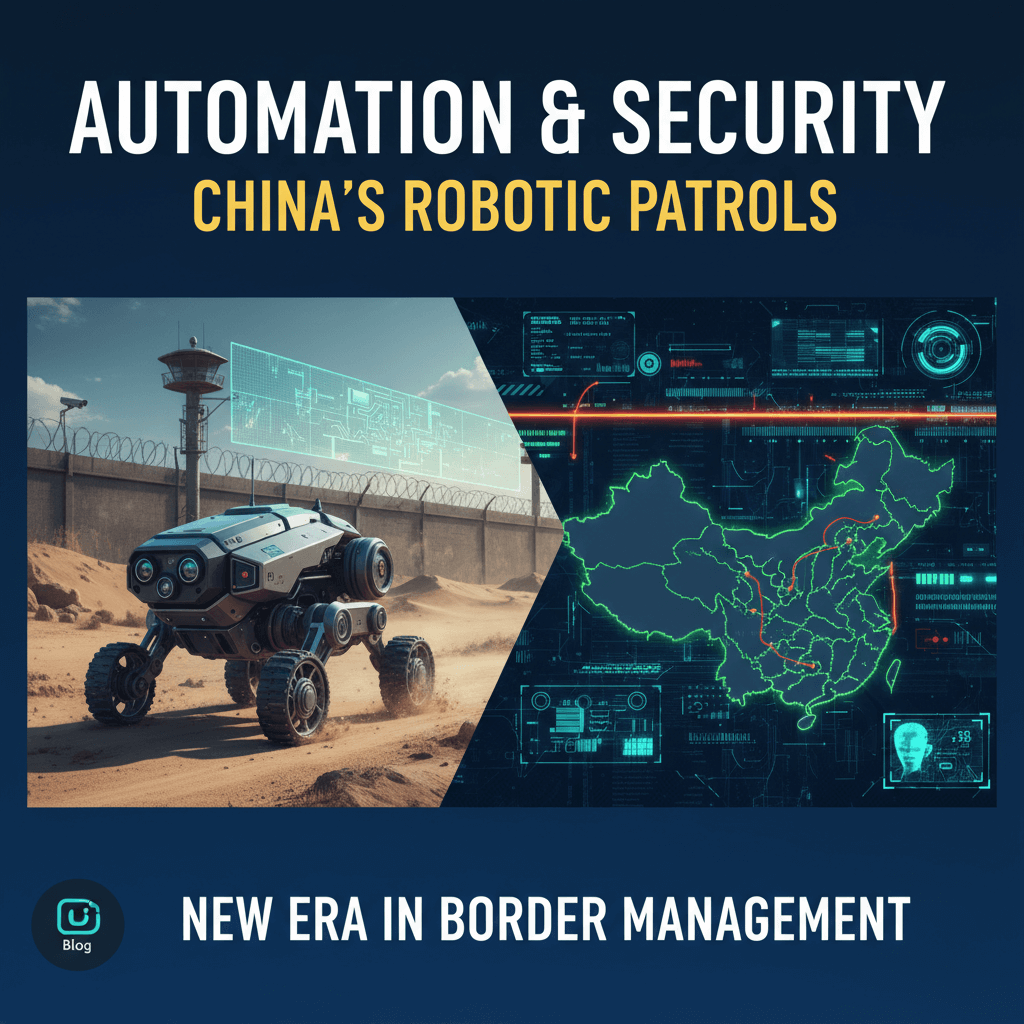
As I stood at a remote technology exhibition last year, watching a humanoid robot navigate complex terrain while carrying out surveillance functions, I couldn’t help but wonder: was I glimpsing the future of border security? That question has been definitively answered by China’s recent deployment of battery-swapping humanoid robots along its border with Vietnam—a move that signals not just an incremental improvement in border management, but potentially a revolutionary shift in how nations secure their territories.
While science fiction has long imagined robot sentinels patrolling sensitive areas, China has transformed this concept into reality. These autonomous machines represent the convergence of artificial intelligence, advanced robotics, and national security strategy—a combination that could redefine border management globally in the coming decades.
The Evolution of Border Security: From Human Patrols to Robotic Sentinels
Border security has traditionally relied on human personnel—border patrol agents walking perimeters, monitoring surveillance equipment, and responding to potential breaches. This approach, while effective, has inherent limitations: humans require rest, face challenges in extreme weather conditions, and can only cover limited territory.
China’s Technological Leap Forward
China’s deployment of humanoid robots along the Vietnam border represents a significant technological advancement. These robots, equipped with advanced sensors, cameras, and AI-powered decision-making capabilities, can patrol continuously without the biological constraints that limit human agents.
The most innovative aspect of China’s approach is the battery-swapping mechanism. When a robot’s power runs low, it can autonomously navigate to a charging station where its depleted battery is quickly replaced with a fully charged one—allowing for near-continuous operation without significant downtime.
Key capabilities of China’s border robots include:
- 24/7 operation through automated battery swapping
- Advanced terrain navigation in challenging border environments
- Multi-spectral surveillance including thermal imaging for night operations
- AI-powered anomaly detection to identify unusual activities
The Strategic Context
This deployment comes amid China’s broader push to secure its borders using technology. According to research from the International Institute for Strategic Studies, China has increased its border security technology investments by approximately 300% since 2015—significantly outpacing most other nations.
The Vietnam border, spanning approximately 1,300 kilometers of often challenging terrain, presents particular security challenges that make it an ideal testing ground for this technology. Traditional patrols struggle with the mountainous sections and dense forest areas that characterize portions of this border.
Economic Implications: The Cost-Benefit Analysis of Robot Patrols
One of the most compelling arguments for robotic border patrols is economic efficiency. While the initial investment in such technology is substantial, the long-term operational costs potentially offer significant savings compared to human-centered approaches.
The Investment Calculation
According to data from the Chinese Academy of Sciences, each patrol robot costs approximately $150,000 to produce—a figure that doesn’t include the supporting infrastructure of charging stations and command centers. However, when compared to the lifetime employment costs of border patrol agents (including salary, benefits, training, and equipment), the economics become more favorable.
Consider these comparative figures:
- Annual cost per human border patrol agent (including benefits): $75,000-$95,000
- Expected service life of patrol robots: 8-10 years
- Maintenance costs per robot: Approximately $12,000 annually
- Robots can patrol continuously, potentially replacing 4-5 human shifts
Beyond Direct Costs
The economic calculation extends beyond direct replacement costs. These robotic systems can potentially detect border incursions with greater reliability than human patrols, potentially reducing the economic impact of smuggling and unauthorized border crossings.
A 2022 study by the Global Border Security Consortium estimated that advanced border surveillance technology could reduce successful unauthorized crossings by up to 37%—representing significant economic benefits beyond the direct operational cost savings.
Geopolitical Implications and International Responses
China’s deployment of robotic border patrols has not occurred in a geopolitical vacuum. This technological advancement carries significant implications for international relations, border management norms, and potential technological competition.
Regional Responses and Technological Competition
Vietnam, directly affected by China’s new border technology, has publicly maintained a measured response, emphasizing continued cooperation on border management. However, security analysts note that Vietnam has accelerated its own border technology programs, with increased funding for surveillance systems and sensor networks.
Other nations with significant border security concerns are closely monitoring China’s initiative. According to diplomatic sources, delegations from Russia, India, and several Middle Eastern countries have already visited China to observe the robotic patrol system in operation.
The international response has been multifaceted:
- The United States has accelerated its own border automation research, with Customs and Border Protection allocating an additional $78 million for autonomous systems development
- The European Border and Coast Guard Agency (Frontex) has launched a comprehensive study on the applicability of humanoid robots for Mediterranean border operations
- Japan has announced a partnership with South Korea to develop their own border security robotics program
Shifting the Security Paradigm
China’s initiative may fundamentally alter how nations conceptualize border security. The traditional model of human-centered patrols supplemented by technology may be inverting to technology-centered approaches with human oversight.
This shift creates new questions about international norms. For instance, how will robotic border incidents be handled diplomatically? If a robot from one nation crosses into another’s territory, does this constitute the same level of incursion as a human patrol? These questions remain largely unanswered in international law and diplomatic practice.
Ethical and Workforce Considerations
The automation of border security raises profound questions about the changing nature of security work and the ethical dimensions of delegating sensitive security functions to machines.
The Changing Nature of Border Security Work
Rather than eliminating human jobs entirely, China’s model suggests a transformation of border security roles. Human agents are shifting from direct patrol duties to supervision, maintenance, and response roles—monitoring robot feeds and intervening when the AI flags potential concerns.
This transition creates both challenges and opportunities for the security workforce:
- New technical skills requirements for border personnel
- Reduced exposure to dangerous conditions and extreme weather
- Potential for more strategic deployment of human judgment and intuition
According to workforce experts at Beijing Normal University, this shift represents part of a broader transformation in security work that will require significant investment in retraining programs and new educational pathways for security professionals.
Ethical Dimensions and Decision Authority
Perhaps the most complex aspect of robotic border security involves questions of decision-making authority. China’s current deployment maintains humans “in the loop” for all significant decisions—robots can detect and report, but human operators make intervention decisions.
However, as AI capabilities advance, the question of autonomous decision-making becomes increasingly relevant. Should robots be empowered to detain individuals independently? What level of force, if any, should autonomous systems be authorized to use?
Key ethical considerations include:
- Appropriate limits on AI decision-making authority
- Transparency in algorithmic decision processes
- Accountability mechanisms for automated security systems
- Privacy implications of continuous surveillance capabilities
The Future: Beyond Border Applications
While border security represents the initial application of China’s humanoid robot technology, the implications extend far beyond this specific use case. The development of autonomous, battery-swapping robots capable of operating in challenging environments opens possibilities across numerous security and civilian domains.
Expanding Security Applications
The technology being pioneered on China’s borders has clear applications to other security contexts. Critical infrastructure protection, disaster response, and even urban security could all potentially benefit from similar autonomous robotic systems.
The Chinese Academy of Sciences has already begun testing modified versions of these robots for nuclear power plant perimeter security, demonstrating the transferability of the core technology to other high-sensitivity security applications.
Civilian and Commercial Adaptations
Beyond security applications, the core technologies—particularly the battery-swapping capabilities and rough-terrain navigation—have significant commercial potential. Logistics companies are already exploring similar technologies for autonomous delivery in challenging environments, while agricultural applications for autonomous field monitoring are in development.
The economic impact of these broader applications could ultimately dwarf the direct security applications, creating a powerful incentive for continued investment and development in this technological domain.
Conclusion: A New Era of Border Management
China’s deployment of humanoid robots for border patrol represents more than just an incremental improvement in security technology—it signals a fundamental shift in how nations may approach territorial security in the coming decades. By addressing the biological limitations of human patrols while potentially offering economic advantages, these systems could transform border management globally.
As other nations observe and likely adapt this approach to their own security contexts, we are witnessing the early stages of a significant evolution in border security. The questions this raises—about workforce transitions, ethical boundaries, and international norms—will require thoughtful engagement from policymakers, security professionals, and citizens alike.
The answer to whether humanoid robots represent the future of international border security appears increasingly clear: they will almost certainly form a significant component of integrated border management systems worldwide. The more pressing questions now concern how we will manage this transition, establish appropriate guidelines, and ensure that these powerful technologies serve human security needs while respecting essential rights and values.
For security professionals, policymakers, and technology developers, the imperative is clear: engage proactively with these emerging technologies to shape their implementation in ways that enhance security while preserving human oversight of critical security functions. The border of the future may be patrolled by tireless robotic sentinels, but the values and judgment guiding their operation must remain fundamentally human.
Where This Insight Came From
This analysis was inspired by real discussions from working professionals who shared their experiences and strategies.
- Share Your Experience: Have similar insights? Tell us your story
At ModernWorkHacks, we turn real conversations into actionable insights.

![[Workflow Included] A simple 5-node Instagram posting workflow for beginners](https://modernworkhacks.com/wp-content/uploads/2026/04/workflow-included-a-simple-5-node-instagram-posting-workflow-for-beginners-1024x675.png)





0 Comments